productivity |

|
 very month, women’s mags offer up no shortage of ways to “keep your marriage hot!” as the years pile up and communications peter out. But what if that “marriage” is a business relationship? You can’t just stick a love note in a lunch bag, or have a weekly heart-to-heart to make sure you’re headed in the same direction. very month, women’s mags offer up no shortage of ways to “keep your marriage hot!” as the years pile up and communications peter out. But what if that “marriage” is a business relationship? You can’t just stick a love note in a lunch bag, or have a weekly heart-to-heart to make sure you’re headed in the same direction.
Now what if your challenge is to make sure a passion for innovation and information sharing stays vital across a team of 35 people, ranging from newbies to experienced marketers, sited at nine different locations of a decentralized parent company, and with no direct reporting relationships to one another? That’s one tricky marriage.
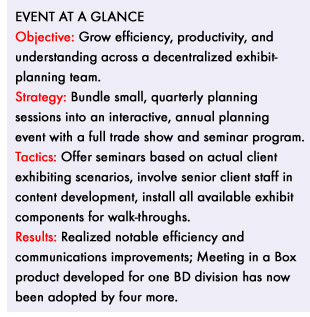 Yet for 16 years, exhibit- and event-design firm MG Design Associates and medical-technology firm Becton, Dickinson and Co. (BD), for which MG Design designs, builds, and manages more than 100 trade show exhibits a year, have made it work. But even this old couple had communication issues. “On occasion, when a multidivisional BD exhibit was being set up, the only person in the booth some BD staff would know was me,” says MG Design executive vice president Betty Kasper. “They didn’t know each other well, and they didn’t know everything we could do for them.” The result: MG Design staff were spending extra time briefing BD clients on available resources. Learning and information weren’t being shared efficiently. And when shared understanding about capabilities and resources is spotty, efficiency and productivity tend to suffer while innovation takes a backseat to simply getting everyone aligned around the basics. Yet for 16 years, exhibit- and event-design firm MG Design Associates and medical-technology firm Becton, Dickinson and Co. (BD), for which MG Design designs, builds, and manages more than 100 trade show exhibits a year, have made it work. But even this old couple had communication issues. “On occasion, when a multidivisional BD exhibit was being set up, the only person in the booth some BD staff would know was me,” says MG Design executive vice president Betty Kasper. “They didn’t know each other well, and they didn’t know everything we could do for them.” The result: MG Design staff were spending extra time briefing BD clients on available resources. Learning and information weren’t being shared efficiently. And when shared understanding about capabilities and resources is spotty, efficiency and productivity tend to suffer while innovation takes a backseat to simply getting everyone aligned around the basics.
As the MG Design team gathered in an airport on the way home from a half-day strategy session with BD exhibit planners, they began to brainstorm. There had to be a way to better connect their dispersed BD clients, show them how their counterparts were solving exhibiting problems, and establish a uniform, foundational knowledge of the resources available to them through their corporate relationship with MG Design. Their answer: Grow the traditional quarterly planning meetings into one big, interactive experience at MG Design’s headquarters.
On the surface, a large-group planning meeting doesn’t sound terribly innovative. Agencies bring clients in for working sessions all the time. But MG Design’s idea was no simple conference-room working session. Instead, the company decided to invite 14 of its BD exhibit-planning clients to a private learning conference about trade show marketing, accompanied by a full-on trade show.
The idea’s scope and scale was both appealing and unsettling to Dan Grimm, BD’s global director of communication services. “We’ve been doing annual planning meetings for a while,” he says. “The reality was, maybe it was time to freshen things up — to change the paradigm about what this meeting should be, and what our relationship is about. MG Design’s offer to do something unexpected, not commonplace, was very interesting to me.”
Still, MG Design’s proposed event plan unnerved him a bit, since it meant taking his staff out of their offices for three days (including travel), as opposed to the day and a half that prior planning meetings required. Whatever MG Design had in mind, Grimm thought, it had to deliver learning, productivity, and innovation dividends that would more than compensate for loss of 42 office days for his team.
Under pressure to deliver and with client expectations sky high, MG Design forged ahead with its new take on the client-agency, annual-planning session.
Private School
The resulting BD Exhibit Coordinators Meeting, hosted by MG Design at its Pleasant Prairie, WI, headquarters, had all the elements of a complete conference and trade show, including pre-show promotions, a comprehensive seminar program, an exhibit hall, facility tours, management Q and As, and a high-end evening reception.
At the heart of the event were the learning sessions. Developed collaboratively by Liese Tamburrino, MG Design vice president of global sales and marketing, and BD’s Grimm, the more than eight hours of general sessions, workshops, and breakouts went far beyond the typical content of annual-planning meetings. Instead, Tamburrino drew on her history as an event-marketing trainer to create a curriculum steeped in real-world market pressures, drawn through BD issues and examples.
“According to Exhibit Surveys Inc., the health-care industry spends about $50 more per trade show lead than exhibitors in other industries,” Tamburrino says. “So they have tremendous pressure to make their events more lucrative for their companies.”
With that in mind, Tamburrino zeroed in on content that would address exhibit effectiveness, using workshop-style exercises and scenarios to spark creative thinking among the BD staff. For example, one workshop asked the BD team to imagine and describe what they would do if they had a million-dollar budget. Next, Tamburrino limited the fictional budget to $1,000. “The responses were great,” she says. “They all had their heads down together and were exchanging ideas to find some creative breakthroughs in the shared trenches of budget cuts.” Additional sessions addressed core trade show concerns such as effective staffing, measurement strategies and techniques, and budgeting processes.
Although Tamburrino’s audience was small — just 14 BD staffers — the content-development challenge was as complex as for a large audience, due to the disparate levels of experience among the group. “My challenge was to find the point where it’s still demanding for more experienced people without leaving the newbies behind,” she says. “We then engaged them to help us make it pointed and relevant to BD.”
As a result, the scenarios, case studies, and challenges presented were all based on actual BD events. The solutions were real-world BD examples, straight from the planners who had dealt with the situations, using the tools available to all BD divisions thanks to their relationship with MG Design. It was learning with unbeatable relevance.
Tire Kickers Welcome
To build on that relevance, MG Design knew it would need to show the actual exhibits at the center of the planners’ stories. No matter how clear a photo, how thorough a description, or how detailed a drawing, nothing builds true understanding of scale, form, and function like a first-hand look at an actual product.
“There are people in the world who are conceptual enough, who can imagine the possibilities if you can describe them, and those who cannot,” Grimm says. “We have a blend of conceptual people and less conceptual people on our staff.”
|
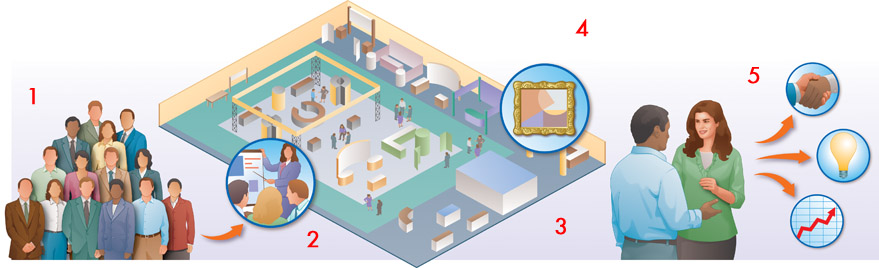 |
The Show-Me FÊTE
1. MG Design Associates invited 14 of 36 Becton, Dickinson and Co. (BD) exhibit planners to a private conference and trade show.
2. First up: a custom workshop and seminar program, with case studies drawn from real-world BD exhibiting scenarios.
3. Next, the seminars came to life in a full-fledged exhibit hall, where the planners browsed 19 fully installed BD booths.
4. A fancy, private dinner at the Milwaukee Art Museum furthered the idea sharing and networking.
5. Today, efficiency and productivity are way up, while program cross-pollination and innovation flourish.
|
|
From MG Design’s perspective, BD was not taking full advantage of its huge array of exhibit properties, components, and graphics. “We have an extranet site for BD that lists all of their components,” Kasper says. “But just walking through the extranet wasn’t enough for all to understand the pieces. When a client looks at 2-D detail of a component, it’s so much different than seeing it in 3-D, kicking the tires, and saying, ‘now I get it!’”
To give all BD staff a chance to kick the tires on every exhibit available to them, MG Design pulled together a showstopper: a trade show floor with 19, 100-percent-complete exhibits, sporting lighting, graphics, and even live presentations. That’s a full trade show — for 14 people.
As attendees approached the exhibit hall — the transformed MG Design warehouse — they were greeted with the signs, posters, and aisle carpet typical of a full trade show for thousands. A ceremonial ribbon cutting, handled by MG Design’s president Michael Grivas and BD’s Grimm, officially opened the show floor for business.
The BD planners entered the hall to find the fully installed exhibits, ranging from 10-foot portable backwall displays and tabletop exhibits to the 20-by-30-foot double-deck BD corporate booth. Alongside the BD and other smaller exhibits, MG Design installed its own corporate stand, so BD staff who had not seen the exhibit at trade shows or industry events could better understand the full breadth of MG Design’s services.
At one of the stands, attendees were able to watch and participate in a live game-show presentation hosted by MG Design. A BD division had developed the presentation with MG Design for one of its events; now, attendees saw in action how that game show could be adapted for each business unit and exhibit property.
Anchoring the hall was BD’s double-deck corporate exhibit. Prior to the MG Design warehouse show, only two BD divisions had used the double-deck property at divisional events. Now, the other planners had the opportunity to walk through the 20-by-30-foot space and see how the double-deck option could increase their available workspace without requiring larger floor plans at their own shows.
Each booth was fully lit, with graphics and staff at the ready to answer questions about the exhibit and its components. “To have all of our various properties and components available, including pieces that aren’t widely used, was a wonderful opportunity,” Grimm says. “It was a primary benefit of the event. To be able to look at them with a peer, and hear a colleague say, ‘I use that all the time; here’s how I use it,’ that’s when light bulbs start to go on. Then the other person becomes more effective in her own use of the component. It’s really simple, and really effective.” While most of the exhibits were actual BD properties, MG Design did include stands developed for other clients so the BD team could see a complete inventory of available materials such as rental pieces, custom-fabricated components, and prefabricated system pieces.
According to Kasper, the internal event also offered a safe environment for MG Design to take some design risks — ideas that, again, can be difficult to verbalize or to fully understand when seen only in a 2-D rendering. “We did some things differently with their own booths that they hadn’t seen before,” Kasper explains. “It was a way for them to see something new and either say, ‘I like that,’ or ‘You’re out of your mind!’” For example, MG Design staff set up booth scenarios to demonstrate two design ideas which the team believed would have positive economic outcomes for their BD clients. In one, MG Design demonstrated how lightboxes could adapt to portable booths, which would save BD time and expense in graphics changes. Another space showed how a pop-up exhibit could be used to create a mural in a larger booth, which only a few BD divisions had tried at the time.
Even the MG Design corporate exhibit, which was fully installed at the event, showed off some edgier techniques for BD’s consideration. There, the design team built in a series of sensory experiences — including sight, sound, and smell — to help tell the MG Design story.
If there was one idea that everyone agreed on, it was a toolkit known as the BD Meeting in a Box: a working example of the rejuvenated idea-sharing and transferable thinking Grimm, Kasper, and Tamburrino had hoped for. Originally developed in response to a request from a BD staffer for a simple, ready-to-go exhibiting kit for small, regional sales events, MG Design included the Meeting in a Box in the exhibit hall. There, several BD staffers saw the kit for the first time, and immediately saw an application for their own needs — efficiently building on a solution created for one of their peers. “It’s great to see that spark, where someone’s solution to a problem is now sharable,” Grimm says. Before the joint event, it’s likely that the other eight divisions would not have easily learned about or understood the Meeting in a Box product, which had obvious and practical advantages for each division.
“One of the things that made this all so cool was how comprehensive it was,” Tamburrino says. “We started with seminars about how important it is to staff an exhibit and man an event properly, then they walked into our trade show floor in the warehouse and saw the principles in action. It was all integrated so beautifully.”
Integrated Details
It was this attention to every detail that drove home to BD just how much MG Design valued their longstanding business ties. “We sent attendees pre-show invitations, we sent them tchotchkes, we called to personally invite them to attend — all in the name of creating some buzz,” Kasper says. “We did room drops at their hotel, and had posters and carpet on site just like they were attending a real trade show. It’s simply the way any attendee wants to be treated, and it showed them the full range of what we can do for them.”
The detail continued through an evening meal to celebrate the end of the event’s first day. Instead of simply making reservations at a local restaurant, MG Design treated the BD staff to a private dinner and tour at the Milwaukee Art Museum, with its famed Santiago Calatrava-designed pavilion. It’s an awe-inspiring venue for a group of hundreds — so imagine the impact on a group of 14. “The Milwaukee museum dinner and tour were treated as we would handle any large-scale special event,” Kasper says, adding, “It was a great way for us to show off our other talents beyond exhibit design and logistics.”
The next morning, the group returned to MG Design’s warehouse and offices for a second day of learning and hands-on experience. Now, the BD team broke into three groups, which rotated through three functional areas at MG Design, gaining the opportunity to dig deeper into a particular process or to ask follow-up questions prompted by the earlier day’s events. While one group toured the full MG Design facility and met with department managers, the second explored the BD-specific project-management extranet with MG Design developer Cindy Yi. Meanwhile, the third group returned to the exhibit hall to ask more questions about the components and stands they had been introduced to the day prior.
Adaptive Reuse
The 14 attendees’ reports on content, value, and the overall experience of the event were uniformly positive. And more important, the event is paying off in streamlined planning efforts and more creative yet efficient use of BD’s complete suite of exhibit components. More BD divisions are using the lightbox graphics technique MG Design demonstrated at the event, and four more BD teams have already begun to use or have budgeted to adapt and use the scalable Meeting in a Box solution, originated by MG Design for one of the BD teams’ exhibit-planner colleagues.
Grimm is so pleased with the results that he asked MG Design to explore ways to repurpose the event into a touring effort of sorts, bringing Tamburrino’s seminars and select exhibit properties to new BD exhibit planners and other BD marketing managers nationwide who may not have direct involvement with trade shows or events. “There are marketing stakeholders out there who have some discretion over our budgets who could benefit from this,” he says. “Early in my career at BD, I was asked to assemble a master view of where our marketing spending goes. Trade shows were our largest category after paid media. But because it’s divided across nine divisions and nine budgets, until you look at it collectively you don’t realize how big the investment is. So by pulling the teams together and identifying common issuesand best practices, while building a social network for ongoing work, this was a huge opportunity to work together to be more efficient.”
MG Design, too, is seeing benefits from its substantial investment in the event. BD staff are better educated and more aware of the products and services available to them at MG Design, streamlining project discussions and decision making. Its Meeting in a Box solution is receiving additional orders, growing a new revenue stream. And most important, this valuable and longstanding relationship has been refreshed. “I’m proud to say that we’ve always had a good relationship with BD,” Kasper says. “This gave us the opportunity to create stronger camaraderie both within their team and with ours, and to really solidify the relationship.”
Grimm agrees. “It’s paying great dividends for us,” he says. “I have a macro thought about the approach. When two parties in a relationship know they have enough safety to cajole and convince the other to try something new, I’ll wager that good will come out of that kind of freedom. Here was an opportunity for MG Design to change the game a bit. We trusted them, and they did it. It has tremendous promise for the next wacky idea that comes along.” e
|
|



