|
|
|
|
insight |
 |
|
 s if the economy weren’t troubling enough for meeting and event professionals, being associated with the industry seems to make you the target of an ongoing public stoning these days. Everyone from neighbors to cable pundits to senators are decrying meetings and events as “lavish,” “wasteful,” and “excessive.” s if the economy weren’t troubling enough for meeting and event professionals, being associated with the industry seems to make you the target of an ongoing public stoning these days. Everyone from neighbors to cable pundits to senators are decrying meetings and events as “lavish,” “wasteful,” and “excessive.”
 Much of the criticism stems from what some are calling bailout backlash, particularly among financial institutions that have accepted federal funds to support continued operations. Launched by the furor over the American International Group Inc.’s (AIG) executive retreat held shortly after the firm accepted billions in federal bailout dollars, highly publicized meeting and event cancellations quickly became the norm in the banking and finance category. These widespread cancellations are fueling a cascading effect across other industries, in which planners are abandoning events and meetings under pressure to avoid any appearance of irresponsible spending. Much of the criticism stems from what some are calling bailout backlash, particularly among financial institutions that have accepted federal funds to support continued operations. Launched by the furor over the American International Group Inc.’s (AIG) executive retreat held shortly after the firm accepted billions in federal bailout dollars, highly publicized meeting and event cancellations quickly became the norm in the banking and finance category. These widespread cancellations are fueling a cascading effect across other industries, in which planners are abandoning events and meetings under pressure to avoid any appearance of irresponsible spending.
However, some, like Wells Fargo CEO John Stumpf, are fighting back after public criticism of their events — in Stumpf’s case, taking a very public stand in a full-page ad that appeared on Feb. 8th in The Wall Street Journal and Washington Post. The ad read, among other pointed barbs, “These one-sided stories lead you to believe every employee-recognition event is a junket, a boondoggle, a waste, or that it’s for highly paid executives. Nonsense!”
But the truth is, very few companies have Wells Fargo-deep pockets that can support a national, mass-media response to criticism while promoting the economic and social value of corporate meetings and events. So thousands of individuals speak up in their own way, responding to the issues particular to their market, their situation, their sensitivities.
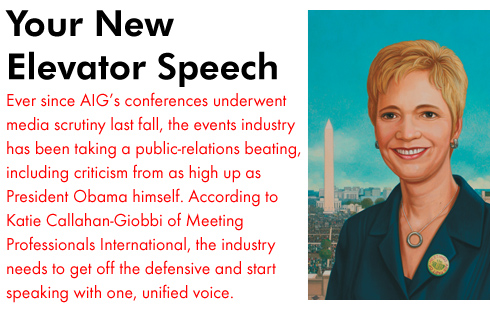
This willingness to speak up is critical to the industry’s future, says Katie Callahan-Giobbi, chief business architect at Meeting Professionals International (MPI), and executive vice president of the MPI Foundation. But what these thousands of individual voices lack, Callahan-Giobbi says, is the influential power of one, collective, unified story. Corporate EVENT spoke with Callahan-Giobbi about the current industry environment, and how a uniform “elevator speech” can help us all return to business as usual.
|
 Face-to-face marketing and meeting activities are often looked at as cost centers rather than as business units or savings areas. It is important to reposition how you sit within your organization. Face-to-face marketing and meeting activities are often looked at as cost centers rather than as business units or savings areas. It is important to reposition how you sit within your organization.
|
Corporate EVENT: Is any portion of the recent public criticism of corporate events valid? If so, how should event marketers and meeting planners interpret that criticism?
Katie Callahan-Giobbi: When we’re talking about the livelihood of a million people in the U.S. economy, we have to look at every comment and criticism very seriously. For meeting and event professionals on the corporate and association side, the burden is on us to defend, articulate, and value the dollars spent in the meetings market.
We’re in very interesting times right now. There is a lot of good discussion happening. Meeting and event professionals have to stand up and be proud of the accomplishments we can point to, and the value we bring within the organization. Every internal conversation around this is going to be very different, and how everyone ups their game on a personal level within their organization is important.
We do believe there is hope throughout this conversation, though. It does start with defining the economic impact of the industry, but then the question quickly becomes, for every dollar we spend, why do we spend it? That naturally leads to a discussion about ROI and ROO, that, quite frankly, we all should view as our sweet spot. As meeting professionals, we must believe meetings and events are an important business tool and when used properly do indeed advance business objectives. And there is data to support that meetings and events do that more quickly than other media.
CE: How big of an impact do corporate events have on the economy?
KCG: Business travel in general supports 2.4 million jobs and injects more than $240 billion into the national economy, along with $39 billion in tax revenue. The meetings and events subset of the business-travel industry is responsible for 1 million jobs, $101 billion in spending, $27 billion in wages, and $16 billion in tax revenue. These numbers are based on estimates from the U.S. Travel Association.
Overall, estimates are that approximately 15 to 20 percent of all travel spending in the United States is directly attributed to the meetings market. It’s important to remember that these numbers are best estimates at this point. As a result of proposed Troubled-Asset Relief Program (TARP) regulations and what we’re calling the AIG effect, there is a very robust conversation among all of our industry organizations about conducting an in-depth U.S.-impact study to update the financial-impact numbers and quantify them in a collective and cohesive way.
CE: The TARP regulations “prevent any recipient of TARP funds from hosting, sponsoring, or paying for conferences, holiday parties, and entertainment events” in the calendar year in which funds are received, and the following year. What is your opinion about how that may affect or influence other public companies?
KCG: We do believe there could be a halo effect to the TARP legislation. We’re seeing signs of this already — fear of going forward with meetings or events due to public perception is already moving beyond TARP industries and companies. We’re just as concerned that other corporations could come under the same public scrutiny.
CE: Even before the economy went so far south in the fourth quarter of 2008, everyone, regardless of market category, was already facing internal budget pressures for 2009. Now, events and meetings departments may feel their reputations — not just their budgets — are also being questioned. How can event managers tackle this internally and externally?
KCG: We do know that budgets are decreasing. In some fieldwork for our FutureWatch 2009 study done with American Express last October and November, our meeting planners told us their budgets were going to fall by about 6 percent. Since then, of course, the market has been changing so rapidly. The data we have now shows that people are certainly more skeptical about meetings budgets.
There is some advice I would give: First, evaluate your portfolio, then be sure you understand and can articulate the value that portfolio of meetings and events brings to your organization in terms of returns. Also be sure you’re ready for any hallway hotseat moments with numbers that show how you’re handling costs and demonstrating savings. Have a talking point, for example, about the value you’re going to produce in that annual sales meeting or product-launch event: “By investing $1 million in this meeting, we are going to demonstrate a sales yield of X percent in the coming year.” Show a correlation to a true business metric.
Face-to-face marketing and meeting activities are often looked at as cost centers rather than as business units or savings areas. It is important to reposition how you sit within your organization. A strategic understanding of the business value your work produces will help you accomplish that.
|
 The call to action is to get involved with your state and federal legislators. On a departmental level, articulate the value you bring to your organization broadly, and the results your individual meetings and events produce. The call to action is to get involved with your state and federal legislators. On a departmental level, articulate the value you bring to your organization broadly, and the results your individual meetings and events produce.
|
CE: Short of taking out a full-page ad in the Wall Street Journal like Wells Fargo, what can event managers do publicly to present the case for corporate events?
KCG: There are many resources out there to support professionals in all parts of the meetings and events industry in how they talk about our work. These efforts are being led by a coalition of the major industry organizations like MPI, the Professional Convention Management Association, the U.S. Travel Association, and others. MPI is sharing news, information, and talking points at www.MeetingIndustryCrisisCenter.org; other resources include www.KeepAmericaMeeting.org. and www.MeetingsMeanBusiness.com.
On each site, there are guides to quick and easy things you can do. Write to your congress people. Rally around industry associations and their collaboration on this issue. On the MPI-managed site, there is special section on how to keep your career going. It has very specific steps you can take if you still have your job, or if you’ve been recently affected by the crisis.
Most of all, there are tips and talking points for all of us to unite with a common voice. This is an important and great time for us to speak with one voice as an industry, and to take that voice to our own company executives, to the media, and to our lawmakers.
CE: So what is that one voice? If we were to create a single message — an industry-wide elevator speech — what would that speech be? What are the three talking points everyone in this industry should know?
KCG: Right now, there is not a formal elevator speech. And while I certainly don’t speak for the entire meetings and events industry, at MPI we see three critically important points we’d like everyone in the industry to know:
 Meetings and events are part of the solution, not part of the problem. Meetings and events are part of the solution, not part of the problem.
The economic impact of the meetings and events business on the U.S. economy is real. Our efforts have an impact.
We believe in clear standards, transparency, and accountability for all of the meeting and event spending that occurs. We still stand up and articulate that time and time again. We want all professionals in the industry to demonstrate personal and organizational accountability for their spend, and to measure the tangible outcomes.
CE: No one knows when this recession will end. But if it continues through 2009, what can event marketers and meeting planners do to start laying the groundwork for program preservation?
KCG: On a personal level, the call to action is to get involved with your state and federal legislators. On a departmental level, articulate the value you bring to your organization broadly, and the results your individual meetings and events produce. Collectively, let’s drive this industry with one unified voice.
Everyone involved in meetings and events has a vested interest in this discussion. Stand up. Be proud. Take an active role.e
|
|
|
|
|
 |
 |