Balancing Act
 As the director of marketing communication for ReliOn Inc., a maker of fuel-cell back-up power sources, I usually manage only those shows where we use our 20-by-20-foot booth. But in 2008, I planned to manage the WiMax show, where we use our 10-by-20-foot exhibit — a property I hadn’t set up in quite some time. So while I knew I needed to brush up on my setup skills prior to the show, I had no idea I’d also have to master a new skill during installation: booth balancing. As the director of marketing communication for ReliOn Inc., a maker of fuel-cell back-up power sources, I usually manage only those shows where we use our 20-by-20-foot booth. But in 2008, I planned to manage the WiMax show, where we use our 10-by-20-foot exhibit — a property I hadn’t set up in quite some time. So while I knew I needed to brush up on my setup skills prior to the show, I had no idea I’d also have to master a new skill during installation: booth balancing.
The booth comprised two 8-by-10-foot structures, which were joined by a center pole that held zipped-in tension graphics. During setup, I planned to lay out all of the pieces and instruct one union labor guy about how to set it up. Since I’d set aside a half day for setup at the show, and installation actually only takes about three hours, I figured I had plenty of time to get my booth together, dismiss my labor with minimal cost, and still set out all of my collateral materials the night before the show opened.
On setup day, everything was going according to plan. Joe, my union labor guy, was pleasant and helpful, and the booth was going together by the book. But as we neared completion, we got stuck, literally. As I zipped in the graphics, the zipper stuck tighter than skinny jeans on Dom Deluise. Joe and I pulled at the fabric, tugged at the zipper, and pushed on the metal frame, but nothing helped.
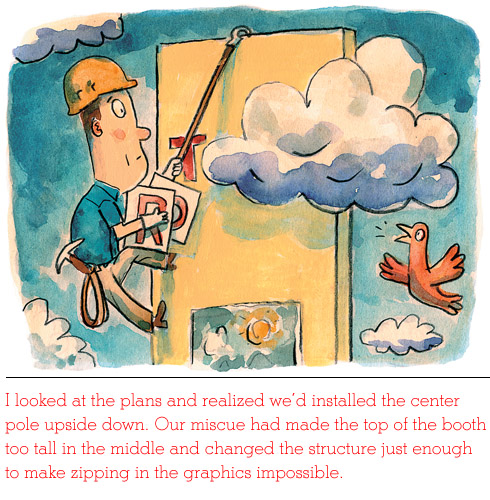
I looked at the plans and realized we’d installed the center pole upside down. Our miscue had made the top of the booth too tall in the middle and changed the structure just enough to make zipping in the graphics impossible. I was in trouble.
To fix the problem properly, we’d need about 30 minutes to deconstruct the booth, and then we’d need to flip the pole and start rebuilding. And that meant additional I&D time for Joe, and extra money my budget simply didn’t have. Plus, if we deconstructed the booth, we’d run into Joe’s union-mandated lunch hour, which would turn my leisurely setup into a rush to the finish.
 As we discussed my dilemma, Joe suddenly came up with a daring solution: Rather than completely disassembling the booth, we’d try to reverse the backward pole with most of the structure still standing. Joe figured that if we disconnected the heavy horizontal bars at the top of the structure from the center pole and found some way to support their weight, he could flip the center pole without having to dismantle everything. As we discussed my dilemma, Joe suddenly came up with a daring solution: Rather than completely disassembling the booth, we’d try to reverse the backward pole with most of the structure still standing. Joe figured that if we disconnected the heavy horizontal bars at the top of the structure from the center pole and found some way to support their weight, he could flip the center pole without having to dismantle everything.
He suggested we set one of the bars on the 8-foot ladder we’d been using and set the other end on a long, heavy cardboard tube we’d found in a nearby trash bin. While a cardboard tube wasn’t exactly an ideal support structure, he figured that with me balancing the bar atop the tube, the sturdy cardboard would hold the weight of half of the booth for about three or four minutes while Joe made the switch.
Truth be told, I’m kind of a risk taker. And with the clock ticking and my budget not getting any bigger, I decided to give it a shot. So Joe climbed the ladder, unhooked both horizontal bars from the center pole, and rested one on the ladder. While I steadied the tube, Joe carefully positioned the bar atop it and then scurried down the ladder and started work on the center pole.
As I stood there, I felt like a circus performer doing some kind of weird balancing act. With one false move, both my booth and my program’s success could come tumbling down. Needless to say, I held my breath as Joe tiptoed around me. But before long, Joe finished with the pole, climbed back up the ladder, and successfully reconnected everything.
With the pole oriented correctly, the graphics zipped easily into place. And instead of an hour or more of fixing our mistake, the whole operation took less than five minutes. Plus, our daring balancing act saved me a lot of time and about $100. Maybe next time I’ll try something with a tightrope.
— Sandra Saathoff, director marketing communication, ReliOn Inc., Spokane, WA
The Maltese Plan B
Before opening my own exhibit house, I was an account executive at another exhibit firm where I handled the company’s largest client, a pharmaceutical company with roughly 100 shows per year. With such an important client, I considered myself a full-service rep, which meant I did whatever was necessary to make the client happy. While I wore the self-appointed title with honor, I never imagined that “full service” would entail replacing a tabletop exhibit at a show in the middle of the Mediterranean Sea.
Back in 2005, the client was exhibiting at a show in Malta, that historic island nation off the coast of Italy. So I’d shipped the company’s tabletop exhibit to the show along with some literature, and I diligently tracked the shipment to make sure there were no problems. But four days before booth setup was to begin, I realized my Maltese mission had turned into a massive problem: The exhibit was held up in customs.
Initially, I tried to be patient, hoping the exhibit would be released and all would be well. But in the back of my mind, I worked on contingencies. After all, my client’s exhibit was being held captive on a remote island several time zones away, and my only connection with Malta was a Humphrey Bogart movie I’d once seen.
My patience with Maltese customs lasted just two days, and I sprung into action. Since the exhibit was made by Nimlok Co., I tried to locate the Nimlok dealer closest to Malta, half expecting to find a company in Italy. But as luck would have it, there was actually a Nimlok rep on Malta.
I quickly called the rep, who had a 10-by-10-foot booth comprising some of the same elements as the missing tabletop. So he quickly scaled down the 10-by-10 to a tabletop, and what’s more, the new tabletop even had frames to fit our graphics. So I sent the rep our electronic graphic files for production in Malta.
With the booth taken care of, I still had to tackle I&D and literature. The I&D part was easy, as the Nimlok rep offered to install and dismantle the tabletop as part of the package. As for the literature, I simply contacted the booth staffers and instructed them to each pack as much literature as possible to take to the show.
Apparently, all went well at the show, for afterwards, the Nimlok rep sent me photos of the exhibit, which was flawless. Plus, despite the added expense, the client was pleased that I had been able to save the day, even in the middle of the Mediterranean.
— Janet Denison, president, Vision Exhibits Inc., Lincoln, NE
|