Photo: San Francisco History Center, San Francisco Public Library
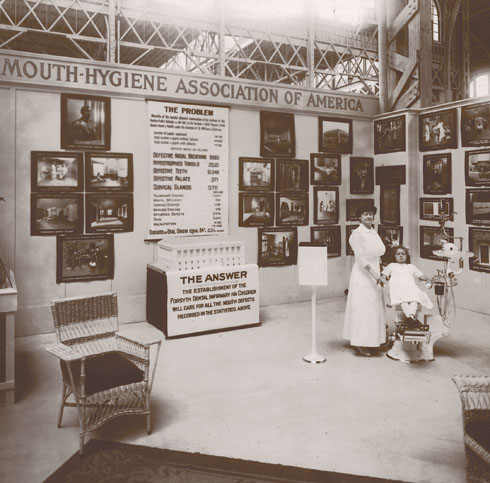
hen the National Mouth-Hygiene Association exhibited at the Panama-Pacific International Exposition in 1915, most Americans had given dental care the brush-off. Because children could expect to lose all of their teeth by age 40, the association tried to scare visitors into better dental hygiene with alarming statistics mounted on signage that warned 84 percent of all “defects” found in children had oral origins. Fear, new advances such as Procaine (a.k.a. Novocain) in 1905, and the first formal training program for dental nurses in 1910, helped Americans put their money where their mouth was.




 hen the National Mouth-Hygiene Association exhibited at the Panama-Pacific International Exposition in 1915, most Americans had given dental care the brush-off. Because children could expect to lose all of their teeth by age 40, the association tried to scare visitors into better dental hygiene with alarming statistics mounted on signage that warned 84 percent of all “defects” found in children had oral origins. Fear, new advances such as Procaine (a.k.a. Novocain) in 1905, and the first formal training program for dental nurses in 1910, helped Americans put their money where their mouth was.