Foul Balls
 Having an athlete sign autographs in your booth seems pretty simple. If you bring some Sharpies and something for the star to sign, and you make sure your sports celebrity actually shows up, you shouldn’t have any problems. Of course, if any one of those things goes wrong, you’ve gone from hitting a home run to striking out. Having an athlete sign autographs in your booth seems pretty simple. If you bring some Sharpies and something for the star to sign, and you make sure your sports celebrity actually shows up, you shouldn’t have any problems. Of course, if any one of those things goes wrong, you’ve gone from hitting a home run to striking out.
That’s the jam I found myself in at the 2008 Drug Information Association show in Boston, where my company decided to spring for a local celebrity to help draw a crowd to our exhibit. Since we were in Beantown, we made a call to the bullpen for Hall of Fame pitcher Dennis Eckersley, a Red Sox icon.
Wanting to get the most out of our celebrity appearance, we bought 1,000 baseballs for Eckersley to sign, all imprinted with our company logo. Now, instead of just a piece of sports memorabilia to prominently display at their home or office, attendees would also display our logo.
As we packed up for the show, everything seemed to be in order. But when our baseballs arrived at our hotel two days before opening day, we immediately discovered that something was amiss. The Canadian vendor that printed our logo on the baseballs had carefully placed each ball in a plastic bag to keep it in pristine condition for signing. But when we opened the box of balls that night, we noticed that the ink from our logo had smeared across the balls, making each little leather beauty an unsignable mess.
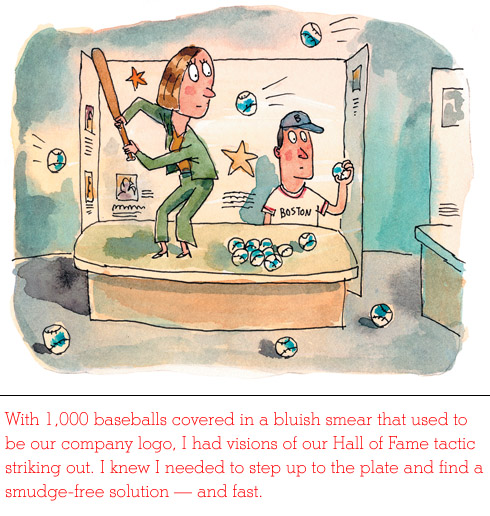
With 1,000 baseballs covered in a bluish smear that used to be our company logo, I had visions of our Hall of Fame tactic striking out. After taking a moment to compose myself, I knew I needed to step up to the plate and find a smudge-free solution — and fast.
 The next morning, I called the vendor in Canada. My rep couldn’t understand why the ink had smeared, and admitted that re-printing the logo on the ball at this late juncture would never allow the ink to dry in time for the show. The next morning, I called the vendor in Canada. My rep couldn’t understand why the ink had smeared, and admitted that re-printing the logo on the ball at this late juncture would never allow the ink to dry in time for the show.
Still, I needed something for our Hall of Famer to sign, preferably something branded with our logo. So I decided to clean up the balls and find a new way to attach our logo.
Luckily, my exhibit house located a couple of general laborers to clean the balls, so I trotted them off to a hotel room, handed them a bunch of towels and some paint solvent, and set them to work gently scrubbing the logo ink from all 1,000 baseballs.
Next, I needed to get our logo back on the balls. Since I had the logo on a flash drive, I headed to a local Kinkos and asked for a rush job: my company’s logo printed on 1,000 small, clear-plastic labels. With the labels in hand, I returned to the hotel to find a room full of workers a little high on solvent fumes. Fortunately, all the balls were finally clean.
With the show opening the next day, my night was destined for extra innings. So I wrangled up some of my co-workers, and together we sat up all night putting our adhesive logos back on the now ink-free balls.
Thanks to our all nighter, we had 1,000 logo-adorned baseballs at the ready when Eckersley showed up, much to the delight of the continual crowds that gathered to get an autograph from the Major League star.
So, even though I had found myself in a proverbial bases-loaded jam, I was able to pitch the right solution and, with the help of some teammates, save the game. I’m sure Eckersley would have approved.
— Lindsay Kershner, marketing events specialist, MDS Pharma
Services Inc., King of Prussia, PA
Blue-Light Special
As president of my own exhibit house, I see clients do a lot of things that make me cringe. But when one of my clients decided to save money with some do-it-yourself sign making, I didn’t have time to cringe because I was too busy trying to head off disaster.
With the 2008 International Water Bottlers Association show looming, my client wanted a new hanging sign over its booth to improve visibility. So when a local Kmart closed its doors, two do-it-yourself guys at the client company purchased an old 10-foot-diameter, tapered, circular hanging sign with its frame. The idea was to cover the old, inexpensive frame with a new fabric graphic printed with the company’s name and logo, and then hang the
giant circular sign over the exhibit.
However, their do-it-yourself shenanigans didn’t stop there. Instead of suspending the sign from overhead truss, they planned to erect a pole in the exhibit and place the sign atop the pole via a homemade crossbeam system.
Making matters worse, timing was tight. Since it was going to be difficult to match the fabric to the frame, the fix-it guys sent the frame to the fabric printer to ensure a perfect fit. But that meant the new sign would arrive back at my office just a couple of days before the show. Thus, we’d have to scramble to make sure it was in working order.
When the sign arrived back from the printer, I immediately discovered a significant problem. Apparently, the crossbeams had not been sent to the printer along with the rest of the frame. So the printer hadn’t cut any holes in the new fabric graphic to allow for the hardware. With just two days before I had to send the exhibit back to the client and ultimately to the show, I took a deep breath and buckled down to find a solution.
Obviously, I could have cut holes in the new graphic to allow the hardware from the crossbeams to poke through. But this graphic needed to last, and if I simply cut out some holes, I was afraid my client’s inexpensive new overhead element would never stand the test of time.
Instead, I decided to add some reinforcements — literally. I ran home and grabbed my sewing machine, making a quick stop at a fabric store for some iron-on patches to reinforce the fabric in the places where I planned to make cuts for the hardware.
Back at my office, I carefully placed the fabric graphic on the frame before marking the location of the holes. Then I took the marked fabric off and ironed the patches on the back of graphic. With my fabric support in place, I cut my eyelets for the hardware and sewed around the edges of the holes to add support.
In the end, I shipped everything from my office on time, and the overhead structure worked like a charm with no rips, tears, or holes around my new eyelets. And of course, my do-it-yourself guys were thrilled with their thrifty concoction — and my sewing. But next time they decide to upgrade their booth, I need to make sure they don’t go shopping around for more Blue-Light Specials at Kmart.
— Janet Denison, president, Vision Exhibits Inc., Lincoln, NE
|