research |
 |
 emory is a net,” wrote Oliver Wendell Holmes Sr. “One that finds it full of fish when he takes it from the brook, but a dozen miles of water have run through it without sticking.” emory is a net,” wrote Oliver Wendell Holmes Sr. “One that finds it full of fish when he takes it from the brook, but a dozen miles of water have run through it without sticking.”
Thirty years ago, what stuck to attendees’ mental nets after they’d pinballed through hundreds of exhibits at trade shows was a mystery harder to solve than why we keep forgetting where we left the car keys. Since then, Red Bank, NJ,-based Exhibit Surveys Inc. has polled thousands of visitors at hundreds of shows to find out which exhibits are unforgettable and why.
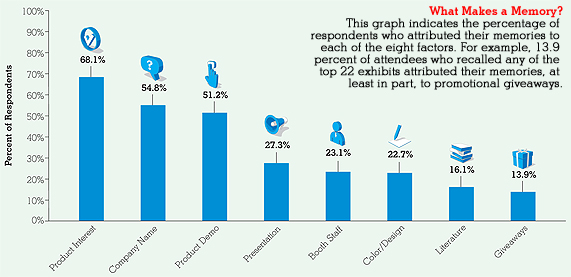
In addition to asking attendees which exhibits they recalled, the surveys also ask them to attribute each exhibit’s memorability to one or more of eight factors, such as a product demo, booth staff, a presentation, literature, exhibit design, and giveaways. The remaining two factors, which have historically proven to be the most important factors driving memorability, are product interest and company name.
Bottom line, if attendees are interested in your product and are familiar with your company, they’re more likely to remember your exhibit. But if you’re an unknown company with a never-before-seen product, don’t lose hope. Other exhibit-related elements, specifically product demonstrations, booth staff, exhibit design, and
presentations, also post high recall rates, indicating that a well-designed exhibit with an engaging presentation, knowledgeable staffers, and an informative product demo can still rank high on the memory meter, even if the exhibitor’s brand is not yet a household name.
Ian Sequeira, vice president of Exhibit Surveys, says the most-remembered exhibits of 2006 followed the trends we’ve seen before: Recognizable names, buzz-worthy new products, and large booth spaces are traits that put exhibits permanently on attendees’ minds. But Sequeira warns exhibitors not to treat memorability as an end in itself. “Being memorable isn’t always a direct measure of success in leads, sales, or any other way you can measure your ROI,” he says. “The goal should be to reach your target audience, and if you can do that and you are also among the most remembered, then consider it a bonus. Memorability, after all, is usually the byproduct of success.”
|
|
 |
 |
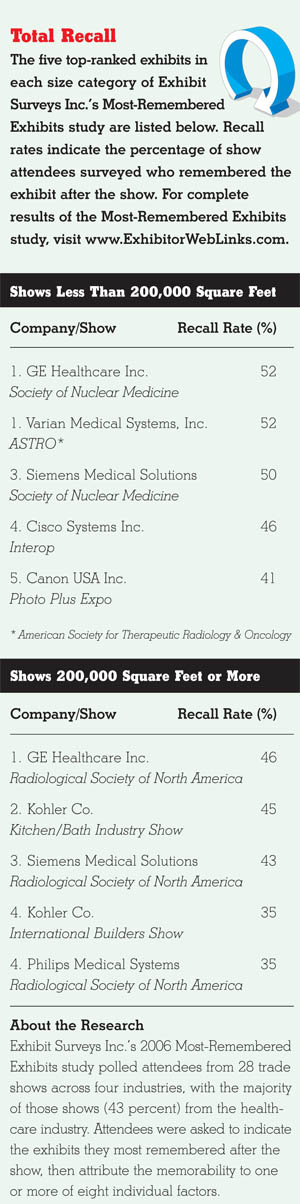
In both size categories (shows 200,000 square feet or more and shows less than 200,000 square feet), the most-remembered exhibits belonged to a household name — GE Healthcare Inc. They also featured a slate of new products for each exhibit’s target audience, and square footage that dwarfed most of the competition at their respective shows.
At the Society of Nuclear Medicine show in San Diego, for example, GE Healthcare’s molecular-imaging division showed up with all the raw ingredients to create a memorable exhibit: a 50-by-130-foot exhibit space rivaled only by two other exhibitors at the less than 200,000-square-foot show; seven new products to launch (an unheard of total for such a focused, vertical-market event); and a name recognized throughout the health-care industry. True to form, 66 percent of attendees who remembered the GE Healthcare exhibit attributed its memorability in part to their interest in the company’s offerings, while 61 percent attributed their memorability to the company’s well-known name.
But GE Healthcare didn’t solely rely on its iconic identity, popular products, and biggie-sized booths to top Exhibit Survey’s list. It devised an exhibit promotion that combined a memorable in-booth experience and a series of scrapbook-worthy giveaways that kept attendees coming back throughout each show.
Specifically, GE Healthcare brought out the stars — Olympic stars, that is. For two hours during each day, attendees were able to rub elbows and get autographs from Olympic champions Mark Spitz, Dorothy Hamel, Bruce Jenner, and Mary Lou Retton. As household names, the Olympic athletes provided an incentive for attendees to flock to the GE Healthcare booth.
Once those attendees came to the exhibit, they were bound to return multiple times throughout the four-day show. Each day, GE Healthcare distributed a different card as an in-booth incentive. The daily cards corresponded to the athlete visiting the booth that day. But to get the card, a prerequisite for an autograph, they needed to play the Olympic Trivia Challenge, an interactive, educational product demo/presentation. The Trivia Challenge was designed to test attendees’ Olympic knowledge, teaching them about GE Healthcare at the same time.
|
But the hottest part of the program was something found only at the GE Healthcare exhibit. In the Technology Pavilion, where attendees signed a release to acknowledge what they were about to see was not-yet FDA approved, medical professionals could discuss the company’s cutting-edge developments with representatives from GE Healthcare in a casual, sales-free environment. “Over half the attendees at the booth went to the Technology Pavilion,” Benson says, adding they spent an average of 22 minutes in the sales-free zone. Since doctors like talking to other doctors, and they come to shows such as SNM to learn, the pavilion was a show highlight for many SNM attendees.
By bringing attendees back each day and offering a unique, sales-free area in its booth that catered specifically to attendees' needs, GE Healthcare was able to score an impressive 52-percent recall rate in Exhibit Survey's study.
For complete results of the Most-Remembered Exhibits study, along with images and information about other top-rated exhibits and how they made lasting impressions on attendees, visit www.ExhibitorWebLinks.com e |
|
|
|



