Fish out of Water
 We’ve all had that figurative “fish out of water” experience. But when setting up an exhibit for my client, Nokia, at the 1997 Telexpo in São Paulo, Brazil, I had that experience literally — and with scores of flopping, gasping fish. Fortunately, some quick thinking and a merciful client turned my deluge of a disaster into a ringing success for the mobile-phone maker and me, even if the story didn’t end so well for our poor finned friends. We’ve all had that figurative “fish out of water” experience. But when setting up an exhibit for my client, Nokia, at the 1997 Telexpo in São Paulo, Brazil, I had that experience literally — and with scores of flopping, gasping fish. Fortunately, some quick thinking and a merciful client turned my deluge of a disaster into a ringing success for the mobile-phone maker and me, even if the story didn’t end so well for our poor finned friends.
My company, Inter-Global Exhibitions, designed and built Nokia’s exhibit for the show, which featured a 1,000-gallon saltwater aquarium at its core. The plan was to place the company’s phones in plastic bubbles and drop them into our sea scene, making the phones look as exotic and attractive as the colorful tropical fish we also planned to put in the tank.
As for those fish, we wanted to get as many distinctive, colorful species as we could find to attract attendees’ eyes to the tank and eventually to Nokia’s phones. The types of fish we had in mind, however, were both rare and expensive. Few pet stores carried them, and those that did typically charged an astronomical price. Thus, we needed an alternative method to fill our tank with schools of colorful fish.
As luck would have it, Nokia’s marketing director had connections in the São Paulo community. So, a few weeks before the show, she assisted us in making arrangements with some private citizens in São Paulo to borrow their beautiful exotic fish — many native to the warm coastal waters of Brazil — for our display.
We’d also arranged for a special
contractor to build our custom aquarium. Prior to the show, the giant fish tank was built off site, and during setup the contractor painstakingly installed it in the proper space in our booth. So with less than 24 hours before the show opened, all seemed to be going well. The booth was nearing completion, and the tank was installed and successfully filled with saltwater and our beloved fish.
As is typical of trade shows in Brazil, however, our crew ended up working on the exhibit well past midnight. Still, I wasn’t worried about the progress of our booth until I glanced over at the water-and-fish-filled aquarium. Despite my bleary eyes, I noticed something odd. The glass pane on the front of the tank seemed to bow outward a bit, giving our fishbowl a rounded look I hadn’t expected. The odd bubble shape caused me to stare, and I was just beginning to wonder if that glass bubble was normal when …
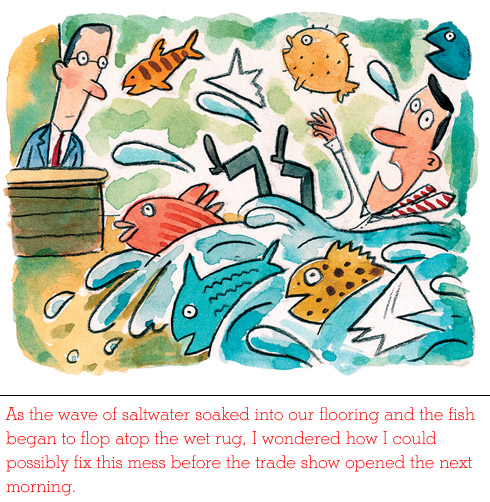
Crash! Whoosh! The bowed glass burst, sending 1,000 gallons of saltwater and scores of rare, tropical fish onto the carpet of our client’s exhibit. As the wave of saltwater soaked into our flooring and the fish began to flop atop the wet rug, I wondered how I could possibly fix this mess before the trade show opened the next morning.
 With a soaked carpet covered with gasping fish, the first order of business was of course to save the fish. My colleagues and the installation crew began life-saving maneuvers even before I had the chance to suggest them. Unfortunately, their solution
involved simply grabbing the fish and stuffing them in their pockets in the hopes that there would soon be
a saltwater-filled container into which they could deposit the fish. With a soaked carpet covered with gasping fish, the first order of business was of course to save the fish. My colleagues and the installation crew began life-saving maneuvers even before I had the chance to suggest them. Unfortunately, their solution
involved simply grabbing the fish and stuffing them in their pockets in the hopes that there would soon be
a saltwater-filled container into which they could deposit the fish.
Meanwhile, someone suggested getting several bowls, water, and table salt to remedy the situation. However, we soon realized that this plan was likely to still kill the fish, since no one knew how to properly warm the water to the correct temperature, whether table salt would kill the fish, or even where to get enough bowls for all of our scaled friends.
Sadly, it soon became apparent that we’d be on PETA’s naughty list, as the fish began to swim (metaphorically) to the Great Beyond. With any thoughts of rescue now out with the ebb tide — and a sickening pile of dead fish accumulating in our booth — we focused our efforts on cleaning and drying the carpet. We brought in brooms, dry and wet vacuums, and fans to clean the mess, soak up the water, and air out our flooring.
While most of the crew set to work on the cleaning detail, including removing pieces of broken glass from our former fish tank, I focused on finding a way to make our vision of an aquatic scene come to life even though live fish could no longer be part of the answer.
I immediately called our graphics printer. (Apparently everyone stays up late in São Paulo.) I told him about our fish-tank fiasco, and explained that I still needed my aquarium — now devoid of water and fish, not to mention missing one of its four sides — to look “sea-nic” so attendees would get the experience we’d promised in our pre-show promotions.
Luckily, my rep at the print shop said he could make us a graphic of a tropical-reef scene to cover the back of our empty tank, though we wouldn’t be able to proof the project if we wanted to get it to our booth in time for the show. With no time to quibble over what it would look like, I said yes, and pitched in to help clean our mess while I awaited our new underwater view.
Within a couple of hours, our graphic — printed to fit one lengthwise wall of our rectangular tank — arrived, and we put it in place on the back of the aquarium. We left the wet sand and other aquarium items we’d planned to put on the floor of our saltwater scene where they were, right in front of our new aquatic backdrop. Then, instead of putting the client’s products in plastic bubbles in the now-missing water, we simply placed them onto the sea floor of our display where attendees could investigate them.
As luck would have it, the client was happy with our improvisation and forgiving of our dramatic midnight deluge. When the show opened, the attendees were still able to enjoy our aquatic theme. Plus, since the phones were more accessible, thanks to the side of the tank that exploded, visitors actually had a more hands-on experience with the products than we’d originally planned.
In the end, our booth still matched the theme and the promotions we’d planned, and the client was happy with our effort and the results from the show. Plus, we learned a valuable lesson about the thickness of glass and water pressure — and about the importance of securing experienced Brazilian aquarium builders. Unfortunately, we still needed to make a few apologies and make some monetary amends to some of the fish owners. But everyone agreed that as sad as our little mishap was, our quick thinking and ability to change with the tides helped turn a disaster into a swimming success.
— Gino Pellegrini, president,
Inter-Global Exhibitions, Denver
|