|

 well-known brand can be both a blessing and a curse. Mention UPS, for example, and most people conjure images of small packages and big brown trucks. well-known brand can be both a blessing and a curse. Mention UPS, for example, and most people conjure images of small packages and big brown trucks.
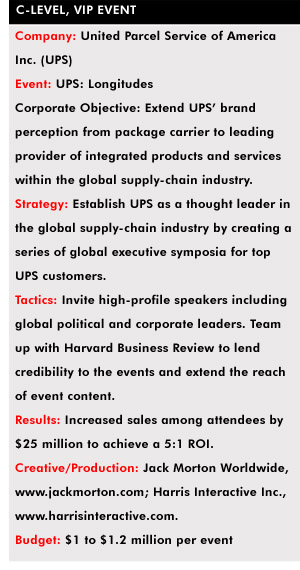
They’re not entirely off base. Despite the fact that United Parcel Service of America Inc. (UPS) has been a global player for more than 30 years, the company has built much of its brand around a single core service — package delivery within the United States — since it was founded in 1907.
Therein lies the company’s curse, says Ken Sternad, UPS vice president of public relations. “We are so well known for package delivery, but we actually are a much broader solutions organization in relation to the movement of goods, information, and funds, and we offer a very broad supply-chain and global-trade portfolio.”
Much of that evolution has happened in the last 10 years. UPS spent approximately $10 billion building up its information-technology infrastructure to become one of the largest providers of integrated, global supply-chain-management services on the planet. “We needed to communicate the fact that UPS had transformed itself and was a different company,” Sternad says.
The company’s first step was to overhaul its brand, a process it launched in 2003 by replacing the neatly packaged, bow-tied box that had adorned the 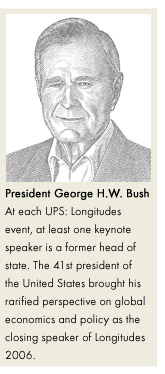 company’s logo for four decades with a “swishy” curve. The company also developed a new tagline (What can Brown do for you?) and launched a comprehensive marketing and advertising campaign to draw attention to the company’s thorough transformation into a global supply-chain leader. company’s logo for four decades with a “swishy” curve. The company also developed a new tagline (What can Brown do for you?) and launched a comprehensive marketing and advertising campaign to draw attention to the company’s thorough transformation into a global supply-chain leader.
By 2004, UPS was ready to launch its next strategy. It wanted to drive home its new image to corporate heavyweights worldwide — namely, Fortune 100 C-level execs who make global supply-chain decisions for their companies.
“These people are savvy and informed, and logistics is their business,” Sternad says. “They know a lot about what our major competitors do. Our question was, ‘How can we differentiate ourselves by making UPS feel more forward-thinking, innovative, and ahead of the curve than everyone else?’”
To help meet this goal, the company created “UPS: Longitudes,” a semiannual executive symposium that engages key UPS customers in a dialogue about global supply-chain management, while positioning UPS as a thought leader on the subject.
Hand-Picked Attendance
UPS personally invites C-level executives and a small percentage of those directly below them (e.g. vice presidents and directors with global supply-chain decision-making authority) from its top-client roster. To further enhance the credibility and exclusivity of the event, UPS caps attendance at around 200, and invitees may not send another person from their companies to attend in their place without prior approval from UPS.
Longitudes events are not marketing and sales platforms for UPS, but in-depth forums for leading thinkers, practitioners, analysts, and academics to explore pressing global supply-chain issues and to learn what it takes to succeed in a global business environment. In fact, 95 percent of Longitudes content comes from third-party speakers, not from UPS.
“Rather than create an advertising forum for UPS, we wanted to create an event that would engage our top customers and showcase thought leadership and best practices in the supply-chain industry,” Sternad says. “We did so deliberately, reasoning that by hosting these events, UPS would gain credibility and become more widely known for being ahead of the curve when it comes to thinking about where things are going with global supply-chain management.”
Regional Relevance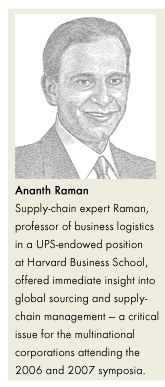
Launched in 2004 and held twice each year ever since — once in the United States and once in an international venue — each Longitudes event follows a similar template, but is customized to reflect regional concerns. In 2004, for example, Paris attendees discussed the implications of Eastern Europe’s growing prominence. At a 2006 event in Frankfurt, Germany, content centered on Europe’s role in the global marketplace and growing business through new supply-chain strategies. In Shanghai in 2005, Joe Hatfield, Wal-Mart Asia president and CEO, spoke about Wal-Mart’s growth in China and how it manages its supply chain from a global perspective.
In the late afternoon of each event’s first day, attendees are greeted on site by Mike Eskew, UPS chairman and CEO, and then are treated to dinner and a guest keynote. Next up, they participate in a full day of conference proceedings including presentations by professors, industry experts, and other notable speakers, along with interactive roundtables and Q&A sessions. In the late afternoon of the second day, a culminating keynote delivered by a former head of state takes place. (Vaclav Havel, the first president of Czech Republic; Lech Wal´e?sa, former president of Poland; and former United States Presidents Bill Clinton, George H.W. Bush, and Jimmy Carter all have taken a turn at the Longitudes podium.) Finally, the event culminates with a closing networking reception.
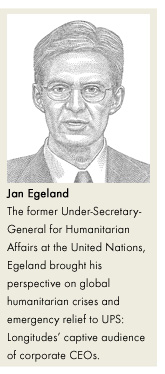
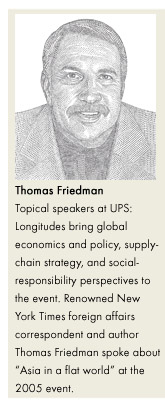
Typically, those experts and political leaders invited to speak at Longitudes are selected based on three conference tracks, according to Larry Bloomenkranz, UPS vice president of brand management, advertising, and sponsorships. These tracks include global economics and policy issues from a high-level, academic view; supply-chain strategy from a practitioner’s view; and social responsibility from a macro prospective. At past events, luminaries occupying such slots have included The New York Times foreign-affairs columnist Thomas Friedman, United Nations Under-Secretary-General for Humanitarian Affairs Jan Egeland, and Harvard Business School Professor
of Business Logistics, Ananth Raman.
UPS also packs each event’s speaking roster with its own customers, all of whom address global supply-chain issues from an organizational perspective. For example, Procter & Gamble Co. CEO, A.G. Lafley, presented a session entitled “Supply Chain as Innovation Engine: The P&G Story” at the 2006 Longitudes event in Chicago. At the 2005 Chicago event, Best Buy Co. Inc. CEO and vice chairman, Brad Anderson, and Best Buy International CEO and CIO, Robert Willet, engaged in a highly rated, frank, moderated discussion addressing the global supply-chain challenges the two electronics executives face, and how they work together to overcome them.
Where’s the Brand?
Integral to UPS’ efforts is the company’s longstanding partnership with Harvard Business School Publishing, a nonprofit, wholly-owned subsidiary of Harvard Business School that helps UPS organize each Longitudes event and also co-hosts sessions, generates content, and provides moderators. The partnership, according to Bloomenkranz, lends each Longitudes symposium a sense of cachet. “In addition to the enormous amount of contacts from the academic and business world that they bring in, their name gives us the third-party credibility we need to make the event feel more like an open thought-leadership forum than a shilling forum for UPS.”
Such third-party credibility has proved to be important, but not essential to the event’s ongoing success. Initially, UPS was so afraid that prospects and customers would shy away from attending the event if the company pitched its own products that it was somewhat militant about keeping promotional content off-limits at Longitudes. “We wanted to make sure that attendees knew that Longitudes was not about us; it was about them and their needs and their challenges,” Sternad says.
To UPS’ surprise, however, the corporate executive attendees at the first two Longitudes events, held in New York and Paris in 2004, provided the company with feedback indicating that attendees actually wanted to learn more about UPS’ offerings. “The feedback we received indicated that attendees did appreciate the fact that we weren’t trying to hard sell them,” says Bloomenkranz, “but at the same time, they wanted to receive more information about UPS and what it can do for them.”
In response, UPS put itself on the program. Today, for instance, CEO Eskew and other UPS top managers host an “executive exchange” breakout session at all Longitudes events. The session kicks off with a 10- to 15-minute overview of UPS’ priorities, solutions, and capabilities, and then segues into a formal Q&A during which attendees are encouraged to ask about the company’s global-logistics capabilities and solutions — as well as specific questions regarding what UPS can do for them.
Maximizing the Message
Yet another goal of Longitudes is to extend the life of each symposium’s conference content beyond the event to a larger audience of international global supply-chain experts, which in turn further broadens and bolsters UPS’ image as a thought leader in the supply-chain industry.
To accomplish this, within a week after each event, event partner Harvard Business School Publishing compiles a brief executive summary that it distributes to attendees and to those invitees who were unable to attend. One month later, a full-scale analysis of the event is posted to the Longitudes Web site and is sent to a hit list of key media contacts, analysts, consultants, and academics in the global-business and logistics market.
As a result, each Longitudes event starts a dialogue that continues long after the conference is over. Attending academics and other third parties, for example, continue to use material from the symposia in business, class, and conference settings as well as in editorial columns — helping to reposition the UPS brand among a wider audience. In addition, the list of global trade and supply experts that request executive summaries and conference reports from Longitudes steadily grows — as does the presence of Longitudes-related content in executive speeches, bylined articles, trade media, white papers, and various other support materials worldwide.
Reaping the Rewards
All told, UPS has spent about $5 million (or approximately $1 to $1.2 per million per event) on Longitudes since the symposium’s inception in 2004. As for the reward those invested dollars are returning to the company, UPS reports that customers who attend Longitudes increase their spending with the company more quickly than the average for all UPS customers — thus far generating an astonishing $25 million return on a $5 million total investment, or an ROI of 5:1.
Beyond such tangible benefits, UPS also credits Longitudes for helping it to strengthen relationships with key customers and prospects, and increase its stature as a global supply-chain leader. Originally, Longitudes was expected to end in 2007, to coincide with UPS’ 100th anniversary. Given the success the event has achieved to date, however, Sternad says plans are now under development to extend the event. e
|





