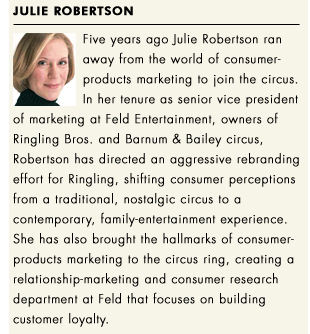
  t some point, we all dream of running away to join the circus. Julie Robertson has actually done it. But she’s not shooting from cannons, walking the tightrope, or taming tigers. Her job just might be tougher than that. t some point, we all dream of running away to join the circus. Julie Robertson has actually done it. But she’s not shooting from cannons, walking the tightrope, or taming tigers. Her job just might be tougher than that.
As senior vice president of marketing for Feld Entertainment, parent company to Ringling Bros. and Barnum & Bailey circus, Robertson has a mighty task. She must convince modern parents and their worldly and entertainment-savvy kids to come one, come all — and then ensure that their experience lives up to a seriously weighty brand promise: The Greatest Show on Earth.
Robertson believes the heart of the circus is like any event: It’s about entertainment, learning, and community — the very same things corporate event managers strive to create for their own attendees. The circus just delivers it up in a sequined package.
Corporate EVENT spoke with Robertson about the challenges of adapting a legacy event for constantly evolving audience expectations — and the marketing imperative to do so.
CE: After 137 years, many would think the circus could practically sell itself. The animals, the performers, the music, the pageantry — what are the challenges of marketing such an event?
JR: Kids today are pretty sophisticated, even more so than just five or six years ago. They’re constantly seeing amazing products in their day-to-day lives, online, in videos and movies and so on, so their expectations are huge. And nothing looks as good on TV as it does live in the actual arena. For instance, in advertising there are so many things you just can’t fully appreciate when you’re watching a 30-second commercial on a screen.
Everything from the pyrotechnics displays to the confetti that floats down onto the audience.
So bringing the experience to life in a marketing campaign is a tough — but good — challenge.
While we’re a unique event, there still is plenty of competition for general entertainment. When you can order a pizza for delivery and have Netflix send movies right to your house, that means an entertaining and predictable family evening with very little cost or hassle. That’s much different than packing everyone into the van, driving across town, parking, and spending the money to attend the circus. We need to prove that it’s absolutely worth it. And when it’s over, they need to feel it was worth their effort.
So we focus on trying to make parents feel like they’ll be heroes by taking their kids to see Ringling Bros.; that this will be an experience their kids will enjoy forever and that they’ll enjoy right along with them.
CE: It sounds much like getting a busy prospects’ attention and convincing him to attend an event he may have attended before. So how do you keep the circus relevant and appealing to past and prospective audiences?
JR: There are a few things that everyone expects from a Ringling Bros. circus: a sense of awe. The size of it all. To see their kids with their eyes wide open, taking it all in — with a little bit of sensory overload, humor, and dare-devilry that keeps them on the edge of their seats.
While these are important things our customers expect, they also need to see that it’s being differentiated from year to year, so they don’t feel they’ll be simply repeating a past experience. For example, there will always be the trapeze, a high-wire act, and big cats. But we make sure that each of these expected elements is pushed to the next level year after year. Instead of having one high wire, we add a second, parallel wire and the performers jump across them, moving between them during their act. Instead of fixed performance rings, we have movable dividers that split the performing space and morph into different shapes. And all the lighting is rigged and managed like a rock concert.
CE: So you’re really putting a twist on your traditional Ringling Bros. principles.
JR: I don’t think anyone wants to get mired today in being categorized as too much of a “traditional” entity. We have a long and respected tradition, and can’t and shouldn’t separate ourselves from that. But positioning yourself as something “traditional” is not the best place to be in 2007.
People are looking for an experience that they can’t have in their other activities. For us, it means saying “yes, you’re going to see the tradition that is Ringling Bros., but you’re going to see it in a way that is right for families of this era.”
CE: How can an event marketer identify the right ways — and the right traditions — to push and evolve in a business-to-business setting?
JR: For us, updating is always a bit of an experiment with every show. We’re lucky — we have so much to work with that allows us to make tweaks and to throw little things in as a test. Kind of like a comedian who tests out a new joke in a routine.
But those are activities. What doesn’t change for us is the core of what we are: We will always be authentic, wholesome, and appropriate for the entire family. Those are our legacy principles, and the things we will never change. We can get edgier with technology, music, and costumes, but there is a line we will not cross.
|
|
You should know what the legacy principles are in your events. It’s what keeps attendees coming back time after time. Chances are your legacy principles are not necessarily the activities that you plan, but rather the sense of excitement, success, or fulfillment that people get from those activities. They also can be the character your event conveys, or its personality.
Still, even with an event like ours with a 137-year history, I absolutely believe that innovation is essential. You can never take your eye off that ball, staying on top of what interests your customers today.
CE: Can encouraging or pushing change in a proven, recurring event ever backfire?
JR: We’ve never had a “new Coke” kind of experience. But it’s definitely about striking the right balance. You can be fearlessly innovative in so many areas, but you don’t want to change things so drastically all at once that you risk alienating your core audience.
When you do try something new, the best way to see its effect is to simply observe your attendees. Sit in their midst and watch their reactions during different parts of your program. You can use more typical research, too — surveys, focus groups, informal conversations, and so on. But when you’re attuned to watching people, it’s pretty easy to see what they get excited about — both positively and negatively.
CE: So how does an event marketer start this process of shaking things up a bit?
JR: You have to start at the end. Know what you’re trying to accomplish, and what you want and need the takeaways to be. For example, we want kids to be absolutely shaking with excitement when they leave, and consumed with what they’ve seen. Now what do we have to do to accomplish that with the increasingly sophisticated kids that we see each year? That’s where we begin.
|
|
What do you want your audience to take away from your event? The most powerful takeaways are usually the emotional connections you want to make. What is the feeling you want to convey? Then create your theme, and build the activities and messages that will create the emotional connections you’ve defined.
One of the things we’ve done is to add loose story lines to our show themes that tie all the activities together. That’s been quite a success. Many of our audience find that a high point of their circus experience. That said, we know the high points won’t be the same for everyone, but everyone should have a takeaway. So you need to make sure you create several ways for attendees to get from start to finish. Too much rigor in keeping all attendees on the same path, and you just might miss some attendees’ high points entirely.
CE: Not many corporate event marketers can use terms like “death-defying!” to describe the potential high points attendees will experience at their events. Still, should event managers strive to create the same kind of emotional or adrenaline rushes in a more conservative business environment?
JR: Every meeting IS an event. When we’re planning our themes and strategies, we view everything as a major event, regardless of the actual scale. For some attendees, your event indeed may be a once-in-a-lifetime experience. Approach your planning with that in mind.
I do think it’s even more important to push businesspeople outside of their comfort zones; to shake them up a bit. We all go to so many meetings and events now that the only way to encourage people to think differently is to push them out on a ledge a bit and show them how exciting it can be to be fearless.
For example, take the expected — like breakout sessions — and present them in a new and different way, or in a new environment. Startle people with an unexpected and surprise insight. Bring in people from outside your industry, then mix them up with your attendees so everyone has the chance to talk to people they normally wouldn’t encounter in their professional lives.
Meticulous detail needs to be evident. People like to see that a lot of thought and work and effort went into planning the event, no matter the size. The room is brought to life. The presentation has been fully thought through, the messages are consistent, and the transitions are seamless. It’s like directing. And like Ringling Bros. and Barnum & Bailey, you want people feel it was worth the effort to attend and that they got something out of it personally. You don’t want them to just show up, pick up their materials, and then go home thinking, ‘yes, that’s about what I expected.’ If that’s your takeaway, your attendees could just as easily have gotten it off the Internet. e |





