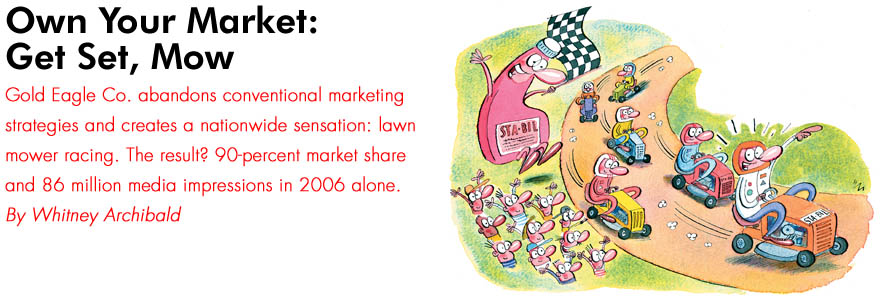
eady, Set, Mow! The Turfinator takes an early lead, with Sodzilla, the Lawn Ranger, and the Mowna Lisa close behind. The souped-up lawn mowers race around the 0.1 mile track for 20 laps at speeds up to 60 miles per hour. In the last lap, Chuck Miller (aka “The Boogie Woogie Man”) pulls ahead, becoming the new champion of the Sta-bil Keeps Gas Fresh Finals.
Founded on April Fools Day, 1992, the official United States Lawn Mower Racing Association (USLMRA) is more than just a bunch of NASCAR wannabes; it’s the key marketing strategy for Gold Eagle Co., a manufacturer of automotive aftermarket chemicals and specialty products.
It all started when the Chicago-based company wanted to raise brand awareness for Sta-bil, a fuel stabilizer for any motor that needs to be stored for more than 90 days. Marketing executives at Gold Eagle heard about the British Lawn Mower Racing Association and thought it would be a great way to promote lawn mowing and Gold Eagle products in the United States. The company hired Merton G. Silbar Public Relations Ltd. of Glenview, IL, to run the program.
To lend “real sport” credibility to the offbeat endeavor, Silbar formed the USLMRA, a nonprofit sanctioning body for the sport. The USLMRA is led mostly by the PR firm’s employees, which means Gold Eagle maintains control of the sport — and its promotional opportunities.
Bruce Kaufman, current president of the USLMRA, account director at Silbar, and self-proclaimed “Mr. Mow-It-All,” says, “The strategy was to promote Sta-bil Lawn Mower Racing as a genuine motorsports event but with tongue planted firmly in cheek. Our mottoes became ‘Live on the Cutting Edge’ and ‘Live to Mow, Mow to Live!’”
Racers in each of the six racing classes, from Stock Class (straight from the factory, 10 mph max) to the Factory Experimental Class (major modifications allowed, 60 mph max) adhere to a 20-page rule book and are inspected before each race to make sure they meet safety and eligibility standards. Blades are removed but the mowers must be otherwise suitable for mowing lawns. Drivers must be at least 16 years old and wear protective helmets and neck supports. And the only fuel additive allowed is Sta-bil fuel stabilizer.
As the sole sponsor for the event, Gold Eagle slathers the Sta-bil brand all over the sport, from the names of major races (“Sta-bil Keeps Gas Fresh Nationals”) to banners on the tracks. Racers are required to display a Sta-bil sticker on their mowers, and may also pick up stickers for Gold Eagle’s other brands at the registration desk at each race.
Gold Eagle’s innovative event marketing strategy follows what author and president of branding think tank Neutron LLC Marty Neumeier calls the new rule of marketing: “When everybody zigs, zag.” In his book “Zag: The #1 Strategy of High-Performance Brands,” he explains, “In a world of extreme clutter, you need more than differentiation. You need radical differentiation. Traditional differentiation is an uphill battle in which companies lavish too much effort on too few competitive advantages: the latest feature, a new color, a lower price, a higher speed. Radical differentiation, on the other hand, is about finding a whole new market space you can own and defend, thereby delivering profits over years.”
Fifteen years after the first race, there are more than 550 USLMRA members and 20 chapters nationwide, which host more than 110 sanctioned races. In 2007, the national race schedule includes 15 events.
Each race draws roughly 20 to 60 racers, and race fans number from a few hundred at local races, to about 2,000 at national races.
According to Kaufman, who can barely open his mouth without a lawn-mower pun escaping, Gold Eagle has “turned a weekend chore into a sport for sod warriors and turf titans from across the USA.”
greener pastures
Although participants and Gold Eagle have a sense of humor about the sport, the results for the company are anything but a joke. In 2006, lawn-mower racing generated 86.6 million media impressions for Sta-bil, a comparable value of $1.4 million in television and print advertising.
Media coverage has included such heavy hitters as The Wall Street Journal, The New York Times, USA Today, NBC Weekend Today Show, Autoweek, and Parade magazine. Races have been televised on The Outdoor Channel, ESPN2, Discovery Channel, Spike TV, and the GSN Network. The sport has also been featured on the TV show “Home Improvement” and in the movie “The Prince and Me,” and has recently been made into a video game, “Lawn Mower Racing Mania 2007.”
To date, the media return on investment for all brands has been 4 to 1 and Sta-bil sales have more than doubled during the last 12 years, resulting in a 90-percent market share.
In addition to the hard numbers, Gold Eagle has developed a die-hard loyalty among its customers. Fans and racers are fiercely loyal to the sport. Two former racers were even buried in their racing attire.
To Neumeier, who defines branding as “a company’s effort to build lasting value by delighting customers,” this is the key to Gold Eagle’s success. “There’s a zaniness to this concept that people find quite unique and engaging,” he says. “It feels exuberant and anti-corporate.”
The key “zagging” tactics that have brought Gold Eagle such success are building community, differentiation, harnessing a trend, communication, and extending success.
building customer community
The target markets for Sta-bil Fuel Stabilizer are homeowners, owners of outdoor power equipment, boaters, classic car and RV owners, and do-it-yourselfers, with a primary focus on married males between the ages of 27 and 54, with two cars and a family income of $30,000-$45,000 per year. Lawn mower racing fits this demographic like a driving glove.
“With any organization, any brand, you need to get into people’s heads,” says Bob Hirsch, CEO of Gold Eagle. “Lawn mower racing has been a good vehicle for differentiating our product. A lot of the awareness is in the rural areas where people have the time to go to something like this. They don’t draw thousands of people. But every time we have an event the local paper and radio stations cover it.”
Attendees and racers comprise an enthusiastic customer community for Gold Eagle — complete with colorful celebrities. Bobby Cleveland of Locust Grove, GA, the most decorated lawn-mower racing champion in USLMRA history, for example, has been racing lawn mowers officially since 1996, although he got his start much earlier.
“My family got our first riding lawn mower when I was just 9 years old. I cried all day because I wasn’t old enough to ride it. Soon I was timing myself when I mowed the lawn, trying to beat my record,” he says.
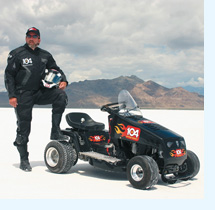
Now Cleveland actually holds the official land-speed record for lawn mowers: 81 mph. He achieved this milestone on July 4, 2006 at the Bonneville Salt Flats in Utah. He also holds the record for Monster Mower jumping (the lawn-mower version of monster trucks), and has won 75 first-place trophies, including nine national championships. Cleveland is modest about his fame: “It’s just enough to keep my ego up, but not too much to get me in trouble.”
Although lawn-mower racing has made him famous, it hasn’t made him rich. The USLMRA Web site explains its reward system: “We do not race for purse money!!! We race for FUN, trophies, points, and bragging rights, and sometimes for lawn ornaments! If any money is made available to racers, it is shared equally among every racer for gas money and to help with their expenses.”
The USLMRA holds races at county fairs and other community events primarily in cities with average populations of 15,000, ranging from Jonesboro AR, (population 69,358) to tiny Aroma Park, IL, (population 821). Attendance at the Nationals in Delaware, OH, averages about 1500 per year. The neighborly atmosphere at the events is intentional. As Neumeier says, “Every brand is built by a community.”
Part of what attracts the lawn-mower racing community is its low cost. Admission is free or minimal ($5 to $7), depending on the venue and event. Racers’ entry fees run from $0 to $20.
As Hirsch explains, “What’s nice about it is that people love to race. But racing can get expensive. Lawn-mower racing can be done on the cheap. You can just take your blade off and go out and race with the big dogs.”
Although entry fees are minimal, the sport can get expensive between travel costs and the extra parts racers buy to soup up their machines. To help defray the costs, the USLMRA encourages racers to find additional sponsors and even helps them with proposals. Of course, even racers sponsored by non-Gold Eagle companies must display a Sta-bil sticker on their vehicles.
Lawn-mower racing has become a family sport. “There are a lot of women involved, a lot of families involved — it’s a tight-knit group of racers,” Hirsch says. Races even include activities for kids, such as races on pedal tractors. Cleveland is now racing with the children of racers he started competing against when he first entered the sport.
To keep the members of its community in touch, the USLMRA also hosts an online forum at Yahoo! Groups, with 2,700 members averaging about 500 posts per month. Members post information about upcoming events, photos of races, questions about upcoming races and how to modify their mowers, and queries for spare mower parts. Mostly, they log on to chat and keep up with the latest racing news.
The community continues to grow and become even more fanatical, with some racers attending up to 16 races a year. Cleveland says, “I’ve met so many good people. Nobody’s rich and famous, they’re just good ole boys and girls.”
differentiation
Before 1992, Gold Eagle’s marketing strategy was much like the strategies of its competitors, including tactics such as print advertising. Lawn mower racing has enabled it to differentiate itself from competitors to win 90 percent of the market share for fuel stabilizer.
Neumeier says, “‘Onliness’ is the true test of the zag. If you can’t say you’re the ‘only,’ go back and start over.” He suggests that every company should be able to write a concise statement identifying its unique place in its market.
According to Neumeier’s formula, Gold Eagle’s “only” statement is this: “Gold Eagle is the only manufacturer of aftermarket automotive chemicals that sponsors a racing association for riding-lawn-mower owners across the United States who want to race in an era of speed and competition.”
ENGINE ANSWERMAN
In 2005, eight-time Sta-bil National Lawn Mowing champion Bobby Cleveland became Gold Eagle’s official Engine Answerman. He now tours the country promoting Gold Eagle products and doling out advice about anything with a motor.
Cleveland parks Gold Eagle’s custom, 72-foot, 18-wheeler at classic car, boat, and RV shows; motorcycle rallies; fishing tournaments; NASCAR, National Hot Rod Association, and U.S. Lawn Mower Racing Association races; and major retailer events — a total of 40 events in 2006. At each stop he displays his two racing lawn mowers, his custom Monster Mower, a Harley-Davidson motorcycle, a personal watercraft, lawn care equipment, and an ATV and distributes Gold Eagle product samples and brochures. “I get paid for playing around with lawn mowers,” Cleveland says. “You can’t get any better than that.”
On July 4, 2006, Cleveland was also the main attraction for a landmark Gold Eagle media event when he set the land speed record for lawn mowers — 81 mph — at the Bonneville Salt Flats in Utah. The record 81 mph ride was featured in 23 publications, and on 392 television programs, including MSNBC, CNN, and Good Morning America.
Harnessing a Trend
The USLMRA owes much of its success to the nation’s speed addiction. Fueled by marketing juggernaut NASCAR (which has attracted 75 million fans and become the undisputed champion of corporate sponsorships), motorsports continue to rev Americans’ passions. “Research told us that motorsports is a significant growth area of American interest, but the cost of participating in motorsports is high,” Kaufman says. “We discovered Americans want inexpensive and fun amateur racing.”
According to Neumeier, trendiness is essential to Gold Eagle’s branding strategy. “You can certainly build a brand without harnessing a trend, but you won’t get the raw, youthful energy of a zag. When focus and differentiation are powered by a trend, the result is a charismatic brand that customers wouldn’t trade for love or money. It’s the difference between paddling a surfboard and riding a wave.”
The USLMRA also rides the corporate philanthropy trend — a portion of the proceeds from racing entry fees go to nonprofit organizations, including the Les Turner ALS Foundation and the American Cancer Society.
communications
Media coverage for USLMRA racing started off with a bang. The first race was featured in such heavy hitters as The New York Times, The Wall Street Journal, USA Today, The Washington Times, and the Los Angeles Times.
Since then, the series — and Sta-bil — has received national and local news coverage in countless print and television spots. Gold Eagle’s PR partner Silbar works with Joyce Julius and Associates Inc., a research firm that measures media exposure for sports-sponsorship programs, to calculate the marketing impact of the racing series. Joyce Julius tracks all media coverage, then calculates the number of impressions based on the audience of each television program (based on Nielsen ratings) and the readership of the print publications (based on circulation). It then determines the equivalent cost of advertising during the particular television programs and in the publications to determine the dollar value of the exposure.
In 2006 alone, Sta-bil was featured in 70 print articles, including twice in The New York Times, generating 6,087,915 impressions at a value of $98,319; and six television news segments, including one in France, generating 11,992,842 media impressions worth $193,684.
In addition to news broadcasts, lawn-mower racing has been featured on its own television specials since 1995. The very first televised race, on the Prime Sports Channel, came about because a television producer in Los Angeles fell in love with lawn-mower racing and asked if Gold Eagle wanted to televise a race. All the company had to do was pay the production expenses.
Since then, races have been featured on ESPN2, ESPN Classic, the Outdoor Channel, Spike TV, and the GSN. It was also the subject of a one-hour Discovery Channel documentary, “Turf Rockets: The Cutting Edge.” “The Prince and Me,” a Paramount Pictures movie, featured a five-minute lawn-mower racing segment, amounting to free product placement for Gold Eagle. The USLMRA offered technical consulting for the film and ensured that sponsor banners and signage were prominently displayed.
Lawn-mower racing has even hit toy stores. In May 1997, Mattel Inc.’s Hot Wheels released the “Home Improvement Action Pack,” featuring the Sta-bil Nationals logo on the packaging and a toy model of the sport’s first pace mower, The Dixie Chopper Jet Powered Mower.
In 2007, the USLMRA released a video game for Microsoft Corp.’s Xbox and PCs called “Lawn Mower Racing Mania 2007.” Players race on 18 different tracks against legends such as Angelina Mowlie, the Lawn Ranger, Weedy Gonzales, and Mr. Mowjangles. “Inventing a public sport for the purposes of building a corporate brand takes enormous skill,” says Neumeier. “If Gold Eagle had been too heavy-handed, it would have looked commercial instead of grass roots, which turns off not only potential customers but also the media that gives you free coverage.”
extending the success
Gold Eagle has extended the success of Sta-bil branding at the events to its other brands, offering decals of its other brands, such as HEET Gasline Antifreeze and No Leak, for racers who want to decorate their machines.
The lawn-mower racing events also opened the door for the Gold Eagle Engine Answerman Tour and a record-setting press event at the Bonneville Salt Flats in Utah.
Neumeier says, “When you’re able to transcend ‘business as usual’ by surprising your customer — by zagging — you have a chance to create a charismatic brand for which people believe there is no substitute.” To put it simply, Gold Eagle’s marketing strategy kicks grass. e