| |
AT A GLANCE
Corporate Objective
Grow the information-security market; insure RSA Security Inc.’s leadership position
in the field.
Strategy
Position the annual conference as the premier education and networking event in the industry.
Tactics
Drive event innovation and design by rigorously and scientifically observing and analyzing customer behavior in all areas of the event experience.
Result
Attendance grows an average of 15 to 20 percent each year, and the number of exhibitors grew by 28 percent from 2006 to 2007. |
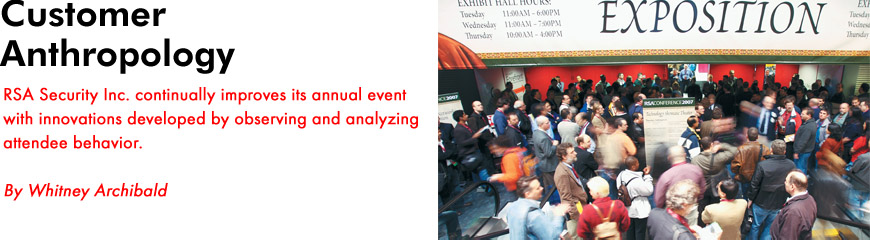
 t’s opening day of RSA Conference 2007. The event’s 17,000-plus attendees have started to stream into the Moscone Center in San Francisco. And the RSA Conference team is watching them. t’s opening day of RSA Conference 2007. The event’s 17,000-plus attendees have started to stream into the Moscone Center in San Francisco. And the RSA Conference team is watching them.
Phyllis MacIsaac, vice president of strategy and measurement for Stone Mountain, GA,-based event company Nth Degree Inc., observes as the information-security professionals who attend the conference stage impromptu meetings in the hallways, holding animated conversations about hackers, security threats, and the best places to eat in San Francisco. That kind of networking is exactly what RSA hopes will happen at the event.
But MacIsaac doesn’t dwell on the positive, at least not this week. As she looks at the hallway scene, she sees two men balancing their laptops on top of a trash can, trying to share some files. She sees a group of four sitting in a hunched circle on the floor. She sees a woman awkwardly balancing a coffee cup, a bagel, and her conference bag as she chats with another attendee.
MacIsaac quickly calls for reinforcements. Soon event staff set up circular tables and chairs on one side of the wide hallway. The main corridor now doubles as a comfortable meeting place for attendees.
This may seem like a small detail, but to the RSA Conference team, comprising staff from both RSA Security Inc. and Nth Degree, anything they can do to help attendees achieve their objectives — preparing for the future, improving decision support, learning about industry best practices, and networking, according to event surveys — is a victory.
field notes
Throughout the conference, each team member becomes a customer anthropologist, a kind of Jane Goodall observing attendee behavior as they go to classes, visit the exhibits, and participate in networking events and special sessions. These observations help the team find the most effective ways to improve the event and the attendee experience each year.
Their success is apparent to anyone who knows the event’s history. The RSA Conference began in 1992 as a humble gathering for 50 cryptographers at a hotel in Redwood City, CA, to discuss e-commerce security. Since then, attendance at the event, hosted by RSA Security Inc., a division of information-management company EMC Corp., has grown between 15 and 20 percent each year. In 2007, RSA Conference attracted more than 17,000 industry professionals, from cryptographers to computer programmers to C-level executives.
The week-long event now includes 220 educational seminars, 350 exhibitors (up from 272 in 2006), a C-level forum, and a variety of other industry meetings and activities. The event has also expanded globally, with annual conferences in Europe and Japan.
RSA Conference helps RSA achieve two of its main corporate objectives. First, RSA wants to grow the information-security marketplace. Sandra Toms LaPedis, general manager and area vice president of RSA Conferences, says, “The purpose of the conference is really to grow understanding and knowledge for all information-security professionals. By growing that knowledge, we’re also helping to grow the market overall.”
Second, RSA wants to position itself as a central and important resource for industry education. “The conference gives a halo effect to the RSA brand,” LaPedis says. “It shows attendees that RSA is a trusted brand that will provide unbiased information. As a result, our customers look at us as a consultative company.”
RSA achieves these objectives by making the event what LaPedis calls a “living laboratory,” constantly innovating to improve the event and the attendee experience. RSA compiles exhaustive research after each event, including focus-group and survey results on everything from the exhibit hall to the food, demographic and attendance statistics, and competitive analyses.
But perhaps the most valuable research technique the RSA Conference team employs is on-site observation, an approach that design-innovation firm IDEO’s general manager Tom Kelley identifies as anthropology in his book, “The Ten Faces of Innovation,” (Doubleday, 2005). Kelley defines the corporate anthropologist as someone who “brings new learning and insights into the organization by observing human behavior and developing a deep understanding of how people interact physically and emotionally with products, services, and spaces.”
anthropology 101
The anthropological approach to event evaluation may not seem new. Most event managers pay attention to what is happening on site. They hold focus groups. They listen to attendees and design their events based on what they learn.
But, according to Robert Lowe, vice president and event architect at Nth Degree, “Measurement as it’s typically done in the event industry can only get you so far. You can ask a question in different ways, but you’re going to get similar types of answers: They didn’t like the food, and they want more networking opportunities. An anthropological approach helps us really understand these people — not just what their answers are, but why they’re answering that way.”
What makes the RSA Conference team’s approach different is that they make customer anthropology a conscious priority during the event and conduct their observations scientifically. “You have to pretend you’ve never been to a conference,” LaPedis says. “What are people trying to do here? What are people seeing? Where are they getting stuck in the system, and what are they doing about it? What are the pain points? What is frustrating people?”
According to Lowe, this means putting your ego aside. “You have to realize that the system that you just spent six months to implement might not be the perfect system. It’s not about whose idea it was, it’s about what’s best for the attendees,” he says. For the 2007 conference, for example, the team developed a networking game for the welcome reception. “No one played it, and there was still plenty of conversation,” LaPedis says. “We really didn’t need to do it.”
delegating details
All members of the conference team are expected to monitor attendee behavior and record observations throughout the event. However, to ensure that all areas of the event environment are thoroughly covered, the team splits the conference activities into specific observation assignments.
These team members watch for specific attendee behaviors such as traffic patterns, their interactions with event staff and other attendees, and the time they spend at each activity. “The Anthropologist looks for insights where they are least expected — before customers arrive, after they leave, even in the garbage, if that’s where learning is to be found,” Kelley writes. “They look beyond the obvious, and seek inspiration in unusual places.”
For example, at least one team member is assigned to the registration area each year. In 2006, the registration anthropologist recognized that attendees were growing frustrated and impatient as they waited in one line to receive everything they needed for the event, including their badges, bags, and conference information.
After the event, the team devised a solution. First, they eliminated a photo requirement for badges. Then, they reconfigured the registration process. They added more self-registration areas to speed wait times, and broke up the process into several steps. Now attendees wait in different lines for each item separately. For example, after they register, by the time they approach the badge window their badge is already printed. Now, the lines are shorter, and the team has observed that attendees seem much happier with the new approach. The total time attendees spend in line tends to be about the same, but the lines move faster, and if attendees don’t want to get everything at once, they don’t have to stand in every line.
Lowe’s favorite observation technique is singling out individual attendees. “I pick a person and literally walk behind him to see what he’s doing,” he says. “You can ask people if the hall signage is good on a scale from one to five. But when I saw a guy stand there, scratch his head, and look right and then left, I knew that the signage was not working.”
This year, RSA added a new observation technique. It hired analyst Martin Smith from Ethnometrics Corp., a customer-experience consulting firm, to set up video cameras throughout the exhibit hall to monitor traffic patterns, spot obstacles that impede attendee-exhibitor interactions, and record how welcoming exhibitors are to attendees. RSA will use the information to better design its exhibit hall next year and to train exhibitors to interact successfully with event attendees.
cultural observations
“Cryptography: That’s Hot.” “Security — Everybody’s Doing It.” “Brainy: The New Black.” “I Read Your E-mail.” Attendees at the 2007 event could choose from badge ribbons with these and other humorous phrases. Tongue-in-cheek components such as these help RSA develop a sense of community among attendees, and help them feel connected to the larger industry. These connections have helped RSA develop a cult-like following for the event so attendees keep coming back year after year.
This celebration of industry culture evolved through RSA’s anthropological observations of attendees’ preferences, attributes, and even quirks. For example, team members noticed that many attendees wore T-shirts from past events — a kind of badge of honor showing their event and industry history. To support these collectors, in 2005 RSA built a store on site that sells RSA Conference-branded T-shirts, jackets, hats, and other paraphernalia, such as thumb drives.
To understand the concerns and pain points of its attendees, RSA conducted a survey in the fall of 2006 and asked attendees, “What are your top technology, work, and business concerns?” As LaPedis read the responses, she realized, “These people have a really hard job. Management doesn’t understand the need for security until something happens.”
The team translated these serious concerns into customized entertainment at the 2007 show, designed to help attendees realize that they were part of a community that understands their daily stresses. At the opening session, after a short video explaining the historical event theme, a group of monks solemnly trudged onto the stage. Suddenly the music started, and they sang and danced to the song, “Under Pressure,” rewritten with cryptographer-specific and humorous lyrics.
“The opening song was an anthem for our customers,” LaPedis says. “These guys are on the front lines trying to protect their companies from negative PR. That’s a lot of pressure. The song encapsulated that perfectly. That’s how they feel.”
RSA also relies upon cultural and social observations to refine networking and social events so that attendees feel comfortable, enjoy themselves, and, most importantly, form valuable relationships with other attendees. It holds a gala event on the fourth day of the event called the RSA Conference Codebreakers Ball, developed with attendees’ social attributes and quirks in mind.
The team has found that attendees like having a choice between several different environments at the event, one with a live band for dancing, one area with comfortable places to sit and talk, and another with activities such as tarot-card readings or caricature artists.
Among the informal measures of the cultural success of the ball is that it made YouTube.com. A search for RSA Conference reveals a prominent attendee performing “enthusiastic” dance moves at the gala event.
observation to innovation
In May, three months after each annual event, the conference team regroups for a three-day retreat it calls Boot Camp, to turn their observations and event research into innovations for the next year’s RSA Conference.
At Boot Camp, the team evaluates the innovations they implemented at the recent event, discusses problems that became apparent through observations and other research, and brainstorms ways that they can improve the event for the next year. When evaluating the event, the team tries to put aside any preconceived ideas of how they expected attendees to react. According to IDEO’s Kelley, this is an important part of the anthropology process. “Anthropologists embrace human behavior with all its surprises. They don’t judge, they observe. They empathize.”
In 2004, for example, team members noticed that many attendees were awkwardly balancing laptops on their knees during the keynote speeches as they took notes, surfed the Web, or checked e-mail. This was not only uncomfortable for them, but distracting to other attendees. But instead of asking attendees to shut off their laptops out of consideration for their neighbors, the RSA team recognized that the laptop use reflected a fundamental aspect of their attendee culture. “These attendees are used to multi-tasking,” says Lowe. “They check e-mail while they watch TV. They have two or three computer screens on at once while they work.”
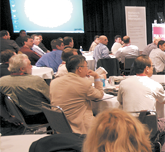
The solution the team devised was Laptop Lane — a row of tables set up in the general assembly hall where attendees can use their laptops comfortably throughout the keynotes.
This year, one item on the Boot Camp agenda is the Interactive Testing Challenge, in which attendees compete to identify the security vulnerabilities of a fictional Web site. On-site observations revealed that the challenge was not as successful as in 2006. The team will evaluate the location of the competition, the way they market the activity before and during the event, and even the name.
a proven path to improvements
Over the years, the team has, through its Boot Camp process, come up with several other innovations that help make the attendees’ experiences more educational, useful, convenient, and comfortable. Here are some examples:
 Session replays. Since attendees have expressed frustration about missing sessions due to scheduling conflicts, RSA makes keynotes available through Webcasts after
the event, sells MP3 files of each educational session, provides a CD with PowerPoint presentations from the educational sessions, and rebroadcasts keynotes at several locations and times throughout the event. Session replays. Since attendees have expressed frustration about missing sessions due to scheduling conflicts, RSA makes keynotes available through Webcasts after
the event, sells MP3 files of each educational session, provides a CD with PowerPoint presentations from the educational sessions, and rebroadcasts keynotes at several locations and times throughout the event.
Event-navigation tools. Before the event, attendees can use the RSA Conference Web site to build, save, and print daily schedules. At the event, they can log on to Knowledge Kiosks scattered throughout the venue to do a Google-esque search for a topic such as “biometric authentication,” if they want to know what sessions and exhibitors addressed the topic.
“The show is getting bigger, so we need to make it feel smaller and easier to navigate,” Lowe says. “We could have put information desks around the event. But these attendees aren’t the kind of people who will walk up to an information booth and ask a question. Where are they more comfortable finding answers? The computer.”
Educational formats. From town-hall meetings (RSA’s version of Q&A sessions on controversial topics), to panel discussions, keynote sessions, peer-to-peer sessions, the Interactive Testing Challenge, and exhibitor-led sessions on the show floor, the conference team is constantly testing new formats and refining current ones.
Networking. Because attendees consistently rank networking as one of their key objectives at the event, RSA has developed networking receptions, networking areas throughout the event, and a special session about networking skills on the first day of the event, taught by a networking expert.
Themes. To help contribute to the culture of the event and the industry itself, the team develops a theme for each event based on a different cryptographer in history. The 2007 event featured a renaissance theme, based upon the “Father of Western Cryptography,” Leon Battista Alberti. Past themes have featured Mary Queen of Scots, who devised a code to communicate with her co-conspirators in a plot against Queen Elizabeth; and rum runners during the U.S. prohibition era, who took advantage of advances in short-wave radio technology to plan their smuggling runs.
The constant improvement that results from the team’s dedication to customer anthropology has made RSA Conference the must-attend event in its industry, with attendance up more than 20 percent in 2007 alone.
One unexpected benefit of the anthropological approach is that it not only helps keep the event fresh and exciting for attendees but for the conference team as well. As LaPedis says, “Even though we have an outsourced model for the conference, I feel like I get so much of the team members on a discretionary basis. They’re e-mailing me on the weekends. We’re all infected with this enthusiasm for figuring out what we can do to make it better.” e
|
|
RSA CONFERENCE INNOVATIONS
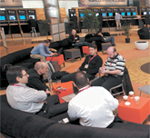
North Lobby
To accommodate attendees’ many impromptu hallway meetings, RSA added tables and seating.
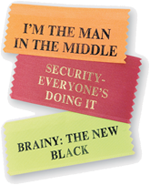
Badge Ribbons
RSA recognizes the unique sense of humor of its attendees with tongue-in-cheek, collectable badge ribbons which sport sayings such as, "I read your e-mail."
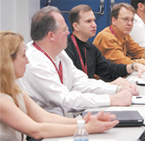
Peer-to-Peer Groups
The team added more sessions to alleviate overcrowding and earned better reviews.

Conference Store
To support the event’s cult following, RSA now sells branded clothing and gear on site.
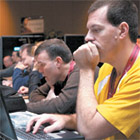
Laptop Lane
RSA added rows of tables in the general-assembly hall to better accommodate laptop users during keynote sessions.

Exhibitor Award
To improve exhibit quality, RSA started an attendee-judged awards program.
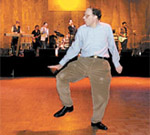
Codebreaker’s Ball
RSA celebrates attendees' culture at an annual gala reception.

Conference Theme
Each year, the RSA Conference features a theme that connects to an historical cryptographer, such as "The Father of Western Cryptography," Leon Battista Alberti, for 2007.

Founders’ Lounge
RSA honors attendees who have attended seven or more events with the word “Founder” on their badges and a lounge where they can escape throughout the event to enjoy refreshments and mingle with other veterans.
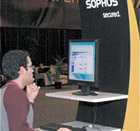
Knowledge Kiosk
Self-serve kiosks let visitors find specific event information.
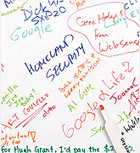
Conversation Wall
Attendees could write their ideas and opinions on a large wall that included questions such as “What's your biggest security threat?”.
Crypto Commons
A special lounge for those who attend both the conference and the expo features keynote-speech broadcasts, a snack bar with light refreshments, laptop stations, and space to just relax.

MP3
All conference sessions are recorded and made available for purchase as MP3s after the event.
|