Case Study |
 |
 hen it comes to country music, people typically fall into one of two categories. They either love it or they hate it. Similarly, when it comes to prospects for Nashville, TN,-based Healthcare Management Systems Inc. (HMS), it’s either a match made in health-care heaven or a mismatched duet more akin to Marilyn Manson and Martina McBride.
That’s why HMS, which provides hospital-management software for small community and rural hospitals, had specific attendees in mind when it saddled up for the 2006 Healthcare Information Management Systems Society (HIMSS) show. And marketing manager Christy Wright had her achy breaky heart set on finding them.
According to Wright, HMS primarily targets small, rural hospitals with fewer than 200 beds, with the vast majority of the company’s clients representing hospitals with fewer than 100 beds.
“There were more than 20,000 attendees at the 2006 HIMSS show, of which only about 3,000 fit within our target audience, so it was truly like looking for
a needle in a haystack,” Wright says.
|
On Stage With HMS
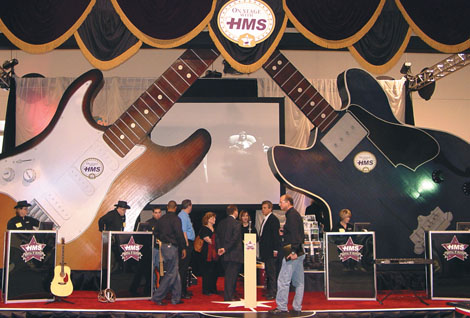
To stand out from the crowd at the 2006 HIMSS show, Nashville, TN,-based Healthcare Management Systems Inc. adopted a country-music theme for its 800-square-foot booth. |
At this show, the most expensive show on HMS’s annual calendar, Wright and her team were limited to an 800-square-foot booth, a far cry from the 17,000-square-foot exhibits that dominate the show floor at HIMSS. “We were definitely one of the smaller exhibits on the show floor,” Wright says. Afraid of being lost in a sterile sea of 900 blue, chrome, and white health-care services booths sponsored by industry behemoths, HMS knew it needed to stand out from the crowd if it wanted to seize the spotlight.
“We had to find a way to get noticed,” Wright says. “We are a small fish in a big pond when it comes to hospital-management software, and we were looking for a very specific customer. We couldn’t afford to look like everyone else, or we’d get passed by.”
Further complicating matters was the fact that the company’s target audience often gets overshadowed by attendees from large hospitals, and intimidated by the countless mega-exhibits marketing pricey solutions for larger establishments. As a result, the 3,000 needles in the HIMSS haystack are increasingly elusive as they often actively avoid conversing with booth staff for fear of being dismissed for other attendees with bigger budgets. “Our goal was to filter out the large hospitals while finding and focusing in on the small rural hospitals in hopes of obtaining a more qualified group of booth visitors,” Wright says.
Ultimately, HMS hoped to generate three highly qualified leads, resulting in at least one new contract worth $500,000.
With that in mind, Wright and her team set out to create an exhibit that would stand out like Dolly Parton at an Eminem concert, attracting targeted attendees and making them feel like the true stars of the trade show.
Boot Scootin’ Booth Theme
With the odds stacked against them, no one would have blamed Wright and her team for singing the blues. But they had a different tune in mind — one that was sure to resonate with HMS’s target audience while branding the company as the Nashville-based answer to all rural hospitals’ needs.
Early in the planning process, Wright and her team began drawing similarities between Nashville’s popular music showcases, traditional vehicles staged for up-and-coming singers, and what HMS hoped to do with its booth. The music showcases in and around Nashville are attended by music-industry bigwigs and feature performances by country-music amateurs hoping to score recording contracts. According to Wright, the country-music theme was a perfect fit, as HMS wanted to showcase its products in front of healthcare professionals at HIMSS in hopes of securing a contract as a direct result of the show.
Wright quickly adopted the theme, “On Stage with HMS — The Rural and Community Hospital IT Showcase,” for the company’s presence at the 2006 show. “A country-music theme was a natural choice,” Wright says. “HMS is headquartered in Nashville, home of the Grand Ole Opry, and country music is often associated with rural America. Therefore, we felt our target audience would be very interested in this type of atmosphere.”
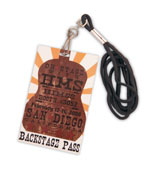
Prior to the 2006 show, the 3,000 targeted attendees received pre-show mailers containing “backstage-pass” lanyards and survey cards with questions about their current software providers, interest in new software vendors, and purchasing time frames. While the survey cards were intended to delve into attendees’ needs, promising a rare photo op with a surprise guest star in exchange for returning them to the booth, the backstage passes did triple duty: They introduced attendees to the theme, promoted an in-booth cowboy-hat giveaway, and helped attendees pre-qualify themselves before setting foot on the show floor.
|
 |
 |
 |
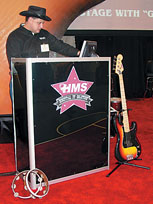
Four software-demo stations were positioned on stage alongside real country-music instruments. |
Prior to the show, HMS sent targeted attendees backstage-pass lanyards that introduced the country-music theme and promoted an in-booth cowboy-hat giveaway. |
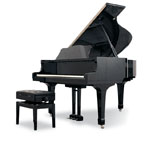
In the “backstage” area of the exhibit, VIPs met with staffers around baby grand pianos that doubled as conference tables. |
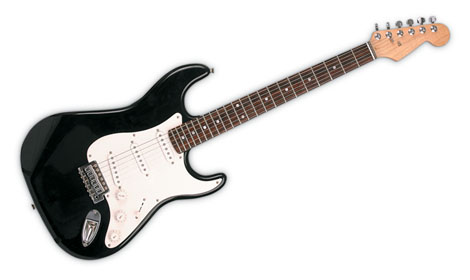 |
Two 17-foot-tall guitars separated the two halves of the booth. A 100-square-foot screen between the guitars ran country-music videos and the HMS logo between songs.
|
|
 |
 |
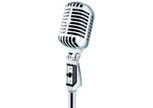
A vintage radio microphone positioned at center stage marked the location where attendees would stand and smile for a photo with a Garth Brooks look-alike. |
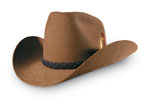
Once on site, targeted prospects exchanged completed survey cards for cowboy hats with the HMS logo on the band.
|
Booth staffers in the exhibit wore blue jeans, black polo shirts with the HMS logo, cowboy boots, and cowboy hats. |
According to Wright, “The goal with the backstage passes was to make the rural and community-hospital attendees feel like VIPs, secure in the knowledge that they were the only people that met the criteria necessary to go ‘On Stage with HMS.’” To accomplish that objective, the backstage passes were printed with the exact qualifying criteria that defined HMS’s target market, a critical component in helping HMS find the sought-after needles and eliminate the unwanted hay.
The Grand Ole Exhibit
“The Ryman Auditorium is the mother church of country music,” notes Carmelo Roman, artistic director of Gary Musick Co., the company that designed the HMS booth. With Ryman as her primary source of inspiration, Roman divided the space to create a two-part exhibit with a Grand Ole Opry feel. The first half of the exhibit became the “stage” area, replete with authentic touches such as heavy, red-velvet curtains drawn back, a vintage radio microphone on a stand at center stage, and even a star to mark where the “performer” would stand. According to Wright, the stage was so authentic that several attendees stopped and asked who the entertainment was and when they would be performing.
The other half of the booth was the “backstage” or VIP area, where attendees with the appropriate VIP credentials (backstage-pass lanyards attendees received in the pre-show mailers) were invited to meet with booth staff and discuss their software needs over two baby grand pianos that doubled as conference tables. The pianos even had tip jars on them with a few dollar bills stuffed inside for a little extra authenticity.
Booth staffers in the exhibit dressed the part, wearing country-music “uniforms” consisting of blue jeans, black polo shirts with the HMS logo, cowboy boots, and cowboy hats. Even the setup crew got in on the act, creating buzz before the show opened by wearing black T-shirts that said “Stage Crew” on the back.
The unquestionable focal point of the exhibit comprised two 17-foot-tall guitars, which separated the two halves of the booth. Between the giant guitars was a 100-square-foot video screen that played country-music videos and displayed the HMS logo between songs.
“Our exhibit was so very different from all the other exhibits,” Roman says. “They were sleek and metal and chrome. It felt good to me as a designer when people would look up and notice we were different and interesting. Everyone needs an edge in sales promotion, and ours was to be different than what people expected.”
Cowboy Hats and Has-Beens
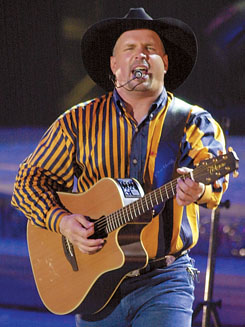
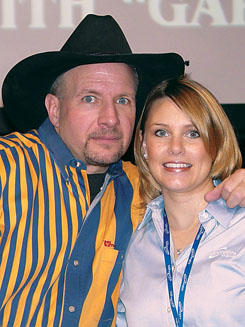
The moment the show opened, the larger-than-life guitars began drawing attendees like cowboys to a country-western saloon. Targeted prospects exchanged their survey cards for free logo-adorned cowboy hats, and donned their lanyards, which were used as admission tickets to come up on stage and pose for a picture with a Garth Brooks look-alike. “With Garth Brooks’ status as the best-selling solo country artist of all time, we chose this look-alike because we knew he would be the most recognizable music artist among the attendees,” Wright says. “His resemblance was uncanny, and his presence at our booth drew quite a crowd.”
According to Wright, nearly all of the top prospects came up on stage for the faux-celebrity photo op, and more than a few were surprised to find out they had not met the real Garth Brooks. At one point, she says, an HMS “stagehand” escorted the Brooks doppelganger around the show floor, to a chorus of requests for autographs. A colleague sent Wright an industry blog entry from after the show in which an attendee wrote that his HIMSS highlight was “getting Garth Brooks’ autograph, even the has-been that he is.”
After posing with the look-alike, attendees received a commemorative Polaroid inside a branded cardboard photo frame. Wright says both the cowboy hat and the autographed photos were high-demand giveaways at the show. “The giveaways were an important part of our success,” she says. “They were tangible things that people could keep to remember their experience with HMS after they left the show.”
|
 |
 |
|
Celebrity Apperance
After posing with a Garth Brooks look-alike, top prospects received autographed Polaroids inside branded cardboard photo frames. The look-alike was so convincing that many attendees were surprised to learn they had not met the real Garth Brooks. |
From there, attendees moved on to one of four on-stage demo stations. To reinforce the “On Stage with HMS” theme, Roman positioned real instruments in front of each of the demo stations, giving passersby the impression that the attendees engaged in software demos were actually musicians preparing for a live jam session.
Following a demonstration at one of the stations, interested attendees were invited to the backstage piano-bar area. There, two flat-screen monitors positioned near the baby-grand conference tables offered more in-depth information on HMS and its offerings.
In addition to the cowboy hats and autographed Polaroids, attendees who completed information cards were entered in daily drawings for music-related prizes ranging from an iPod to an Epiphone guitar valued at $400.
Bottom-Line Line Dance
With an overall budget of only $140,000, including all pre-show mailings and advertising, Wright considers the company’s results from the 2006 HIMSS Show an excellent return on investment. “We more than tripled our initial goal,” Wright says, crediting that success to the uniqueness of the booth, creativity in promotional items, and the company’s ability to successfully target its intended audience.
In the end, HMS’s unexpected country-music theme struck a chord with targeted attendees. In addition to a 50-percent increase in booth traffic, the company generated 10 high-quality leads, a 233-percent increase over the previous year’s lead count. Furthermore, shortly after the show, one of those leads resulted in a contract worth $1.7 million, more than three times the initial goal of $500,000. Since then, HMS has scored two additional contracts, both directly attributable to the company’s country-western booth. With results like that, you can be sure HMS did the boot scootin’ boogie all the way to the bank. e
|
|
|
|
 |
|
|