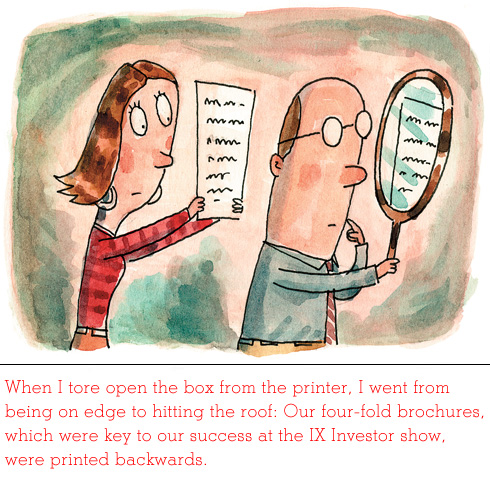
Backwards Brochures
 My company, a financial news and analysis service, had big plans for its first international show, the 2007 IX Investor show in London. But when our booth literature came out backwards, I decided to turn a would-be international incident into a marketing masterpiece by playing off our goof and the No. 1 difference between U.S. and U.K. driving rules. My company, a financial news and analysis service, had big plans for its first international show, the 2007 IX Investor show in London. But when our booth literature came out backwards, I decided to turn a would-be international incident into a marketing masterpiece by playing off our goof and the No. 1 difference between U.S. and U.K. driving rules.
In the weeks leading up to the show, our printer had been a bit slow delivering our booth literature: a tri-fold brochure we typically handed out to all attendees along with a pen, and a four-fold brochure we gave to attendees who showed real interest. While you can sometimes leave your literature at home, we felt our four-fold brochure was a vital instrument for educating attendees on the financial services our company provides.
Knowing that a trip across The Pond was a sizeable marketing investment for my company, I was already on edge when the print order finally arrived a mere two days before our trip. But when I opened the box from the printer, I went from being on edge to hitting the roof: Our four-fold brochure was printed backwards — when looking at the front, the brochure opened from the left side instead of the right.
After venting some frustration at the printer, I needed to make a quick decision about what I would do with 3,000 backwards booklets, which were key to our success at the show.
 Unfortunately, ordering reprints just wasn’t an option. Our original printer had already bungled the job, so
I didn’t want to have it attempt a rush job, and I didn’t have time to find a new printer either. Unfortunately, ordering reprints just wasn’t an option. Our original printer had already bungled the job, so
I didn’t want to have it attempt a rush job, and I didn’t have time to find a new printer either.
Then it hit me. To the Brits, we drive on the wrong side of the road. Why not open our brochures on the wrong side, too?
So we simply flew off to England with our backwards brochures in tow. With heads held high, and upper lips stiff — we were in England now, after all — booth staffers handed out the backwards brochures and in doing so told attendees, “You guys drive on the wrong side of the road, so we printed these backward for you.” The line made us memorable, and gave us a chance to laugh at ourselves with the attendees, who all felt a bit of sympathy for our situation.
After the show, we discovered that our backwards brochures had made us about as memorable as a car driving down the wrong side of the road in rush-hour traffic. Reminding leads of our goof during post-show sales calls turned out to be a great ice breaker, and a nifty way to help attendees recall our company and their experience in our booth. So I guess it just shows that generating memorability — even for the wrong thing — is always helpful in the end.
— Jessica Kurjakovic, sales and marketing director, Trade The News, New York
A Tale of Two Stories
Working ahead of schedule often seems like a luxury in the trade show industry, but when show management nixed our new custom booth design for the 2008 Photo Marketing Association (PMA) expo in Las Vegas, the time cushion I’d built into my exhibit design calendar for peace of mind felt more like an air bag that saved us from a potentially fatal crash.
As marketing communications manager for camera-bag manufacturer Lowepro Worldwide, I knew our new booth would present problems for our designer, Peter Gallagher at Cyclonix Inc. With demands such as eight meeting rooms and secure, private areas for dealers juxtaposed against a request for enough space for 300 products and clear sightlines — so our security could monitor merchandise that often mysteriously grew legs and walked out of previous booths — Cyclonix would need time to come up with something creative.
Fortunately, after about a month on the project, Cyclonix delivered plans for a two-story design that allowed for easy merchandising on the lower level and maximized meeting space on the second story.
Our plans had ticked along like clockwork until show management pointed out the error of our ways — and our exhibit design — during a conference call about our booth space. Despite the fact that the Las Vegas Convention Center has hosted oodles of two-story exhibits in the past, management for our particular show had just implemented a single-story rule, and I had missed the rule change.
Needless to say, this rule came as a nasty shock to us. After more than a month of work on our perfect two-story exhibit, show management sent us back to the drawing board. Even worse, we went from a cushy timetable on the project to a nail-biting, high-speed race to finish the design in time. With just over a month left, Peter’s team had to develop a whole new exhibit design concept, meet
all my needs, and get my final approval before his company could start building the exhibit.
Eventually accepting our fate, Peter and his team at Cyclonix began brainstorming about our limited design options. Our biggest concern was finding enough space for all of the meeting rooms without completely blocking off the sight lines or drastically reducing space in the public area needed to display all our products effectively. In addition to U.S. distributors, the show attracted many of our international distributors, all of whom were scheduled for long meetings during the show. The original booth design had eight meeting rooms to accommodate the nearly 60 meetings — including about 30 for the overseas crowd alone.
Somehow managing to work our redesign into his already overbooked calendar, Peter came up with a design that gave us five meeting rooms in the one-story space along with plenty of merchandising space and the clear sightlines that would keep our products in full view. To make up for the three missing meeting rooms, I booked a hospitality space at the Renaissance Hotel adjacent to the convention center and moved all of our international meetings there.
In the end, I gave final approval to Peter’s new one-story design just in time to get us back on schedule to have the new custom exhibit built; plus, the meetings at PMA went off without at hitch. The only thing that left me shaking my head was that our one-story booth ended up being 20 feet tall — about the same height as our original two-story plan — but show management never had a problem with it.
— Sam Marsh, marketing communications manager, Lowepro Worldwide, Sebastopol, CA
|