presentation |

|

 entists typically spend most of their days educating patients about the benefits of good oral hygiene. But the tables were turned at the 2006 American Dental Association Annual Session and Marketplace Exhibition in October, where dentists became the pupils as they walked the show floor listening to company pitches and presentations. entists typically spend most of their days educating patients about the benefits of good oral hygiene. But the tables were turned at the 2006 American Dental Association Annual Session and Marketplace Exhibition in October, where dentists became the pupils as they walked the show floor listening to company pitches and presentations.
Colgate-Palmolive Co. aimed to take advantage of this role-reversal and educate dental professionals about the benefits of its Colgate Total toothpaste.
Even after a decade on the market, Colgate wasn’t convinced that dental-health professionals completely understood the product’s primary differentiator — its exclusive, clinically proven 12-hour antibacterial ingredient, Triclosan, which helps promote overall systemic health, or health of the entire body.
“In dental school, dentists are taught about prevention, but not about specific toothpastes,” says Kathryn Parrish, Colgate’s convention manager. “They may have learned about the benefits of fluoride, but not about the differences among the various toothpaste brands.”
The systemic-health benefits of Triclosan have been highlighted in a number of studies over the years, including research done by the U.S. Surgeon General’s office in 2000. Triclosan has also been the key ingredient in Colgate Total toothpaste for years. But for some reason, Colgate’s efforts to educate dentists on its unique benefits seemed to be falling on deaf ears.
In the past, Colgate’s approach to education took the form of traditional in-booth presentations. Attendees waited in lines before being ushered into an enclosed theater, where presenters lectured about the science behind the toothpaste’s systemic-health benefits.
“I don’t think we did a good enough job simplifying things at past shows. We focused too much on the science. We were counting on dentists getting the connection, and they just weren’t,” Parrish says.
A survey done at the end of Colgate’s convention cycle in May 2006 asked attendees about their understanding of Colgate Total’s role in systemic health, if the presentation clearly communicated the product’s differentiator, the reaction to the level of science, and how the exhibit experience compared with other presentations at the same shows.
The answers confirmed Parrish’s fears — attendees weren’t retaining key messages. To make matters worse, survey respondents voiced displeasure with long wait times to get a seat in the in-booth theater. Bottom line, Colgate’s traditional approach was not only ineffective in promoting the product, it had an adverse effect on attendees, who left presentations grumbling about the long lines rather than chatting up the toothpaste’s primary benefits.
The challenge, then, became communicating Colgate Total’s key differentiator in a memorable way that would resonate with attendees, without the long, boring lines. The solution? Colgate adopted a strategy of “edutainment.”
“We needed to present the information in a compelling way that involved the attendees,” Parrish says. Ditching the traditional approach and creating an engaging presentation became key. “We decided an edutainment angle — combining education and entertainment — was the answer.”
Along with getting its message across to at least 4,500 dentists and dental hygienists — more than 25 percent of the almost 16,000 attendees at the show — Colgate had another goal, one more clearly rooted in the bottom line. The company hoped edutaining attendees would attract enough attention and build enough buzz around the Colgate brand that it would raise sales at its in-booth store, which sells fluoride and whitening treatments.
To accomplish its objectives, Colgate decided to throw out its previous exhibit plan like yesterday’s mouthwash. It eschewed tradition, creating an inverted theater plan and scattering humor and silliness throughout to add levity to the otherwise dry and unmemorable scientific data.
|
 |
|
|
Rinse and Don’t Repeat
To get dental professionals excited about visiting its exhibit, the company launched the edutainment campaign with a room drop. Roughly 4,500 dental professionals staying at Mandalay Bay received a bright red organdy bag with a tube of Colgate Total, a Colgate toothbrush, and a postcard inviting them to take the short multiple-choice quiz on the card and bring it to Colgate’s booth for a chance to win a $250 American Express gift certificate.
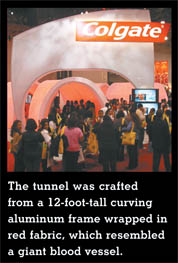
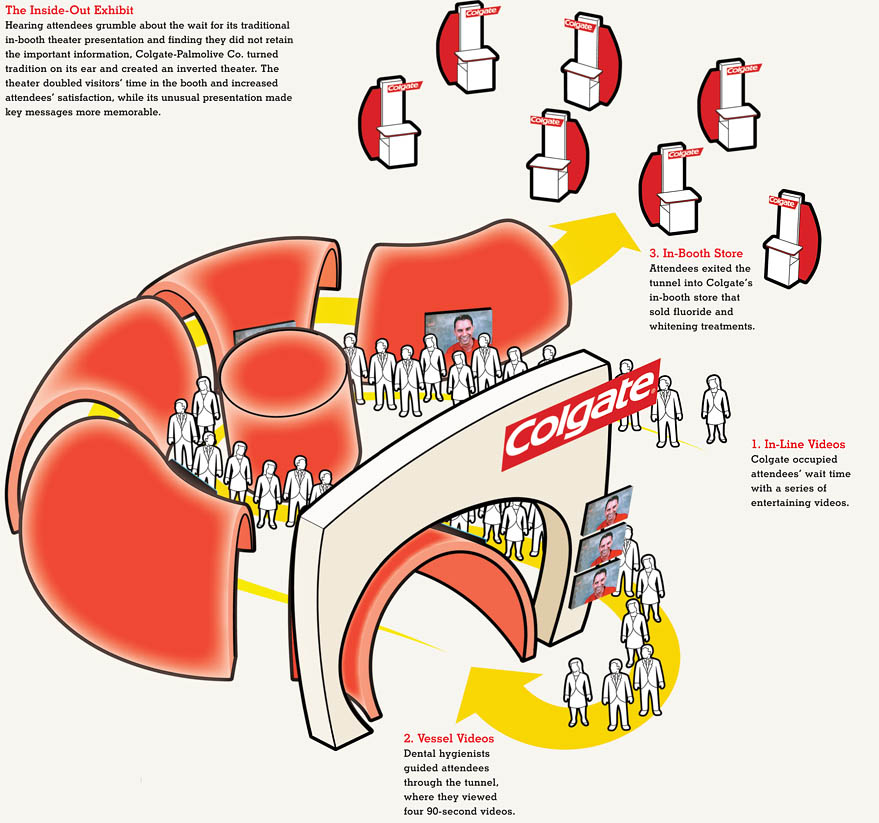
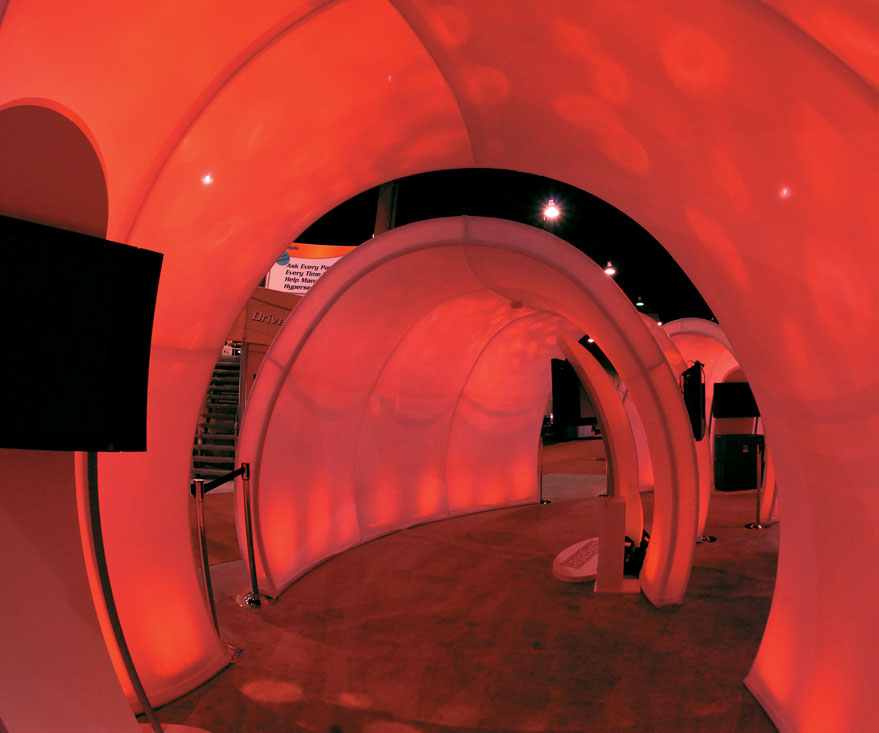
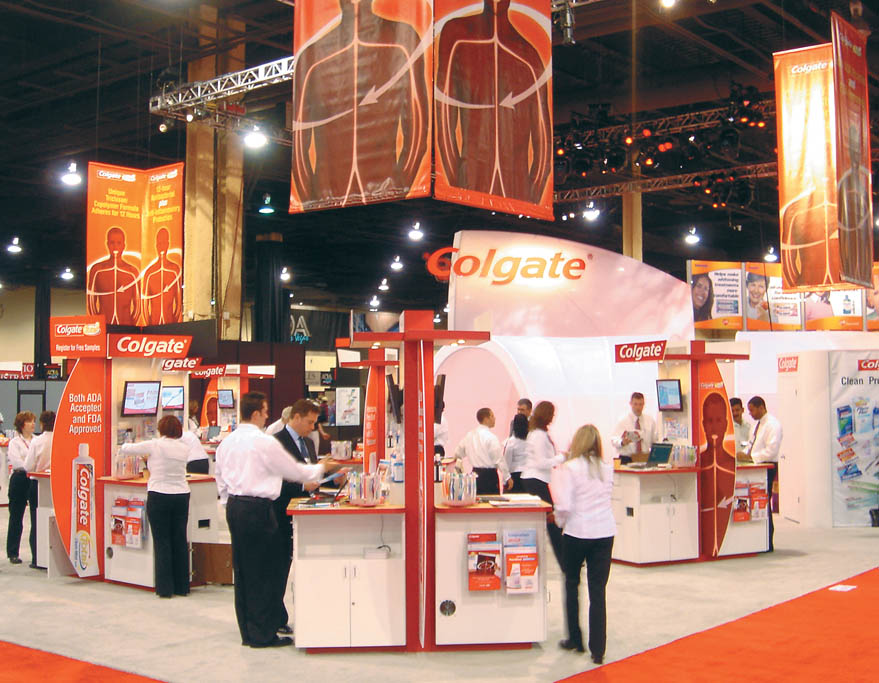
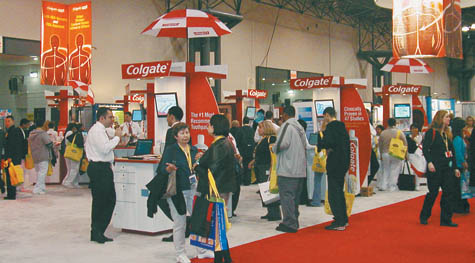
When attendees visited Colgate’s booth to drop off their completed surveys, they found a visually-appealing structure that attracted dentists like plaque to unbrushed teeth. The exhibit’s focal point was a 12-foot-tall curving aluminum frame wrapped in red fabric that looked like a giant blood vessel — complete with corpuscles projected onto the fabric walls that ebbed and flowed as they would through the body. The structure represented the flow of benefits from Colgate Total being carried by the circulatory system from the mouth to the entire body, drilling home the systemic-health benefits of the toothpaste.
Word about the booth spread around the exhibit hall like a shot of Novocaine in a patient’s mouth, bringing scores of attendees to the booth to see what the buzz was all about.
Colgate’s eye-catching exhibit turned the traditional trade show theater inside out. Instead of attendees lining up for a seat to sit and watch a presentation, the presentation began the moment attendees queued up.
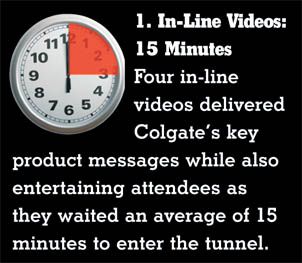
To avoid previous years’ complaints of lengthy, boring lines, the queue to get into the vessel was modeled after line-management techniques from Disney’s theme parks, Parrish says. The roughly 15- to 20-minute wait included plenty of distractions to keep attendees occupied.
“We called it the Disney experience,” Parrish says. “At Disney World, people wait in line and watch cartoons. As a result, standing in line actually becomes part of the fun of going on a ride. Similarly, we wanted to make the time attendees spent in line part of the booth experience.”
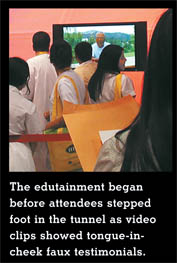
Colgate bombarded queued-up attendees with edutaining videos on four 42-inch plasma screens scattered throughout the line. The screens featured three-minute videos that delivered key messages about Colgate Total via tongue-in-cheek faux testimonials.
On one screen, for example, a surfer, a builder, a ditzy blond, and others shared what they know about Colgate Total. The testimonials ranged from Surfer Guy’s “It’s anti-virus … dude, that’s my computer,” to Valley Girl’s “OK, I brush with Colgate Total and I eat, say, a pudding pop, and it’s still working? Cool.” The comments contained informative nuggets, but more importantly kept attendees’ minds on Colgate’s key messages, while simultaneously alleviating the mind-numbing boredom of waiting in line.
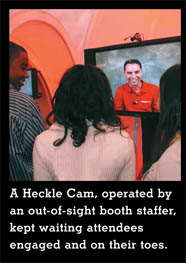
To keep things interesting, one of the screens toward the end of the line featured Colgate’s “Heckle Cam.” A booth staffer hidden out of sight used a concealed camera aimed at the audience. He appeared on the monitor, shouting out comments and picking attendees out of the crowd by reading their badges. The attendees, though caught off guard by the unexpected interaction, jumped right into the fun, playing along with the heckler and enjoying the mischief.
The Heckle Cam not only drew laughter, it took attendees’ minds off the fact that they were standing in line, Parrish says. “We decided that we could not change the fact that people had to wait in line, but we gave them something to enhance the encounter, something they experienced as well as learned from. Because the videos and the Heckle Cam kept them entertained, attendees didn’t realize they were actually waiting even longer than the previous year.”
“The success of this exhibit is the idea of an inverted theater,” says Michael Seymour, a senior vice president at 3D Exhibits Inc., which designed and built the exhibit. “The attendees spent about 15 minutes in line and watched the in-line videos. Unlike a traditional theater, the key messages were already being communicated while attendees were in line — before the actual presentation even began.”
|
 |
 |
 |
 |
Tunnel Vision
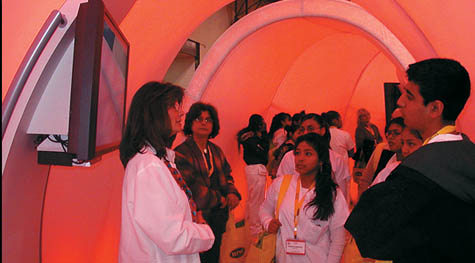
Once attendees made it to the front of the line, groups of 10 to 12 entered the giant blood vessel, moving from the waiting area into the cozy tunnel for a more intimate experience.
That intimacy contrasted greatly with the fun and games outside the tunnel, Seymour says. “It was personal and private. It was very serious, very direct, and very concise. It was exactly what they came for.” The other primary difference between the in-line videos and the so-called Vessel Videos (named for their location inside the structure) was the tone of the messages. While the in-line videos were witty and entertaining, the Vessel Videos took a more scientific, data-based approach, reinforcing Colgate’s key messages, and balancing the fun with the factual.
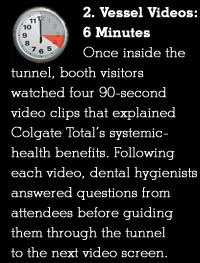
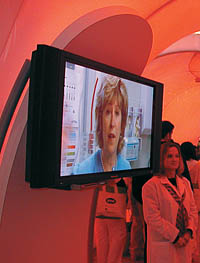
A live dental hygienist welcomed each group and led them through the structure to the first of four screens located throughout the vessel. At each screen, attendees watched 90-second videos designed to teach them more about clinical inflammation, its effects on the body, and how Colgate Total can break the cycle. Following each video, the hygienist answered questions from attendees before guiding them through the tunnel to the next video screen.
The first Vessel Video set the stage with experts discussing the dangers of chronic periodontitis — or inflammation and disease of the oral cavity. They explained how it can damage tissue, not just at the site of the inflammation, but throughout the body, and how untreated inflammation can contribute to stroke and cardiovascular disease.
The second video expanded on the dangers of chronic inflammation and how it can trigger the inflammation cascade, a chain of events in the body that can result in tissue destruction and health consequences.
In the third video, Colgate pulled out its secret weapon, Triclosan, an important tool to break the cycle of chronic inflammation. Dental-school professors touted its antibacterial and anti-inflammatory properties and how they contribute to patients’ systemic health.
In the final video, various experts reiterated the most important information, hitting on key points from the previous videos — Triclosan’s unique anti-inflammatory and antibacterial qualities, the impact of good oral hygiene on systemic health, and Colgate Total’s 12-hour protection — wrapping all the details up into one short, concise message.
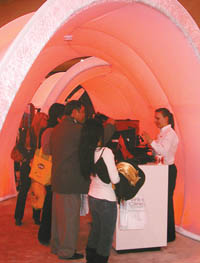
Following the last video, the dental hygienist led them to a desk at the end of the tunnel, where each attendee received a branded canvas bag with another tube of Colgate Total and a Colgate toothbrush.
The two-part, inverted-theater approach was the foundation of Colgate’s edutainment strategy. “What I think made it successful for Colgate was the unusual presentation of information outside the tunnel. It was a great departure for the company,” Seymour says. “The attendees spent the longest time in the line outside, but they were entertained. Then they got to the tunnel and received the serious message in just over six minutes. Because that part of the presentation was shorter, I think attendees enjoyed it more. Plus, they weren’t sitting through an eight-minute presentation — they were walking through a giant blood vessel, which made the experience more unique and memorable.”
Crowning Achievement
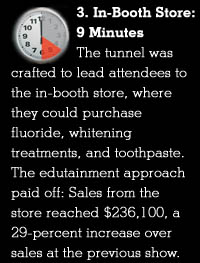
After exiting the vessel, attendees experienced another Disney-inspired treatment. The tunnel funneled attendees directly into Colgate’s in-booth store, where they could buy products such as fluoride, whitening treatment, and toothpaste.
Whether the engaging presentation put attendees in a better mood or they finally understood the product’s unique systemic-health benefits, sales from the store totaled $236,100, a 29-percent increase over the previous show’s sales results.
By inverting its theater, using an intriguing exhibit design, and making the presentations as much fun as fact, Colgate increased participation and interest in its exhibit.
Approximately 5,000 attendees — more than 25 percent of the show’s total attendance — walked through the Living Proof vessel presentation, roughly 10 percent more than the company’s goal of 4,500. Furthermore, attendees spent an average of 20 to 30 minutes in the booth, a 50-percent increase over the previous year — a remarkable achievement, given past attendees’ displeasure with waiting in long lines.
Most importantly, one-on-one exit interviews with attendees indicated the inverted theater with its edutaining videos was a success, increasing attendees’ ability to recall the company’s key messages and product benefits. According to Parrish, impressions were uniformly positive, giving her and her team plenty of reason to flash their pearly whites. e
|
 |
 |
 |
 |
|
|
|