working ideas |

|

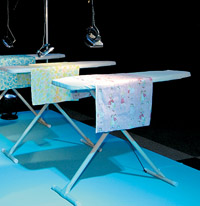
Irons have come a long way in the 123 years that Rowenta, the home-appliances brand of Stockholm, Sweden-based Groupe SEB, has been manufacturing them. In April 2007, when it launched its new pressure iron and steamer, Rowenta wanted to show editors how advanced the new product is by showcasing how much irons have changed. So the company set up six historical vignettes at a media cocktail hour at New York’s Fashion Institute of Technology. The vignettes spanned the 19th and 21st centuries, displaying historical Rowenta irons along with typical fashions of the time.
|

Strategic Horizons LLP is not just a typical business consulting company — it’s a “thinking studio dedicated to helping companies conceive and design new ways of adding value to their economic offerings.” The Aurora, OH,-based company holds an annual event it calls “ThinkAbout,” offering two days of interactive learning experiences that provoke attendees’ thought processes about their own businesses. To get participants to start thinking about the September 2007 event theme, “Authenticity in Business,” hosts Jim Gilmore and Joe Pine issued the following challenge via e-mail before the event: “Over the next several days as you go about your daily routine as a business professional and consumer, take note of just how often the notion of authenticity arises. Be it in the grocery store or mall, in discussions, mentioned in the news, or plastered across advertising; you’ll know it by words like ‘real,’ ‘genuine,’ ‘natural,’ ‘original,’ and ‘faux,’ among many others. And when you sense just how prevalent and prominent the desire for authenticity has become, your next thought likely will be: ‘What does this mean for my business and my customers?’”
The question engaged attendees before the event, provoked curiosity about what Gilmore and Pine would have to say about the subject, and enhanced the on-site discussion as attendees came prepared to share their own observations.
 |

 Sometimes before a company can prove to customers that its product will fill a need, it has to educate them about the need itself. In 2006, Staples Inc. set out to convince its consumers that identity theft is a rising threat and that the products sold in its stores, such as paper shredders and computer-security software, are the solution to the growing personal security problem. Sometimes before a company can prove to customers that its product will fill a need, it has to educate them about the need itself. In 2006, Staples Inc. set out to convince its consumers that identity theft is a rising threat and that the products sold in its stores, such as paper shredders and computer-security software, are the solution to the growing personal security problem.
In the Fall of 2006, the Framingham, MA,-based office-supply store teamed up with Frank Abagnale, a reformed identity thief who now helps corporations and government agencies such as the FBI prevent fraud (his story is dramatized in the movie “Catch Me If You Can”), in a mobile tour that visited Staples stores in 17 cities across the country.
At the events, collectively called the “Staples Shred Across America Tour,” the office-supply store provided information about identity theft and tips from Abagnale about how to prevent it from happening. Abagnale appeared in person at the first two events, while Staples handed out sheets of paper with Abagnale’s best fraud prevention tips and information to attendees at subsequent events.
Staples also invited attendees to demo its myriad security products, including a very personal demo of its new line of shredders — it asked customers to bring their own documents with sensitive information to the event, where they could try out the shredders for themselves.
|

 They’re a wanted generation — teens and 20-somethings, stereotyped with an obsession for technology and a knack for tugging at parental purse strings. They’re a wanted generation — teens and 20-somethings, stereotyped with an obsession for technology and a knack for tugging at parental purse strings.
Coty Inc., a worldwide fragrance company based in New York, is among the many companies vying for the attention and spending power of this generation, which it cheekily calls “technosexuals.”
To launch its new perfume, Calvin Klein’s ckIN2U, Coty Canada held a pop-up event for three days in July in a storefront in Toronto’s entertainment district. In contrast to the traditional stores nearby, the venue was set up as a laid-back techno-lounge where attendees could come to relax, nosh, enjoy unlimited text messaging with cell phones provided by Virgin Mobile Canada, dance to live music — and try out the new scent, which was displayed throughout the club-like venue.
A uniformed scooter brigade drew attention to the pop-up lounge, while Facebook ads and influential bloggers built more buzz.
Open from 10 p.m. to 1 a.m., the venue offered a sense of fleeting impermanence, upping the insider feel for its targeted audience of ahead-of-the-curve club kids.
Four hundred visitors dropped by the lounge during the two days it was open to the public (following a media day), hitting club capacity and exceeding Coty’s attendance goals for the event.
|
|