 A United Front A United Front
on Climate Change
 To Green a United Nations-sanctioned event at the global level, the Globe Foundation gets a Green government to back it up. To Green a United Nations-sanctioned event at the global level, the Globe Foundation gets a Green government to back it up.
When governments make a promise to go organic and natural, generally they mean they’re just going to sling a lot more manure. But when Canada pledged in 2005 to become “the Greenest government in the world,” it was a promise it would have to keep — especially when the United Nations decided to hold its third bi-annual World Urban Forum (WUF3) in Vancouver, British Columbia, in June, 2006.
The U.N. chose the venue precisely because it needed a municipality that would abide by the ecologically sensitive management practices it had established for the WUF3, which addresses the most pressing issues facing the world today. At the June 2006 event, that issue was the rapid urbanization of the world’s population.
The U.N.’s strategy was to acknowledge Green’s importance not by flashing its Greener-than-thou cred around, but by weaving it into the cultural and logistical DNA of the event. It would be a sort of Zen showing, demonstrating that in an event addressing the ills caused by urbanization, the U.N. could help address those ills with eco-conscious principles. The event guidelines included best practices in waste management and energy conservation, and suggested working with suppliers and vendors to ensure that the event had zero impact on the environment. “We had to build an event that didn’t just recycle plastic water bottles,” says Nancy Wright, the vice president of marketing for the Globe Foundation, which produced the event for the U.N. “We had to construct an actual Green culture.”

In fact, the five-day event itself was as big as some entire cultures. Nearly 12,000 attendees from 150 nations were spread over 19 venues and throughout the Vancouver Convention and Exhibition Centre (VCEC).
More significantly, the event took Greening on the journey from novelty to no big deal. “Eventually, a certain level of ‘Green-ness’ is assumed by attendees,” says Wright, “and you have to meet those expectations, even if they don’t automatically notice those changes.”
Many events that pivot on a socially responsible theme adopt a winking “do as I say, not as I do” attitude as they wallow in conspicuous consumption among a guest list more familiar with Hermès than hydrocarbons. Here it was the opposite, with Globe striking a role-model pose even before the event’s official kickoff.
 |
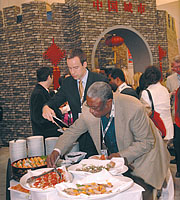
Food and beverage followed locavore principles: All items were produced within 100 miles of the Vancouver, B.C., event location.
|
All the computer equipment Globe used in its offices was Energy Star compliant, a standard set by the U.S. Environmental Protection Agency and the U.S. Department of Energy that limits, for example, the amount of power computers and other electronic equipment can draw. Office lights and computers were turned off at night and on weekends. Every piece of paper, from inter-office memos to event brochures, was printed on 100-percent recycled post-consumer material, and whitened without the use of chlorine or chlorine bleach. Globe installed bike racks at the venues and arranged for nine of the shuttle buses to run on biodiesel fuel, a gasoline alternative made from biodegradable, non-toxic vegetable oils which typically spew about 60 percent less carbon dioxide into the air than regular diesel.
Once attendees arrived, they were surrounded by this almost invisible field of Green even in the middle of the industrialized Pacific Rim city of nearly 2.2 million. Event hotels had been coaxed by Globe to use energy-efficient compact fluorescent light bulbs, install water-conserving fixtures, provide recycling bins, and offer every-other-day laundry service. Guests moved from venue to venue on foot, by bike, on the veggie-fueled event buses, or with free passes Globe supplied for TransLink, Vancouver’s public transit system. Lanyards were made of recycled pop bottles, and the bags attendees carried were woven from natural fibers such as hemp, unbleached cotton, and Merino wool, then colored with organic dyes. Printed materials at the 160 educational sessions and the accompanying music and film festivals appeared on recycled paper, printed with soy-based ink, and were bound with staples or spiral wire to ease the recycling process.
Even the attendees’ human fuel was Green: The main event hotel, the Pan Pacific Vancouver Hotel, and the VCEC offered locavore options, such as free-range chicken, sustainably harvested seafood, and organic vegetables, all obtained from within 100 miles, the generally accepted limit of what constitutes locavore food. The juices, coffee, milk, cream, and teas served were Fair Trade-certified, indicating the refreshments were cultivated in safe and healthy working environments and whose producers were equitably paid.

The Greening of the WUF3 may have been inconspicuous, but any social movement requires people to buy into it by urging them to publicly practice what they preach. Globe used pre-event e-mails to ask attendees to bring their own mugs, water bottles, pens, and pencils; to turn off lights and TVs in their hotel rooms; and to choose the online event daily over the printed version. “They were small things to ask,” says Wright, “but they helped draft everyone there into playing a role and made everybody realize they can have a positive impact.”
Estimating that the event had disgorged 10,740 tons of greenhouse gasses, Globe bought offsetting credits to support wind-power development in Canada, as well as solar energy, biomass, and even forestation projects. Constrained by budget, Globe estimates that it compensated for 19 percent of the energy expended, but it was a solid start, especially since some of the suppliers and attendees compensated on their own.
 Good News for Good News for
the Green Movement
Reuters Media makes its own news, earning eco-cred for its annual ad-sales event by Greening everything from the hors d’oeuvres to a towering, lighted billboard in Times Square.

Not to impugn Kermit the Frog or anything, but it is easy being Green — because with few government-defined standards for just what counts as environmentally friendly, claiming your company is the environment’s BFF is as easy and empty as slapping the prefix “Green” on everything from tortilla chips to nuclear power. Often, it’s just a lot of hot air. But for highly visible companies like New York-based Reuters Media — the media division of the global news agency with 16,900 staff members in 94 countries — showing you’re Green is what’s hard. “We’re expected to be as cutting edge as the news we report,” says Liz Airhart, Reuters director of trade marketing. “That includes being Green.”
When the company planned its fourth annual Reuters ReMix ReDux party, attended by about 400 of its ad-sales clients, it decided the June event should be as Green as a bowl of organically grown arugula. That’s when Airhart turned to Strategic Event Design Inc. (SED), the New York event design and production company that had produced Reuters ReMix ReDux for the last four years.
“Reuters’ strategy was to actually impact the environment in a noticeable way and not just pay lip service to being Green,” says Bethney Ruggiero, the CEO of SED. After researching their options, SED and Reuters started drawing up a Green game plan for the event. But they may as well have held it in a carbon dioxide-spewing smokestack in a Rustbelt factory if no one knew it was a Green event.
To remedy that, Reuters first consulted with TreeHugger.com, a Web clearinghouse for information on eco-issues, to find more ways to Green the event. It then met with the Center for Resource Solutions (CRS), a San Francisco nonprofit that focuses on developing renewable energy, and certifies events as Green if they pass muster. After analyzing Reuters’ plans, CRS gave them the green light, and its seal of approval: the “Green-e” certification.
Reuters made changes that would be tangible to attendees — substituting Green physical elements for their non-Green counterparts. For example, Reuters sent non-polluting e-mail invitations to the 1,000 invitees, conserving the energy needed to print and transport hard-copy mail. The invitations urged attendees to walk or use public transportation to the site, alerting them that every person who hoofed it or took the subway would reduce an estimated 5 pounds of carbon-dioxide emissions.
 Once attendees arrived at the venue, the home of the NASDAQ stock exchange in Times Square, they experienced even more Green touches. Staff in organic-hemp shirts handed them cards (printed on recycled paper) that suggested tips for saving energy. Ten generic banners from the previous year’s event, ranging in size from 20-by-18-feet to 3-by-7-feet, were re-used. In place of disposable silverware and plates, the company rented china, which created less garbage and less CO2 than trucking in plastic utensils. Once attendees arrived at the venue, the home of the NASDAQ stock exchange in Times Square, they experienced even more Green touches. Staff in organic-hemp shirts handed them cards (printed on recycled paper) that suggested tips for saving energy. Ten generic banners from the previous year’s event, ranging in size from 20-by-18-feet to 3-by-7-feet, were re-used. In place of disposable silverware and plates, the company rented china, which created less garbage and less CO2 than trucking in plastic utensils.
Even the food they ate was Green. Since the average meal in the United States travels 1,200 miles from the farm to your plate and requires 10 times more energy to produce and transport than locally raised victuals, Reuters followed locavore principles for the catering, buying foods grown and produced within 50 miles for its menu of Peking duck, fresh tuna tartare on fingerling potato crisps, and parmesan tuilles with Caesar salad, among other dishes. The event’s eco-friendly elements continued to the door prizes: photovoltaic backpacks that can recharge electronic devices with a built-in, solar-powered plug.
|
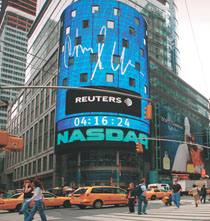
Reuters took over the iconic NASDAQ Tower in New York’s Times Square for its event — then offset the energy consumption by paying for renewable energy sources in upstate New York.
|
If attendees didn’t already see the light figuratively, they eventually did literally. Reuters replaced incandescent lighting in 38 fixtures (which would consume 22,000 watts) with low-energy LEDs that consumed only about 1,000 watts, reducing energy consumption by nearly 95 percent.
But all these efforts would have been futile if Reuters hadn’t addressed the mother of all energy sucks: The exterior of the event venue itself, was across the street from the NASDAQ Tower, the largest video screen on the planet, a 7-story-high, non-stop blinking, flashing orgy of scrolling stock quotes, news, and wasted energy.
Normally that wouldn’t have been Reuters’ problem, but the NASDAQ sign is combined through a partnership with the adjacent Reuters Sign, and referred to as Times Square2. When guests arrived, the staff snapped their pictures, and then uploaded them to a computer that flashed their portraits 100 feet high on the screens. To show that it wasn’t a Marie Antoinette-ish “Let them eat carbon” frippery, Reuters needed to find a way to make this particular footprint much more petite. “We had to show we meant it when we said we were Green,” says Airhart. “We had to offset the wattage used by the screens.”
Reuters and SED worked with Sterling Planet, a Norcross, GA, company that provides the opportunity to offset fossil-fueled electrical use by buying renewable energy virtually anywhere around the country. After Sterling calculated that the Reuters sign and the NASDAQ Tower together used 100,000 kilowatt hours per month, Reuters purchased that amount in wind power in upstate New York. “We kept it local, like we did the food,” says Airhart, who says future events will also be equally or more Green than this one. Reuters estimates virtually 100 percent of attendees got the message that it Greened the event because the company followed the oldest rule in journalism: Seeing is believing.
 Taking Sustainable Taking Sustainable
Steps to go Green
Cisco gets to Green with a bite-sized approach that steadily and sustainably feeds its big eco appetite.

You know you’ve got to be perceived as Green when it gives your competitors an edge. That’s what Cisco Systems Inc. found out earlier this year when one of its rivals in the networking equipment industry, Brocade Communications Systems Inc., started claiming its storage-area network directors consumed a third of the power that similar Cisco gear did.
While the claims were debatable, they struck a nerve with the San Jose, CA,-based company. It didn’t want people to think the only thing Green about Cisco is the money it hauls in. So when Cisco held its annual Global Sales Meeting (GSM) in Las Vegas last August, its strategy was to showcase not just its advanced technology to 13,600 members of its worldwide sales force, but its advanced knowledge of how to minimize the environmental impact of large-scale events — and by extension, the Cisco brand.
Like many businesses, Cisco is trying to get its arms around the Green movement. A February company-wide memo at Cisco spurred its workers to find innovative ways to Green the company. “We’re on the cutting edge of tech,” says Angie Smith, manager of operations and event management at Cisco. “We want to get on the cutting edge of Green.”
This isn’t just bandwagon-jumping for Cisco. For seven years the company has adhered to ISO 14001, a collection of international standards on environmental-management systems which companies voluntarily implement. Since part of being ISO 14001-certified is demonstrating continual progress, Cisco has added several Green initiatives, including its Take Back program on America Recycles Day, where it collects old electronic equipment from customers and recycles it.

Assisted by the George P. Johnson Co. (GPJ), an Auburn Hills, MI,-based event firm, Cisco decided that its GSM had to actively engage its attendees in the Green process to be effective. “We started simple, with a series of Green tips to get guests involved,” says Smith. The 15-item “Go Green” list included advice such as: Use the two event hotels’ electronic checkout processes to reduce paper waste, avoid carry-out food to reduce clutter, pick up at least one piece of litter each day, separate recyclable items from trash in your room’s garbage cans, and bring a nightlight with you instead of leaving the bathroom light on all night. Instead of handing out hard copies that eventually end up in a landfill somewhere, Cisco e-mailed the list before the show to every invited guest, and flashed it on monitors welcoming them at the main convention halls in the Mandalay Bay and MGM Grand hotels.
By identifying immediate, easy-to-implement, concrete actions for attendees instead of giving them a massive laundry list of facts and figures, Cisco avoided what London-based Research International Group found in a 1993 focus-group study of attitudes toward the environment: too much information freezes people into a state of inaction. The clearer and more defined the choices, the more people will join in.
The next step Cisco and GPJ took was to reshape the guests’ daily activities from washing to eating to sleeping. The strategy was to model easy behavior-changing tactics that worked in anti-litter and anti-smoking campaigns. They mixed descriptive norms (what we see other people doing) with injunctive norms (what the rules force us to do). The descriptive norms, which were simply established as a way of day-to-day life at the GSM, included, for example, guests at meals watching each other eat off of china instead of disposable plates, place cloth instead of paper napkins on their laps, and pour their condiments from bulk containers instead of individual packets. Attendees rode on shuttle buses that ran on recycled motor fluids and batteries. Collectively, they tossed plastic bottles and metal cans into recycling bins.

For injunctive norms, or those that had written rules to define the desired behavior, Cisco required attendees to register online and to forgo paper airline tickets in favor of their electronic counterparts. Attendees also had to wear their badges in badge-holders and lanyards recycled from the prior year’s GSM.
An event that runs for four days with more than 13,000 people attending sessions in dozens of rooms spews an enormous amount of waste. To offset the event, Cisco purchased carbon credits. “It’s like that old Boy Scout saying,” says Smith, “you leave a place as clean as you found it. Even if it’s Las Vegas.”
 Energy Stars Come Energy Stars Come
out for Sundance
Lexus turns the de rigueur celebrity swag suite on its ear with a Green-themed eco gallery at the Sundance Film Festival.
|
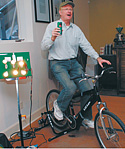
Eco-celebrity Ed Begley, Jr. demonstrated a non-polluting way to power his cell phone by pedaling a bike hooked up to a generator.
|
If you want to interest your customers in going Green, toss the recycle bins and can the low-flush toilets. Use elephant poop instead.
That’s how the Toyota Motor Corp.’s Lexus brand initially drew attention to its event last January at the Sundance Film Festival, the competition for independent films and filmmakers in Park City, UT, founded in 1978 by actor/director/activist Robert Redford. Event organizers sent out invitations and press releases made from the environmentally friendly cellulose fibers found in elephant dung for the eco-event, called Lexus Hybrid Living’s Project Greenhouse, held in conjunction with the 2007 cinema festival.
The event’s goal itself might seem as thrilling as a bowl of granola laced with Ambien: raise awareness of sustainable lifestyle options. But given the target audience of Hollywood insiders, socialites, and other high-profile celebrities whom organizers deemed alpha-influencers in setting the cultural agenda, Lexus’ strategy was to take the serious issue of a climate headed for a boil and celebrate the remedies with tongue in cheek, in much the same way the movie Spinal Tap goosed the documentary-film genre. “We wanted to create a parody of the media-frenzied gift suite,” says Liat Cohen, CEO of Global Kinect Conscious Marketing, a New York-based marketing firm that helped co-produce the event.
Co-sponsored by Home & Garden Television (HGTV) to promote its Green-themed “Living with Ed” series, which stars Project Greenhouse host Ed Begley, Jr., the invitation-only event and eco-conscious “lifestyle suite” was checked with invited VIPs such as Parker Posey, Gina Gershon, Kristen Bell, Sharon Lawrence, Timothy Hutton, and Kevin Bacon, who strolled through the gallery’s various sections. In one, Begley, the Ed McMahon of the environmental movement, demonstrated an i-Zip Hybrid Electric Bike. He jumped on the bike, which was connected to a generator that was in turn hooked up to a cell-phone charger which charged the phone as he pedaled. Later, Begley stood outside the lifestyle suite to make toast in a solar oven, which heated up to 225 degrees in the 18-degree weather.

Hand-picked, believably eco-conscious celebrities like Timothy Hutton and Kevin Bacon grew media interest in the Greenhouse.
|
|
The rest of the gallery was like a stroll through an Earth-friendly version of Rodeo Drive. The celebs and media hauled recyclable and reusable bags from Earthwise Bag Company Inc., stuffing them with Green goodies from event participants including preservative-free T-Bars from Tzu The International Inc., organic energy drinks from Steaz, handmade soaps made with organic fruits and vegetables from Lush Cosmetics, bamboo appetizer plates, organic lip balm, and non-toxic Begley’s Best All Purpose Cleaner. For those who get high on more than just the knowledge they’re saving the planet, there was Vodka 14, distilled from certified organic grains.
It wasn’t all swag-n-bag. There were presentations by a Lexus “lifestyle concierge” on sustainable living, and Toronto-headquartered Fairmont Raffles Hotels International Inc. encouraged guests to book a complimentary trip to its eco-conscious Fairmont Mayakoba resort in Mexico, which donates food from its buffet lines to shelters and soup kitchens, and whose employees raise money for endangered species. TerraPass Inc., the San Francisco company which helps offset your carbon emissions by investing in renewable-energy projects across the country, helped offset a percentage of Project Greenhouse’s carbon footprint.
 The event’s celebrity-as-publicity-magnet strategy worked. Running for three days from 10 a.m. to 6 p.m., the returns on Project Greenhouse’s goals created a snowball effect. Of 463 total attendees, the event attracted six A-list Celebrities (such as Bacon) and a total of 69 others it refers to as “Best Supporting Actors,” meaning lesser-known stars in the pop-culture firmament. The Lexus eco-suite reaped coverage in eight newspapers and six magazines, including AdWeek, The Boston Globe, The Salt Lake Tribune, and Hollywood must-read sheet Daily Variety, as well as coverage on TV, and at TreeHugger.com, one of the most trafficked Green Web sites. While it’s difficult to map the influencers’ word-of-mouth effect, the event achieved a life of its own, morphing into a traveling road show that was scheduled to appear at the Coachella Music Festival in Coachella, CA, the Winter Music Conference in Miami, and other venues. e The event’s celebrity-as-publicity-magnet strategy worked. Running for three days from 10 a.m. to 6 p.m., the returns on Project Greenhouse’s goals created a snowball effect. Of 463 total attendees, the event attracted six A-list Celebrities (such as Bacon) and a total of 69 others it refers to as “Best Supporting Actors,” meaning lesser-known stars in the pop-culture firmament. The Lexus eco-suite reaped coverage in eight newspapers and six magazines, including AdWeek, The Boston Globe, The Salt Lake Tribune, and Hollywood must-read sheet Daily Variety, as well as coverage on TV, and at TreeHugger.com, one of the most trafficked Green Web sites. While it’s difficult to map the influencers’ word-of-mouth effect, the event achieved a life of its own, morphing into a traveling road show that was scheduled to appear at the Coachella Music Festival in Coachella, CA, the Winter Music Conference in Miami, and other venues. e
|



