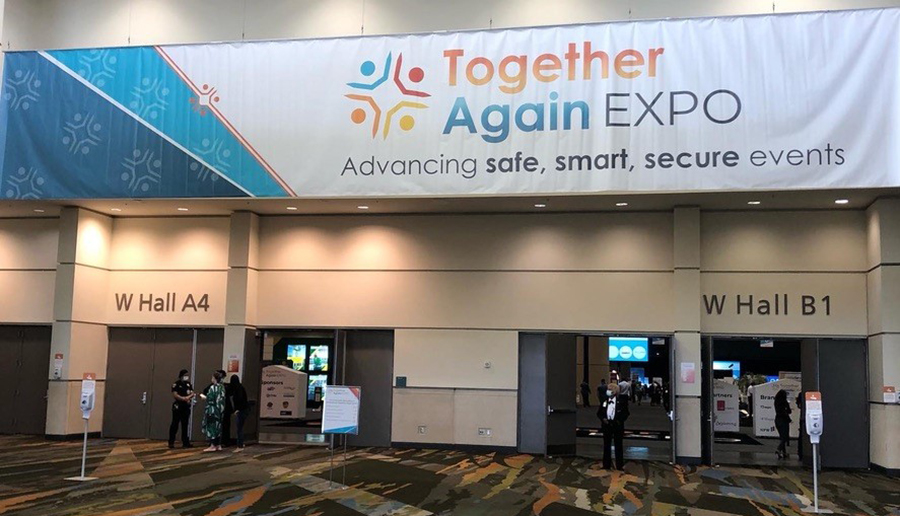
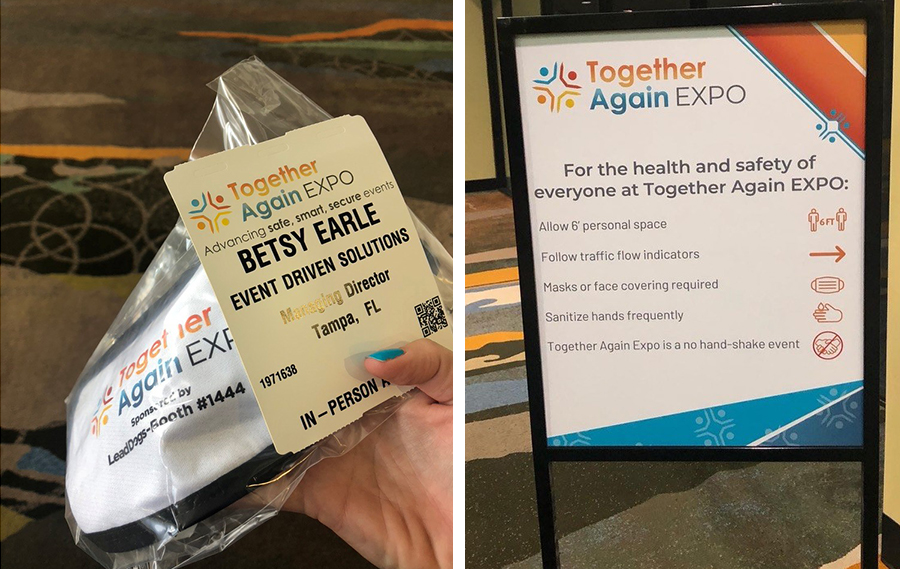
Inside, another show rep pointed out directions, and stanchions and arrows told us which way to go. I took an escalator up (being mindful not to touch the railings), crossed the West Hall skybridge, and descended another escalator to get my badge. There was not a line at the registration counter, and stickers on the floor ensured that any future queues would be socially distanced. The registration rep, sheltered behind a sheet of Plexiglas, handed me my badge, along with a cellophane bag containing a lanyard and mask. While I appreciated that the lanyard and mask were bagged, it also felt like an extra touchpoint for fingers other than mine. That being said, I'm not sure if there is a better way.
As I neared the exhibit hall, I discovered signage that marked one set of doors as the entrance and another set as the exit, so as to not have people bumping into each other. The crowds were minimal, so there wasn't too much concern for this. On the show floor, booths were set up in a traditional 10-by-10 style. Personally, I would have allowed for wider aisles, but organizers chose to put arrows on the floor indicating that each aisle should have one-way foot traffic. Unfortunately, I didn't even notice these arrows until someone pointed them out to me after being at the show for an hour.
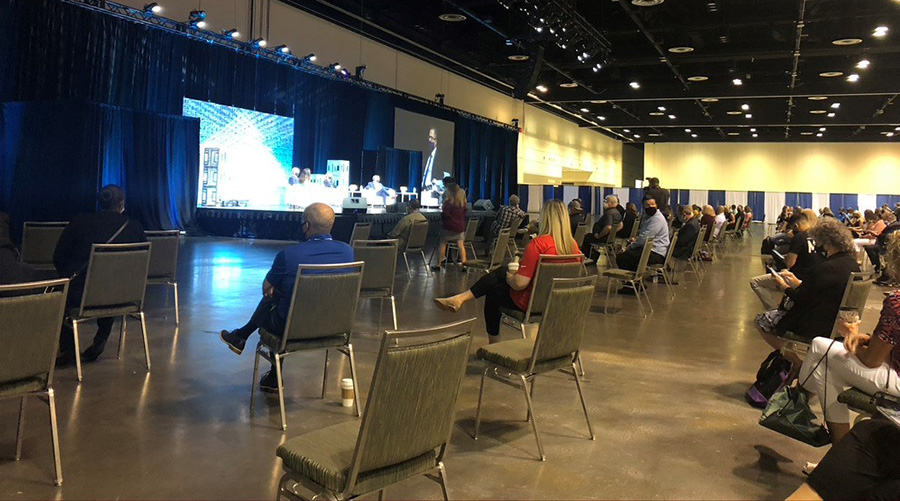
I didn't participate in any of the other sessions, as I really just wanted to see the opening presentation and observe what was being done in regard to social distancing. I did use the restroom, which was immaculate, largely due to a custodian scrubbing surfaces and spraying the floor with disinfectant. When I left the facility, I passed another worker sanitizing the escalator railings. What's more, I only saw two people not wearing masks the entire time I was in the OCCC. However, I have yet to be contacted by a show rep, so I don't know if management plans to follow up with guests to make sure that we remain free of COVID-19.
While attending the event felt about as safe as a trip to my local grocery store, I believe a number of measures provided a false sense of security. For example, temperature checks won't identify asymptomatic attendees or staffers. And while Florida is already seeing a spike in infections, what if people had flown in from other states with as high or higher rates? What if a number of attendees refused to wear masks in their everyday lives and only donned one for the event because they were mandatory? And what if an attendee comes down with COVID-19 after the event? Is this show-goer obligated to contact show management, who is in turn obligated to inform all of the registrants? Unfortunately, I don't know, as expo organizers didn't communicate any of these policies. Based on what I saw, the future of our industry is going to require extreme attention to detail to make everyone as safe as possible. I do not believe we are ready for large shows, but I'm cautiously optimistic that small events might be able to be navigated safely.
 Betsy Earle, CTSM
managing director and founder of Event Driven Solutions LLC. Earle obtained her MBA at the University of Miami and earned her Diamond-level CTSM designation in 2018. [email protected]

Marketplace

- Audiovisual Equipment
- Convention Centers
- Event Design and Production
- Exhibit Fabrication
- Exhibit Producers
- Exhibit Rental
- Experiential Agency
- Flooring
- Graphics
- International Exhibit Producers
- Kiosks
- Lead Retrieval
- Modular Exhibit Systems
- Portable Display Systems
- Shipping and Transportation
- All Companies
2023 Crash Course: What You Need to Know About Trade Show Shipping
June 16, 2026
4007R Exhibit Law Primer: Legal Concepts and Practical Advice
July 9, 2026
3006R Omnichannel Marketing Strategies for Your Live Events and Trade Shows
July 28, 2026
3050R Focus on Attention: How to Optimize your Messaging on the Trade Show Floor
Aug. 4, 2026
6010R The Basics of Event Planning and Management ‑ Part I
All Sessions >>