While a display of whirling gears within your exhibit may be as innocuous as a Shih Tzu, humans' instinctive reaction to stop and take note of moving objects makes kinetic elements mighty tools in marketers' arsenals. Furthermore, the idea that motion attracts attention isn't just a 10,000-foot view with no practical significance or data to back it up. A study from the Stockholm School of Economics found that when it comes to product displays, motion increases sales. That research concluded that grocery store shoppers were 64 percent more likely to buy a particular brand of milk when its product display included a kinetic element.
Given the moving arguments for dynamic displays, EXHIBITOR compiled nine examples of exhibits that incorporated some eye-catching action to attract attention. By Claire Walling
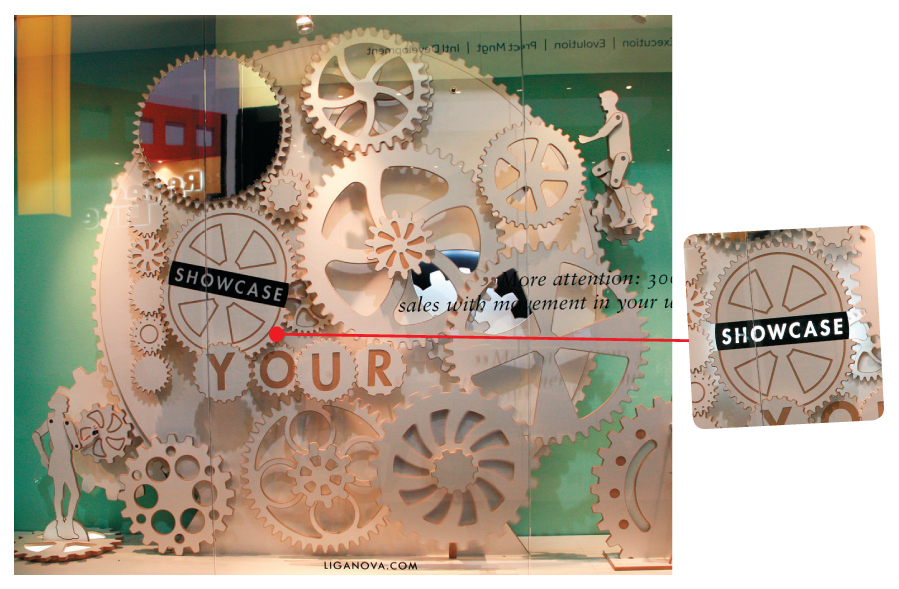
In any busy environment, whether it be a frenetic trade show floor or a bustling shopping mall, static displays have a tendency to get lost in the shuffle. So to stand out from the crowd, Liganova GmbH (aka Brand Retail Lab) lent a little momentum to its exhibit at EuroShop by embedding a kinetic display behind an aisle-facing window. Text on the window read "More attention: 300-percent increase in sales with movement in your window." Then, as if to prove its own prophecy, a whirling assemblage behind the glass proceeded to attract attendees' eyeballs like moths to a five-alarm flame. A series of dimensional gears and lights rotated and twinkled as they progressed through a carefully orchestrated sequence. First, the word "we" appeared inside a large gear positioned in the top-left of the display. Next, another gear appeared to part like the Red Sea, revealing the word "showcase," which then lit up. Four smaller gears, each bearing an individual letter, came to a stop, forming the word "your," and the phrase "brand & products" appeared in lights, embedded within a final gear in the lower-right corner of the structure. The kinetic element drew curious attendees' eyes to Liganova's exhibit while simultaneously communicating the company's key message. Talk about a double-duty display.
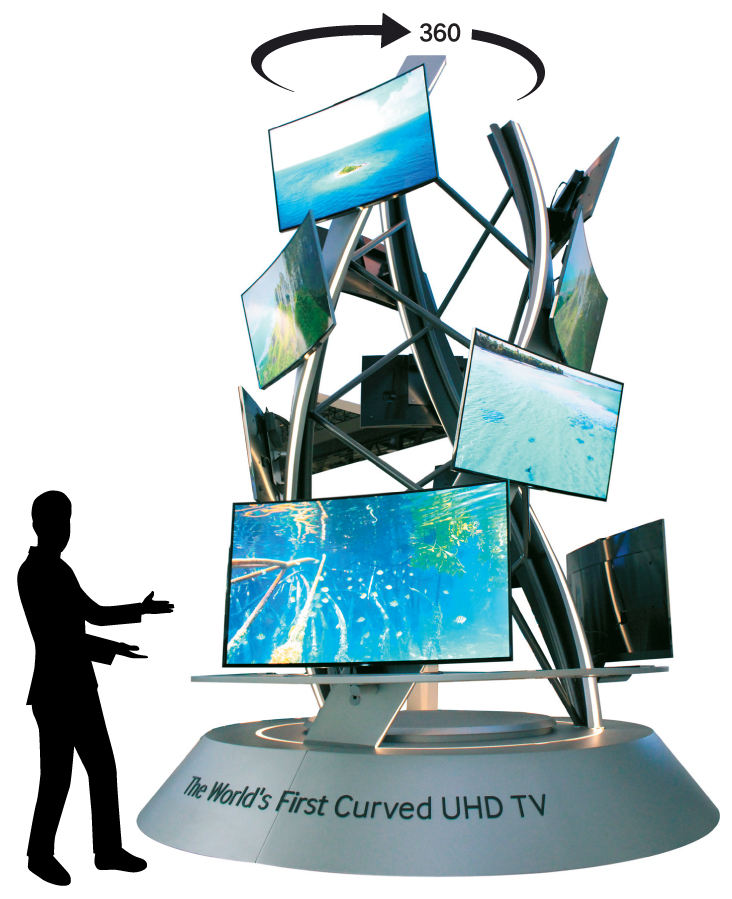
Farewell flatscreens, the future is curved. At least that's what Samsung Electronics Co. Ltd. wanted attendees at the International Consumer Electronics Show to believe. But displaying the company's curved televisions posed a challenge, since concave screens and their flat brethren look an awful lot alike when viewed head on. To ensure its curved Ultra High Definition (UHD) televisions attracted a large viewing audience, Samsung decided to take its products for a sophisticated spin. A double-helix-like structure, designed by Chestnut Ridge, NY-based exhibit house MC², held a dozen of the curved monitors, and the entire display slowly rotated 360 degrees. The slow-motion installation provided attendees an ever-changing viewing angle that underscored the screens' subtle curves. Furthermore, as the structure rotated, imagery on the monitors seamlessly transitioned from one bright nature scene to the next. The rotating kinetic element didn't just get attendees' eyes on Samsung's new products; it also showcased the curved UHD screens in the best possible light — and from every possible angle.
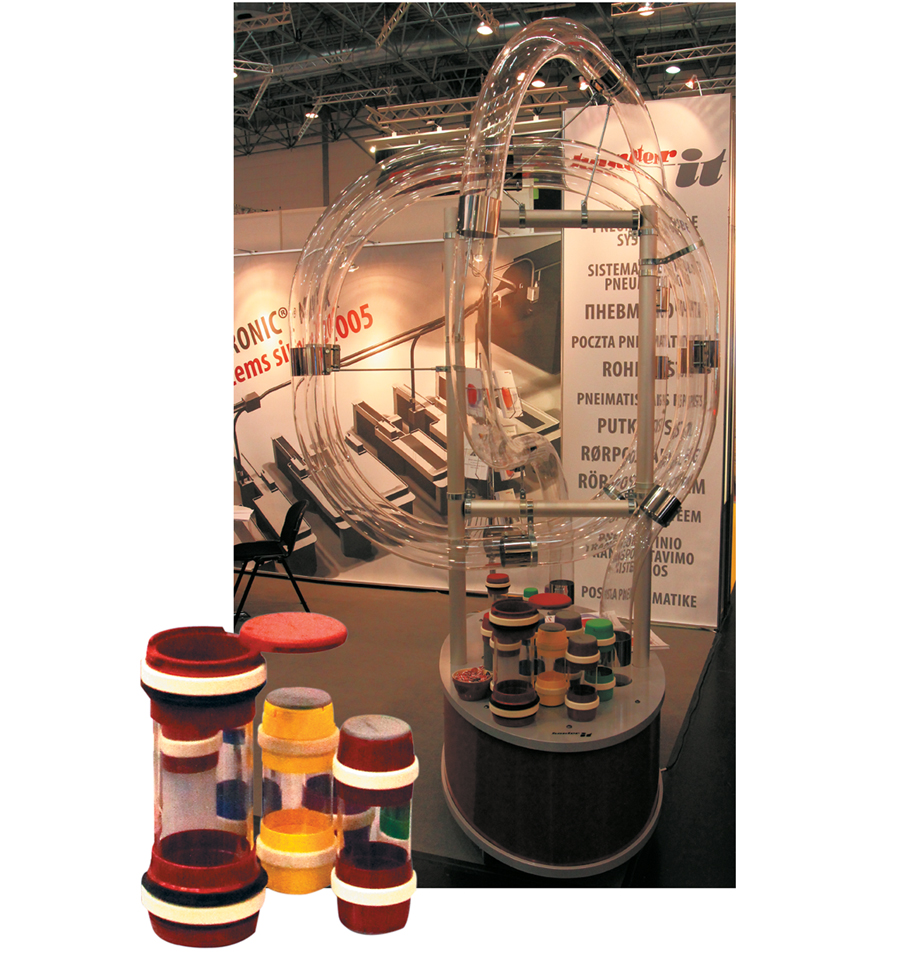
Let's face it: Some products are easier to demonstrate and display in an exhibit than others. Consider pneumatic tube systems — you know, the kind you use to relay cash and deposit slips at your bank's drive-up window. Swedish material handling and pneumatic tube system maker Hanter Ingenjorsteknik AB wanted to effectively display this industrially chic product, so it took advantage of its most alluring characteristic — movement. To demonstrate the product, and get attendees' eyes on the company's fast-moving canisters, it created a closed-circuit structure consisting of a pair of transparent interlocking tubes affixed to a coffee-table-sized base. The demo/display hybrid continuously sent one of Hanter's burgundy, yellow, or green canisters up, over, and around a circuitous track before returning it to its point of origin. The touch of a button activated the product demonstration to start up again, as the containers traversed the course in the opposite direction. The constant movement lured interested attendees to Hanter's booth, and instantly communicated the company's offerings.
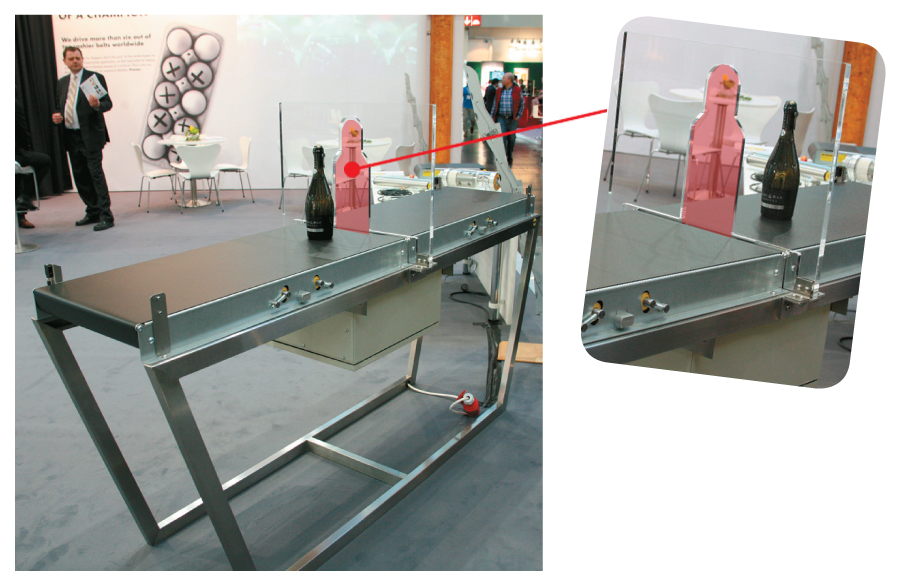
To illustrate how flat its belt system is and how smoothly it operates, Interroll Holding GmbH crafted a one-off product demonstration for its exhibit at EuroShop. The company, which manufactures conveyor belts typically used in supermarket checkout lines, devised an ingenious aisle-side presentation featuring two joined belt systems that operated for roughly five seconds in one direction and then reversed to move five seconds in the opposite direction. Staff positioned a bottle of champagne on the belt setup, and between the two belts was a clear Plexiglas wall with a bottle-shaped cut out just big enough for the bubbly to pass through. Thus, throughout the trade show, the bottle moved back and forth a number of times without ever touching the frame — demonstrating the belts' smooth operation and captivating passing attendees drawn to the kinetic display.
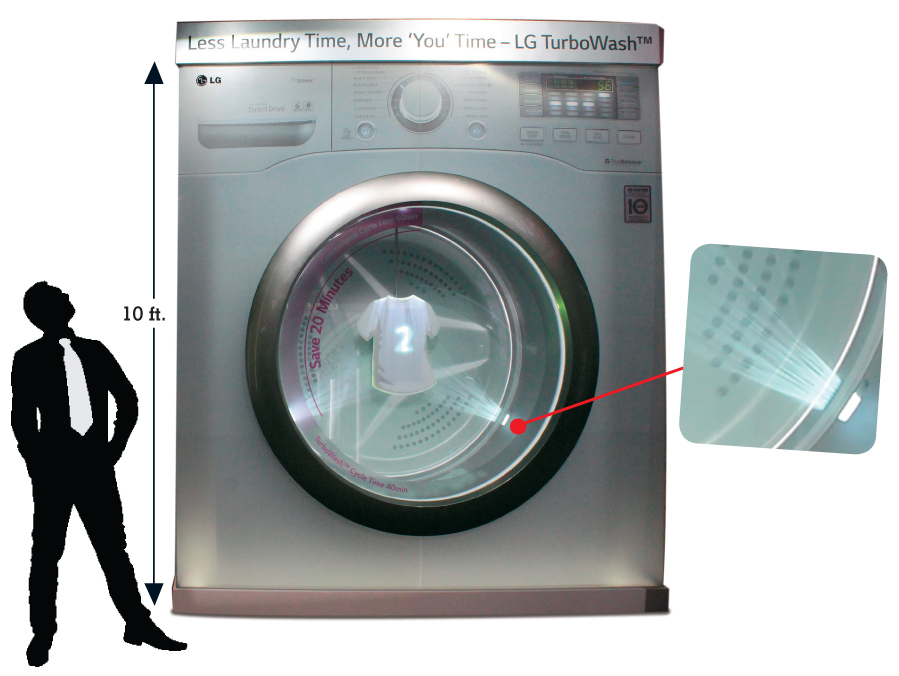
When it comes to motion, sometimes bigger is better. So to communicate to attendees at the International Consumer Electronics Show that its new TurboWash washing machine can slice off 20 minutes per load, LG Electronics Inc. supersized its demonstration. Partnering with J'Dee Cubric and Taylor Manufacturing Industries Inc. (The Taylor Group), based in Korea and Canada, respectively, LG created an oversized replica of the washer complete with white lights that resembled water jets embedded in its rotating drum. When activated, the machine appeared to "wash" a white, T-shirt-shaped piece of vinyl applied to the front-load door, while text projected onto the T-shirt touted the TurboWash's time-saving capabilities. The continual motion inside the oversized appliance drew in attendees for a closer look at the easy-to-interpret visual that communicated the washing machine's key differentiator in a glance.
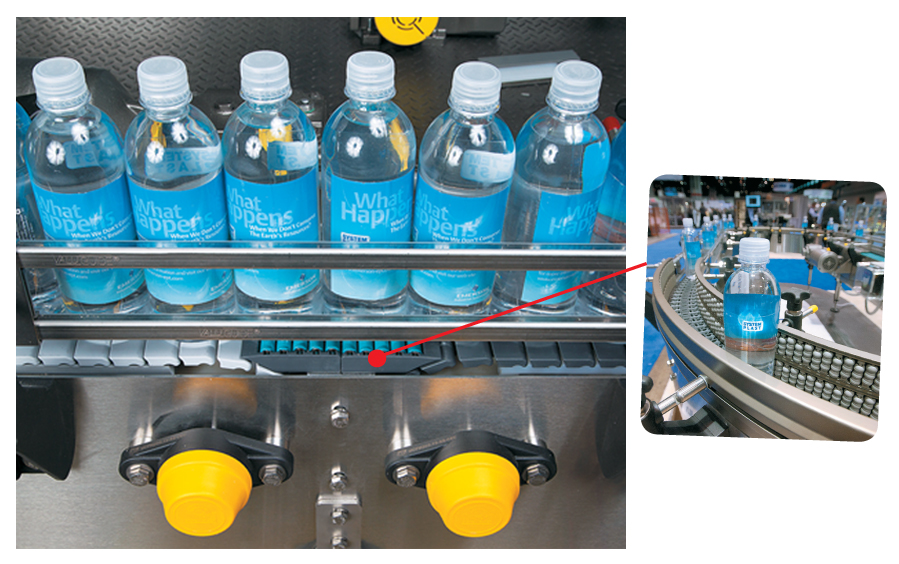
At Pack Expo International, Emerson Industrial Automation, a division of Emerson Electric Co., placed an open 8-by-10-foot, oval-shaped conveyer-belt system in one corner of its 30-by-40-foot booth. One half was equipped with Emerson's System Plast brand conveyer track, belting, etc., and the other half was equipped with industry-standard (and less environmentally friendly) components. Moving parts at the bottom of the track propelled its contents forward, while beaded sidewalls kept those objects upright. The channel-like track was filled with 16-ounce disposable water bottles bearing custom labels that read "What happens when we do not conserve the Earth's resources?" Booth staffers distributed the water to attendees throughout the show. Meanwhile, an overhead monitor tracked the energy usage of both sections of the demonstration, underscoring the 20-percent energy savings attributable to the System Plast components. The kinetic display demonstrated the energy-conserving benefits of its products while the accompanying graphics effectively backed up Emerson's claims.
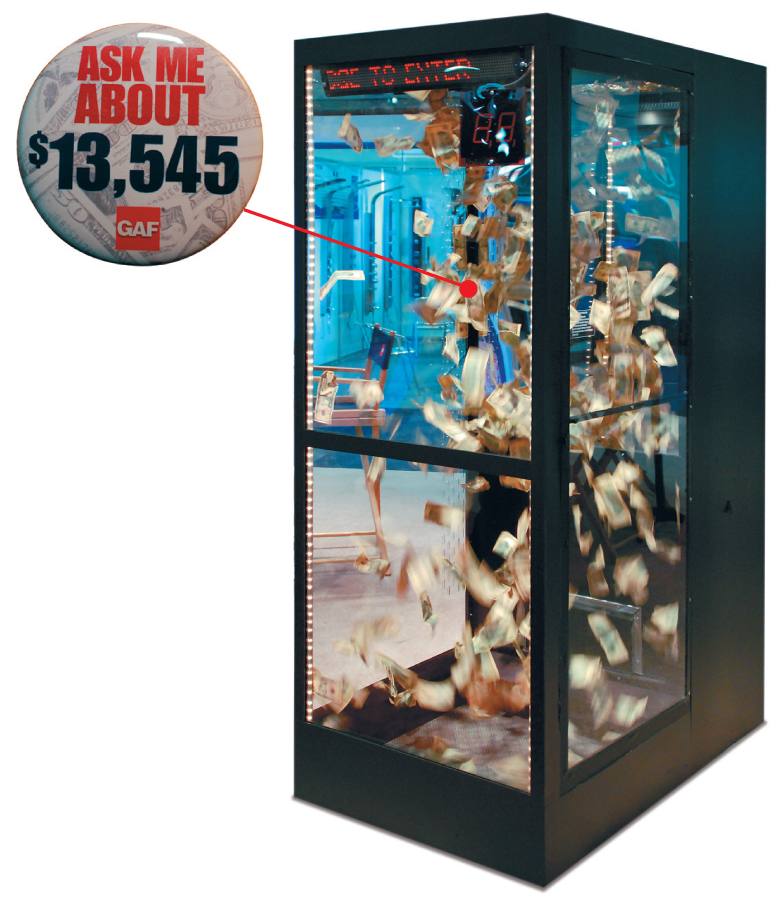
Motion captures the eye — but so does the sight of a whole lot of cash. That's why GAF Materials Corp., with the aid of its exhibit house, Schaumburg, IL-based 3D Exhibits Inc., created an element that incorporated both motion and money for the International Builders' Show. At one edge of the shingle maker's 50-by-60-foot exhibit was an enclosed Plexiglas structure stuffed with cash, which stood 30 inches wide, 30 inches deep, and 7 feet tall. Several thousand dollars' worth of $10 and $20 bills swirled around the booth courtesy of an adjacent air blower. The fast-moving cash reinforced GAF's key selling point: According to a study by the National Association of Realtors, installing GAF's Timberline Lifetime shingles increases a home's value by 5 percent, versus installing competitors' basic three-tab shingles. And for a home valued at the national median listed price of $270,900, that equates to an extra $13,545 in a home seller's pocket. A sign next to the display said "Win $13,545 in cash (The value of upgrading to a Timberline Roof.)" GAF wasn't handing out that chunk of change; rather, staffers explained that home sellers could expect to recoup approximately that amount of money by upgrading their roofs using its Timberline shingles. After the initial attention-grabbing effect of the motion subsided, supporting information was within attendees' gaze. For GAF, that was a reward well worth its weight in gold — or any other currency.
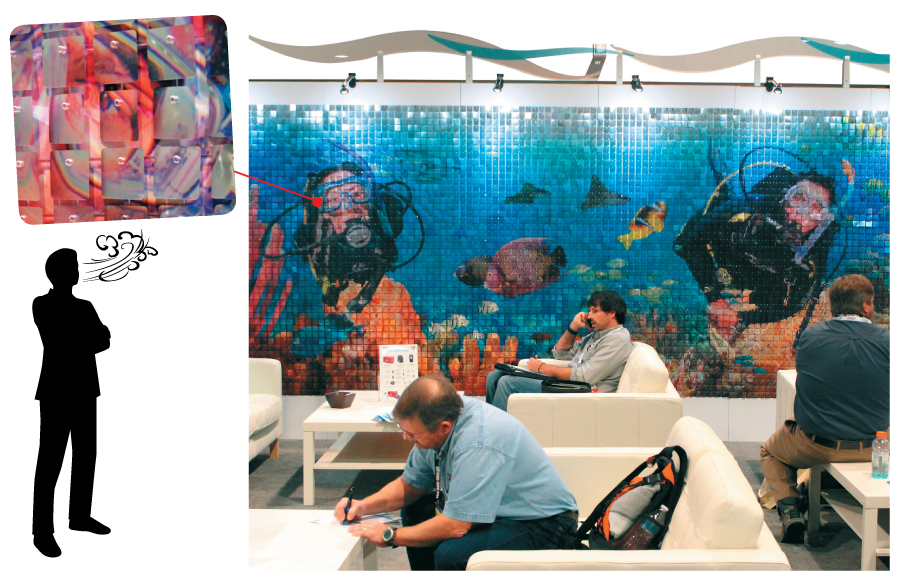
To make its target audience of scuba aficionados feel right at home in its exhibit at the 2014 Diving Equipment & Marketing Association show in Las Vegas, the Professional Association of Diving Instructors (PADI) turned one wall of its in-booth lounge space into an underwater scene. But instead of just printing a seascape on some tensioned fabric and calling it a day, PADI made the scene into a mosaic of sorts with the help of Radiant Manufacturing. Portions of a photo of two divers among coral reefs and tropical fish were printed onto hard, Post-it-sized tiles, which were affixed to the wall sequentially with metal pins. Air currents turned the kaleidoscope of tiles into a moving mosaic that comprised the complete image. Not only did the effect lure in passersby who stopped, stared, and oftentimes blew on the image to make it move, but also the kinetic effect resembled ocean currents and light dappling through the water, creating a see-worthy environment.
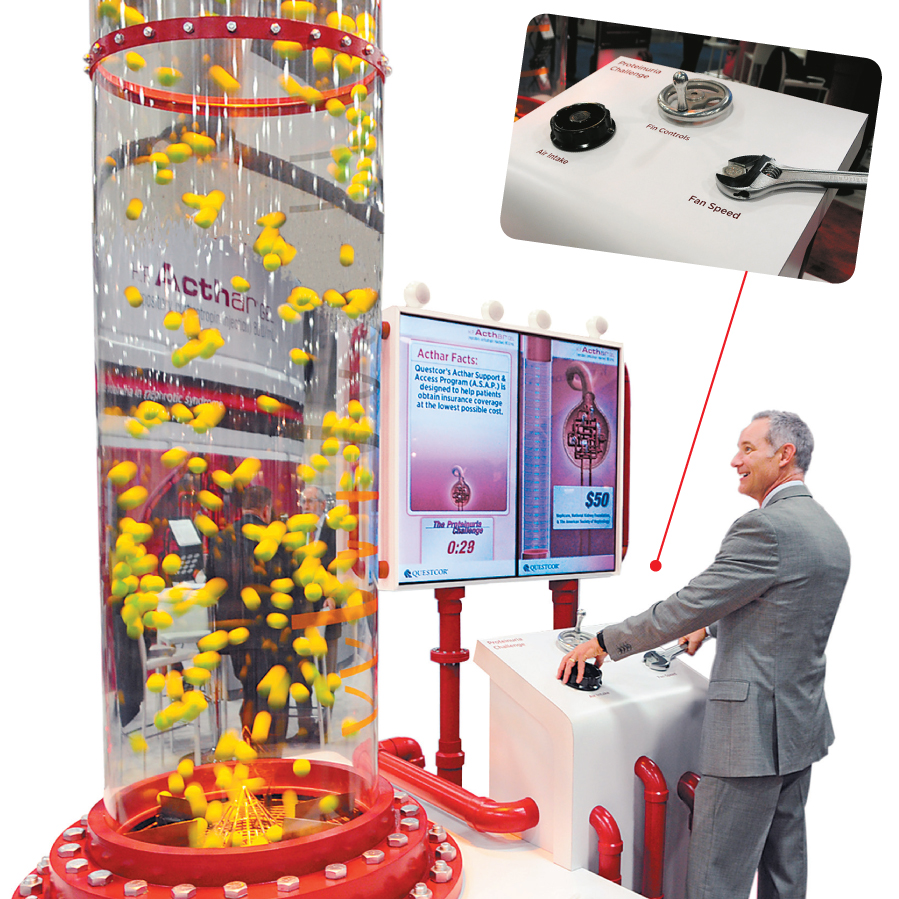
At the American Society of Nephrology Kidney Week show, Questcor Pharmeceuticals Inc. (now known as Mallinckrodt plc) incorporated movement into its hands-on activity to demonstrate how its new drug, Acthar, could help control proteinuria (a condition that results in excess protein in patients' urine). Questcor's exhibit house, Milwaukee-based Derse Inc., built a 10-foot-tall test tube and filled it with more than 100 neon-green foam balls, which represented particles of protein found in a urine specimen. By moving a wrench-shaped lever on an adjacent module that controlled a built-in fan and variable air intake, attendees could manipulate the height at which the balls floated. The purpose was to get the protein particles to hover at an acceptable range marked on the side of the test tube, mimicking how the drug works to control protein levels in patients' bodies. The dynamic in-booth activity was a win-win for Questcor: Drawn from the aisles by the sight of balls swirling like an asteroid belt on fast forward, passersby streamed into the booth where they could participate in the activity and learn more about the company's new medication.
One aspect that affects the degree to which motion attracts the eye is image saliency, i.e., how much a moving object stands out from its background environment. As such, objects in motion that are brightly lit or contrast sharply from their background will stand out more and demand more attention from viewers than poorly lit objects that blend into their backgrounds.
Perceived danger influences motion perception. Nothing in your exhibit should be physically threatening, but there are certain factors that make the human brain perceive an object as more threatening. Faster objects and those moving toward the viewer pose more of a potential threat — and therefore attract more attention — than slower objects moving away from the viewer.
While humans will sense and respond to practically any moving objects within their range of vision, those on the periphery are often deemed less noteworthy than those directly in their line of sight. So instead of a rotating sign hung high atop your exhibit via overhead truss, consider incorporating kinetic elements that will be closer to the eye level of attendees walking by.


Marketplace

- Audiovisual Equipment
- Convention Centers
- Event Data Analytics
- Event Design and Production
- Exhibit Fabrication
- Exhibit Producers
- Exhibit Rental
- Experiential Agency
- Flooring
- Graphics
- International Exhibit Producers
- Kiosks
- Lead Retrieval
- Modular Exhibit Systems
- Portable Display Systems
- Shipping and Transportation
- All Companies
3050R Focus on Attention: How to Optimize your Messaging on the Trade Show Floor
Aug. 4, 2026
6010R The Basics of Event Planning and Management ‑ Part I
Aug. 6, 2026
6011R The Basics of Event Logistics and Implementation ‑ Part II
Aug. 13, 2026
7110R Don't Hesitate, Go Negotiate!
Sep. 22, 2026
2101R Show Ready: Your Guide to Trade Show Operations
All Sessions >>