exhibitor q&a
Help!

Staff Training
QI want to make sure my staff goes to our next show prepared to speak to anyone who walks into our booth. How can I help prepare them to have high-value conversations with attendees without focusing my training solely on product knowledge and memorization?
Often, exhibit marketers approach booth staffing with one goal in mind: Pack every possible product fact into anyone who sets foot on the show floor. The intent is good, but the outcomes are poor and predictable.
It turns booth training into a cram session as people try to pack their brains hoping they'll recall the right answers under pressure. Staffers parrot lists of features, struggle to listen to visitors, and miss the signals that let them tailor conversations, creating a far-from-optimum experience for attendees. This approach not only derails the potential for connection, but tends to drain staff confidence.
The secret to effective booth training is that you don't need everyone in your booth to be able to regurgitate product specs ad nauseum. Rather, your booth team should comprise confident humans who know how to open a conversation and catch the signals that separate a casual visitor from a real opportunity. You'll need a couple of subject matter experts (SMEs) to take over in-depth conversations once attendees have been qualified. However, training for the majority of your staff should build communication and engagement skills, not test product retention. To that end, here's a practical framework that preps teams for high-value conversations without burying them in technical training.
Prioritize Audience Relevance
Rather than focusing on product details, take a deep dive into audience relevance. Start by defining your audience demographic: Who are they? Why are they attending the show? What problems are they trying to solve?
Next, prepare your staff with a short reference guide that links each type of visitor to the outcome that matters most to them. For example, an IT director may care about reducing risk, while a business leader may care about efficiency or cost savings. When staff can match who they are talking to with what that person values, they can more easily spot buying intent and shape the conversation around the visitor's problem instead of the company's product.
Align on the First Three Minutes
The first three minutes after a visitor enters your space set the tone for everything that follows. Thus, staff training must include effective greetings, subtle qualification tactics, and ways to uncover needs. Instead of creating a rigid script, map out a simple conversation path that gives staff a general structure to follow while keeping the interaction natural.
Also, teach staff members how to listen with the intent to understand. Doing so allows them to more easily identify whether someone is researching, comparing vendors, or actively evaluating solutions.
Training should also emphasize the art of asking open-ended questions. Rather than launching into a product pitch, staff can learn to invite visitors to share what brought them to the booth or what challenges they're currently facing. This approach shifts the dynamic from a one-sided presentation to a genuine dialogue. When attendees feel heard, they're far more likely to engage meaningfully and remember the interaction long after the show ends.
Decrease the Details
Training should limit product content to only those details that support the qualification process. Staff members need just a minimal set of product messages to qualify visitors and create effective ways to link those messages directly to the pain points of your target demographic.
Arm staffers with three to five clear value points tied to specific audience profiles. Anything more complex than this should be relayed by your SMEs. Along these same lines, train staff to properly pass the baton. Spend some time talking through smooth and simple ways for booth staff to hand off attendees to SMEs.
Focus on Scenarios
Replace endless presentation decks with scenario modeling that emphasizes skill instead of recall. Walk staff through conversations based on real interactions from past shows, and give them examples of strong handoffs, good open-ended questions, and common traps. Teach skills in engagement, qualification, and transitions through role-playing so the team knows how to support one another on the floor. Scenario-based training also helps staff recognize common traps, such as getting pulled into overly technical conversations they're not equipped to handle or spending too much time with visitors who are unlikely to convert. By practicing these situations in advance, team members develop the instincts needed to navigate tricky moments gracefully.
Assign and Clarify Roles
An effective booth team is a lot like a well-oiled crew of restaurant employees. Each person has a role to play, and each position requires special knowledge or technical skills. Some people greet and serve while others prep meals, manage the crew, or clean up. Within the team, everyone knows their role and stays in their lane.
Your job, then, is to create clear roles for booth staff, such as engager, qualifier, SME, or closer. When each staff member understands their role and how the team functions together, they can trust the conversation path and handoff process. And if you properly assign roles, this structure also keeps energy high, since people are working within their strengths.
Role clarity also benefits team members who are uncomfortable initiating conversations with strangers. By assigning them to positions that play to their strengths, managers can keep these valuable contributors engaged without subjecting them to tasks that drain their energy. This thoughtful allocation of responsibilities ensures that the entire team operates at peak performance throughout the event.
Build Confidence with Tools
Everyone loves a good cheat sheet. So craft one for each role on your team. Focus on visitor profiles, problem statements, value points, differentiators, and handoff cues. And avoid death-by-details product specs. Also design the cheat sheet to be easy to reference on a phone.
Bottom line: When your staffers understand your audience, master the early minutes of a conversation, and know exactly when and how to transition the conversation to an SME, the booth stops feeling like a perpetual pop quiz. Instead, it becomes a place where visitors feel heard and your team gathers real opportunities. That shift delivers far stronger outcomes than any crash course in product details ever will.
It turns booth training into a cram session as people try to pack their brains hoping they'll recall the right answers under pressure. Staffers parrot lists of features, struggle to listen to visitors, and miss the signals that let them tailor conversations, creating a far-from-optimum experience for attendees. This approach not only derails the potential for connection, but tends to drain staff confidence.
The secret to effective booth training is that you don't need everyone in your booth to be able to regurgitate product specs ad nauseum. Rather, your booth team should comprise confident humans who know how to open a conversation and catch the signals that separate a casual visitor from a real opportunity. You'll need a couple of subject matter experts (SMEs) to take over in-depth conversations once attendees have been qualified. However, training for the majority of your staff should build communication and engagement skills, not test product retention. To that end, here's a practical framework that preps teams for high-value conversations without burying them in technical training.
Prioritize Audience Relevance
Rather than focusing on product details, take a deep dive into audience relevance. Start by defining your audience demographic: Who are they? Why are they attending the show? What problems are they trying to solve?
Next, prepare your staff with a short reference guide that links each type of visitor to the outcome that matters most to them. For example, an IT director may care about reducing risk, while a business leader may care about efficiency or cost savings. When staff can match who they are talking to with what that person values, they can more easily spot buying intent and shape the conversation around the visitor's problem instead of the company's product.
Align on the First Three Minutes
The first three minutes after a visitor enters your space set the tone for everything that follows. Thus, staff training must include effective greetings, subtle qualification tactics, and ways to uncover needs. Instead of creating a rigid script, map out a simple conversation path that gives staff a general structure to follow while keeping the interaction natural.
Also, teach staff members how to listen with the intent to understand. Doing so allows them to more easily identify whether someone is researching, comparing vendors, or actively evaluating solutions.
Training should also emphasize the art of asking open-ended questions. Rather than launching into a product pitch, staff can learn to invite visitors to share what brought them to the booth or what challenges they're currently facing. This approach shifts the dynamic from a one-sided presentation to a genuine dialogue. When attendees feel heard, they're far more likely to engage meaningfully and remember the interaction long after the show ends.
Decrease the Details
Training should limit product content to only those details that support the qualification process. Staff members need just a minimal set of product messages to qualify visitors and create effective ways to link those messages directly to the pain points of your target demographic.
Arm staffers with three to five clear value points tied to specific audience profiles. Anything more complex than this should be relayed by your SMEs. Along these same lines, train staff to properly pass the baton. Spend some time talking through smooth and simple ways for booth staff to hand off attendees to SMEs.
Focus on Scenarios
Replace endless presentation decks with scenario modeling that emphasizes skill instead of recall. Walk staff through conversations based on real interactions from past shows, and give them examples of strong handoffs, good open-ended questions, and common traps. Teach skills in engagement, qualification, and transitions through role-playing so the team knows how to support one another on the floor. Scenario-based training also helps staff recognize common traps, such as getting pulled into overly technical conversations they're not equipped to handle or spending too much time with visitors who are unlikely to convert. By practicing these situations in advance, team members develop the instincts needed to navigate tricky moments gracefully.
Assign and Clarify Roles
An effective booth team is a lot like a well-oiled crew of restaurant employees. Each person has a role to play, and each position requires special knowledge or technical skills. Some people greet and serve while others prep meals, manage the crew, or clean up. Within the team, everyone knows their role and stays in their lane.
Your job, then, is to create clear roles for booth staff, such as engager, qualifier, SME, or closer. When each staff member understands their role and how the team functions together, they can trust the conversation path and handoff process. And if you properly assign roles, this structure also keeps energy high, since people are working within their strengths.
Role clarity also benefits team members who are uncomfortable initiating conversations with strangers. By assigning them to positions that play to their strengths, managers can keep these valuable contributors engaged without subjecting them to tasks that drain their energy. This thoughtful allocation of responsibilities ensures that the entire team operates at peak performance throughout the event.
Build Confidence with Tools
Everyone loves a good cheat sheet. So craft one for each role on your team. Focus on visitor profiles, problem statements, value points, differentiators, and handoff cues. And avoid death-by-details product specs. Also design the cheat sheet to be easy to reference on a phone.
Bottom line: When your staffers understand your audience, master the early minutes of a conversation, and know exactly when and how to transition the conversation to an SME, the booth stops feeling like a perpetual pop quiz. Instead, it becomes a place where visitors feel heard and your team gathers real opportunities. That shift delivers far stronger outcomes than any crash course in product details ever will.

Kimberly Kee
general manager, chief marketer network,
Access Intelligence Rockville, MD
Editorial
Muscle Memory
We didn't invent trade shows. We inherited them. They represent humanity's oldest behavior.
Exhibitor Q & A
Staff Training
I want to make sure my staff goes to our next show prepared to speak to anyone who walks into our booth.
Ask Dan
Problem Solving
I want to encourage my staff's creative problem-solving at shows. How can I do that?
Exhibiting 101
David Versus Goliath
In a sea of show-floor behemoths, a small booth can employ the proverbial slingshot to hit above its weight.
Fuel
Ideas That Work
Queue the Experience, Build-a-Brand, Pillow Talk, and more
Products
New Tools
Three Can't-Miss Product Launches
Fixing Snafus
Location, Location, Relocation
When your perfectly installed booth needs to relocate twice in one day...
Archive
Message in a Bottle
1895: The Bordeaux Exposition features a giant bottle of absinthe
Quiz
Cross Examination
Decipher the clues to fill out the crossword puzzle with some of our industry's peculiar jargon and slang.
Design Awards
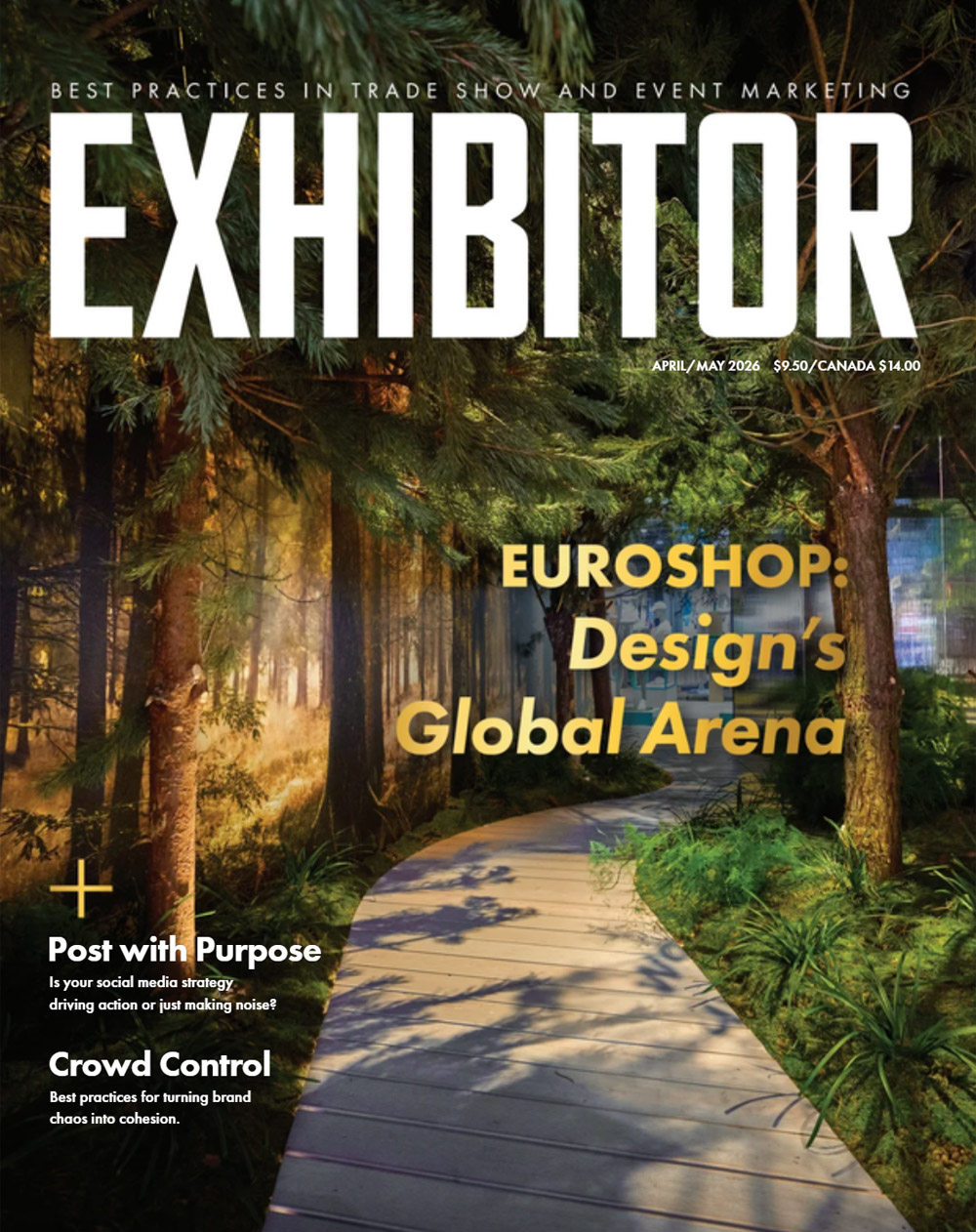
EuroShop: Design's Global Arena
Every three years, EuroShop sets the tone for what retail and exhibit design will become.
International
Designing with Purpose
When it comes to sustainability and experiential design, the world's best stands are raising the bar.
Portfolio
Serving Up Style
Six innovative designs that turned traditional hospitality into memorable highlights of the exhibition experience
Social Media
Posting with Purpose
If your social media strategy is just announcing your booth number, you're missing the point.
Experiential
Ready! Steady! Activation!
Providence, Rhode Island offers plenty of inspiration for event planners trying to engage the public.
Brand Strategy
Crowd Control
Five companies, big and small, show how they de-clutter their multiple brands.