brand strategy
Crowd Control
How is a trade show floor a lot like a Starbucks?
Instead of a simple cup of Joe like you'd get back in the “Mad Men” heyday of Folgers and Maxwell House, you're faced with the daunting task of choosing from among 170,000 possible
combinations that even Stephen Hawking and ChatGPT together couldn't figure out. The problem is generally known as “decision overload,” when people are overwhelmed with too many choices and products.
The same principle that makes the coffee franchise drive you to drink another kind of beverage is hard at work when companies crowd too many brands into one exhibit. Product overload often results, which generates confusion and a crippling inability among your target audience to distinguish one brand from another.
There are as many ways to display multiple brands in one exhibit as there are, well, brands. Here five companies, big and small, show how they de-clutter their brands faster than you can say, “Marie Kondo.” By Charles Pappas
The same principle that makes the coffee franchise drive you to drink another kind of beverage is hard at work when companies crowd too many brands into one exhibit. Product overload often results, which generates confusion and a crippling inability among your target audience to distinguish one brand from another.
There are as many ways to display multiple brands in one exhibit as there are, well, brands. Here five companies, big and small, show how they de-clutter their brands faster than you can say, “Marie Kondo.” By Charles Pappas
Kenvue Gets its Stories Straight
Open up a typical American medicine cabinet and you'll see enough Kenvue Inc. brands to fill an emergency room: Tylenol, Band-Aid, Neutrogena, Listerine, and Imodium, among many others. Spun off from its giant parent Johnson & Johnson in 2023, the consumer-health company's lineup of products is as crowded as an ER on a weekend night. So when Kenvue wants to put a spotlight on its brands and avoid making them look as jumbled as a hospital bill, the Summit, NJ-based company performs a kind of marketing triage.
When it comes to trade shows and events, it adjusts to the specific type, rather than rely on a one-size-fits-all approach. For example, at Smilecon, the American Dental Association's annual conference, it might focus on Listerine. At the National Association of Convenience Stores (NACS), it'll highlight its top 15 products, comprising eight different brands since convenience stores could carry up to that many. Contrast that with its strategy for the Kroger Wellness Festival. At that outdoor consumer event, it focuses on the importance of sun safety, offering free on-site skin checks with dermatologists, and emphasizing the Neutrogena brand, known for its high-SPF sunscreens.
Theme Weaver
Kenvue's favorite way to accomplish cohesion among its many brands at a trade show or event is through a shared theme. For example, during Ulta's Field Leadership Conference a few years back, Kenvue employed a theme of “Get Your Skin in the Game,” which consisted of an interactive boxing experience shared across Neutrogena and Exuviance skincare. Both brands held on to their visual identities by being situated on their respective sides of Kenvue's section, but they also shared a central 360-degree photo booth and brand-specific props, including boxing bags and gloves, jump ropes, and even a Neutrogena Hydro Boost-branded bench press.
But one of the true masterpieces of this strategy was a media event held at the New York Public Library in 2024. With the famed literary institution as backdrop, inspiration, and even metaphor, Kenvue, working with ADM Creative Group, divided its products into stories and chapters whose themes were as clear as “Dick and Jane.” Guests — some 65 journalists and influencers from Allure, Cosmopolitan, Parents, and other publications — entered through a giant open book, its pages replaced with a glowing archway. Inside, cocktails bore cheeky literary aliases such as “The Love Story,” and “The Hard Cover.” The dinner's conversation cards, printed with questions (“When has everyday pain stopped you from doing something you loved?”), divided the attendees into thematic clusters (skin health over here, parenting over there) ensuring that no brand spilled into another's storyline. A poet performed with verses tracing the life cycle of self-care from cradle to adulthood, Johnson's baby products to Tylenol.
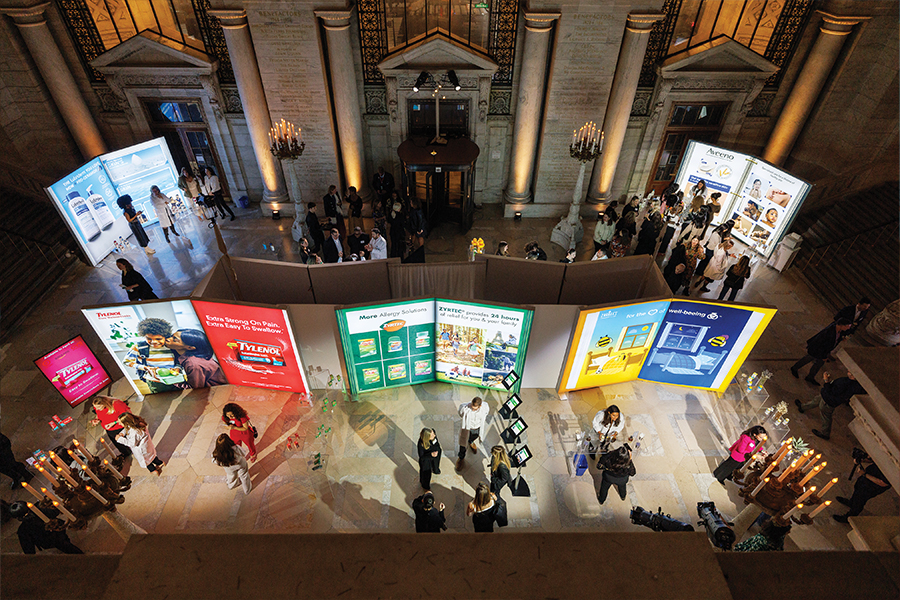
In the event's final act, 11 freestanding installations were styled as oversized books. Behind each one stood a different world. Neutrogena's sunscreen shimmered under a projected sun; Zarbee's was scented with lavender plants; OGX offered a hands-on experiment with static-resistant hair; Band-Aid staged karaoke, its jingle looping like an earworm you can't escape. Together, they built an anthology of stories bound in a single volume.
Media coverage swelled beyond its goal — more than 35 stories, 20 million impressions, and a 10 percent lift in earned media — but the subtler victory was perceptual. In a culture perpetually overwhelmed by brands, Kenvue managed to introduce itself as not only something more than a faceless corporation, but also as an author of products as familiar as “Once upon a time” and “It was a dark and stormy night.” That's Kenvue's story and they're sticking to it.
Family-Style Exhibiting
When Dine Brands Global Inc. set up shop at the Restaurant Finance & Development Conference (RFDC), its goal was to tell a family-style story, which was appropriate for the business behind such family-friendly names as Applebee's, IHOP, and Fuzzy's Taco Shop.
Dine's exhibit team, Hill & Partners, faced down the company's most familiar challenge: The vast majority of attendees at RFDC would recognize the sub-brands instantly, but the Dine Brands name was as unfamiliar to most people as acai bowls and matcha were to the public 20 years ago.
Food for Thought
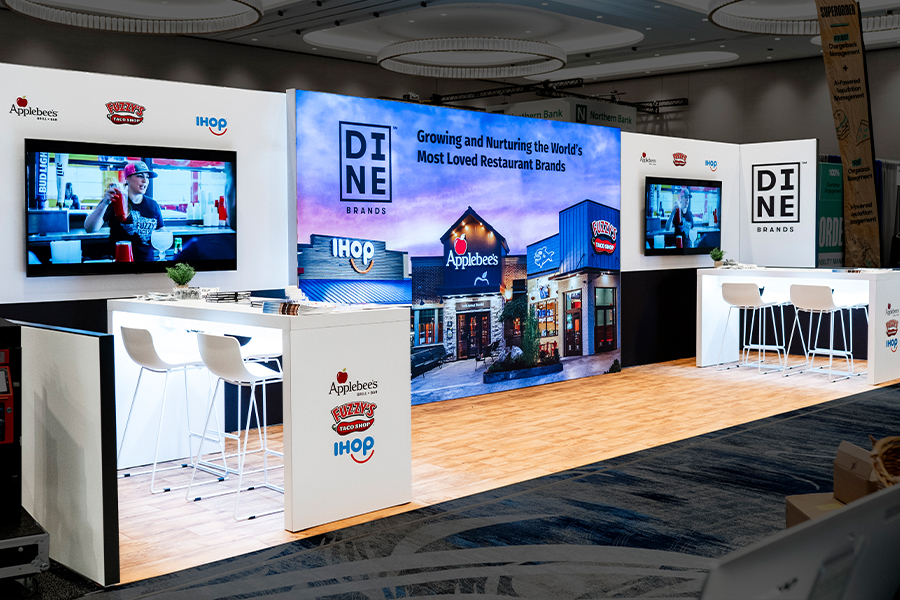
That problem was solved in a 10-by-30-foot booth. In the layout, designers placed the brands in a linear, plain-vanilla arrangement that even mimicked the way the company has started co-locating Applebee's and IHOP restaurants. The simplicity was intentional, removing hierarchy and allowing each brand to stand alone while still contributing to a larger, unified narrative. Each brand had plenty of visual breathing room, yet all were anchored by a cohesive design of modern materials, clean lines, and a warm, even communal feel. In the middle stood a large, glowing lightbox featuring exterior imagery of the sub-brands' restaurants — iconic facades that drew attendees in with the mental click! of instant familiarity. The approach invited passersby to ask how these iconic chains were related. Once they engaged attendees, Dine's representatives were able to widen the conversation from a single franchise to the entire family of brands.
Meeting tables, instead of demo stations, stimulated conversation and turned the usual menu of transactional business discussions into the kind of connections that happen over a good meal. In a space barely longer than a walk to a salad bar, Dine demonstrated that an authentic brand story, along with a well-set table, can bring everyone together.
It's What Inside that Counts
If you had as much skin(care) in the game as L'Oréal S.A., you'd start to understand why its 40-plus empire of brands, from LaRoche-Posay and CeraVe to Thayers and Maybelline, rules the day when it comes to exhibiting. No matter its goal for a show, the groundwork for each starts by laying out a foundation with its exhibit designer, IGOO Activation Ltd. of Hong Kong. The two map out each brand's “territory,” which includes price point, audience, positioning, and visual identity. So-called key “hero” brands (i.e., leaders in their field with sky-high name recognition) are put in center stage, while its niche names receive curated moments in the spotlight within the master design.
That marketing cartography was in evidence for flagship shows such as the TFWA (Tax Free Worlds Association) World Exhibition & Conference that took place in Cannes, France, in October 2025. L'Oréal slathered on its full multi-brand strategy, creating a 55,000-square-foot environment divided into a triad of sections containing nearly 20 brands. Rather than relying exclusively on physical partitions to prevent garbling the brands' messaging, L'Oréal's primary technique was to craft sophisticated yet subtle spatial, visual, and narrative separation for each brand, while making the overall environment feel like one coherent experience.
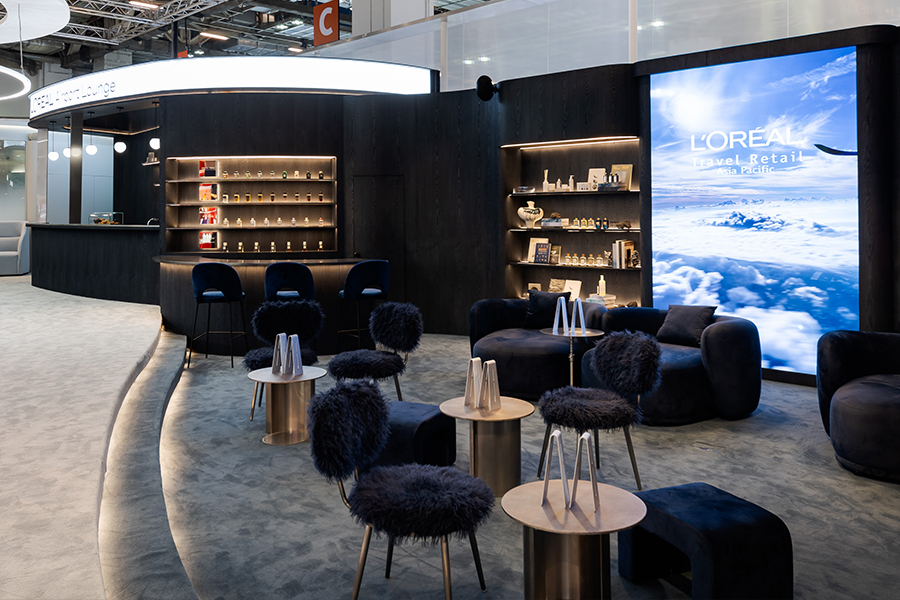
Take the exhibit's Fragrance and Beauty Bar, a discrete zone that contained 11 luxe brands placed on a bar where attendees could spritz scents on themselves and ask the mixologists to whip up a beverage inspired by the mood and story of each of the five featured brands. While those took center stage psychologically, the other brands were placed on the wall, though they were anything but wallflowers.
Compare that to the Slow Care Zone. While the Fragrance and Beauty Bar was as dark as a little black dress, the Slow Care Zone was the shade of flamingos and pink sand beaches.
The space offered a Lancôme experience zone in its core, with two counters showcasing a gallery of the fragrance brands (Armani Prive, Valentino, Miu Miu, among others) and the skincare brands (such as Armani and YSL). Guests could linger with a beverage to wait for consultation service from Lancôme behind the curtain.
While the two spaces appeared as different as mascara and moisturizer, the underlying template for both was the same restrained logic: distinct brand worlds built shoulder to shoulder. In each, the designers carved out a trilogy of space, sightline, and story. Color contrasts drew invisible but palpable borders, while well-planned activities slowed the visitors' pulses just enough to make them stay longer than they probably meant to, and all without causing a single wrinkle of confusion.
Split Take
Problem: Dublin-based Seabridge Freight Services needed a booth for Multimodal 2023 at England's NEC Birmingham. Remedy: a workaround King Solomon would have approved of. More to the point, the global provider of logistics and shipping services required a stand that would allow it to promote both Seabridge and its sister brand, Cosco Shipping, at Multimodal, a key exhibition for the logistics and supply-chain management industry.
Mirror Image
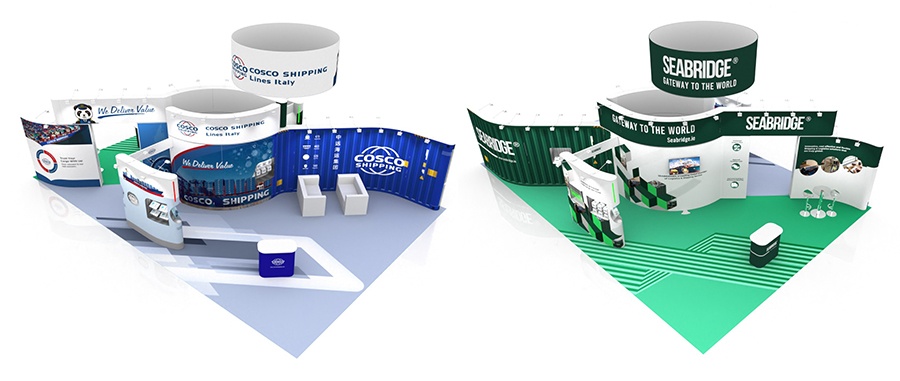
The solution its exhibit house, Quadrant2Design, provided harked back to the Biblical monarch, who built a temple, found time for 700 wives, and turned a custody battle into a parable. But as a substitute for dividing an infant right down the middle, it split the 12-by-8-meter (about 39-by-26 feet) island stand right down the middle instead. Known as mirrored branding, the strategy included one brand with unique messaging, color scheme, and features on one side, while the opposite side of the stand incorporated the sibling brand with its own version of the same attributes. Essentially it created two distinct booths in a single structure. The stand walls themselves became the partition between the dual brands, keeping them separate without muddying their respective messages.
Seabridge's two-in-one booth also featured two suspended cylindrical banners, individually branded, that hung above both sides of the structure to attract visitors to either company. Even the photo-floor was divided straight down the middle, half with Seabridge graphics and the other half with Cosco imagery. A walkthrough feature set into the stand depicted matching shipping container effects for both companies in their corresponding brand colors. This reinforced the link between the two brands, yet also allowed for cross-selling or cross-promotion. Mirrors, in fairy tales like “Snow White,” can be agents of truth or deception. But in Seabridge Freight Services' exhibit, a mirror strategy proved to be the fairest of them all.
Auto Tune
For businesses that have built themselves product by product through acquisition, managing brand identities under one roof can be as difficult as parallel parking blindfolded. For Cox Automotive, a powerhouse that now encompasses a dozen well-known names such as Autotrader and Kelley Blue Book, that dynamic plays out on the trade show floor with all the complexity of a Formula 1 race.
For years the Atlanta-headquartered company cruised along with separate booths for individual brands at trade shows like the National Automobile Dealers Association (NADA) and the Show Digital Dealer Conference.
But independent branding through co-located booths at expos eventually ran out of gas. Cox steered to a refined strategy that concentrated on pulling everyone into one large footprint and one shared strategy. Meaning: Its multiple booths would now be in a single booth, achieving brand cohesion without sacrificing individual brand strength.
In the Driver's Seat
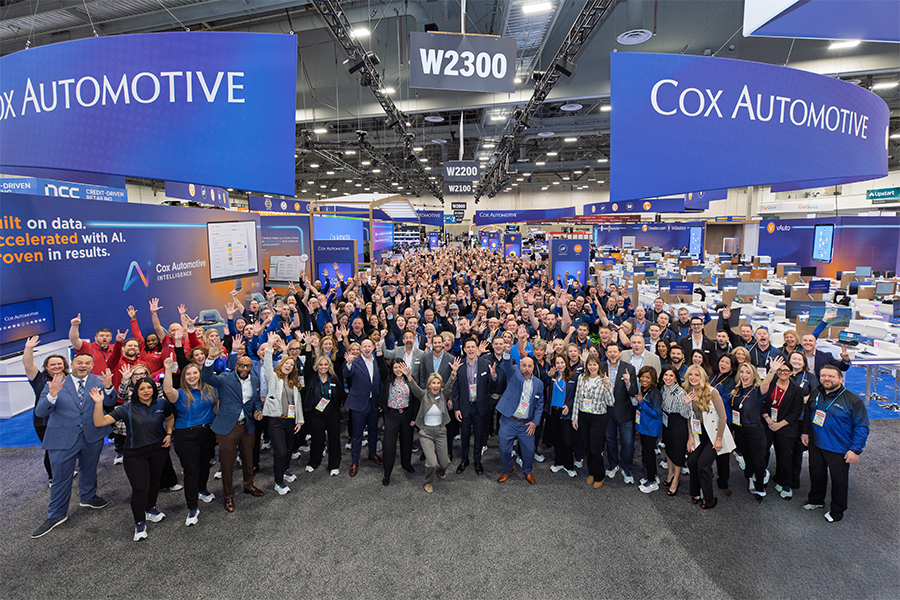
Going from separate booths to a combined exhibit was a big jump that even a monster truck would have trouble making. To handle this, Cox would use a refined strategy that focused on creating a cohesive space that still allowed for individual brand identity. The top-level signage was focused on Cox Automotive and the eye-level signage was focused on the individual brands. The brand identity came through in each of their individual areas within the booth. These included demo stations, logos, digital screens, etc., tied together with key elements like overhead structure, lighting, and carpet.
The company's marketing team evolved its staff training to speed beyond mere product knowledge. The training now spans everything from handling booth flow and demo handoffs to how to introduce clients to other brand experts within the shared space. Live demos remain an anchor to engagement, with sales associates trained to guide discussions across the company's full suite of offerings. That designed-in ebb and flow capture how its clients actually move through the marketplace, weaving between brands in search of what they need.
The strategy is not rigid. A hot topic of ongoing discussion at Cox is whether to showcase all brands versus only participating brands. At the Digital Deal Conference & Expo last fall, it placed all brands on the exterior backwall and showcased participating brands in the interior backwall and on screensavers.
The Cox strategy was firing on all cylinders at the 2026 NADA Show in Las Vegas. The tier one of its 22,000-square-foot exhibit was established by the Cox Automotive name brandished on an exterior ceiling element that formed a can't-miss-it brand umbrella. Tier two was on the inside, where it promoted 10 of its 12 brands in distinct zones within the booth that allowed each to be unmistakable while connecting with the Cox name through shared materials, lighting, and content. Cox extended the message through off-floor touchpoints like receptions, out-of-home placements, and experiential events that linked each brand to the company's larger story. By changing direction with its brand exhibiting, Cox Automotive swerved through an obstacle course of potential pitfalls with a strategy for which, as Porsche used to brag about its sleek roadsters, “There is no substitute.” E
Open up a typical American medicine cabinet and you'll see enough Kenvue Inc. brands to fill an emergency room: Tylenol, Band-Aid, Neutrogena, Listerine, and Imodium, among many others. Spun off from its giant parent Johnson & Johnson in 2023, the consumer-health company's lineup of products is as crowded as an ER on a weekend night. So when Kenvue wants to put a spotlight on its brands and avoid making them look as jumbled as a hospital bill, the Summit, NJ-based company performs a kind of marketing triage.
When it comes to trade shows and events, it adjusts to the specific type, rather than rely on a one-size-fits-all approach. For example, at Smilecon, the American Dental Association's annual conference, it might focus on Listerine. At the National Association of Convenience Stores (NACS), it'll highlight its top 15 products, comprising eight different brands since convenience stores could carry up to that many. Contrast that with its strategy for the Kroger Wellness Festival. At that outdoor consumer event, it focuses on the importance of sun safety, offering free on-site skin checks with dermatologists, and emphasizing the Neutrogena brand, known for its high-SPF sunscreens.
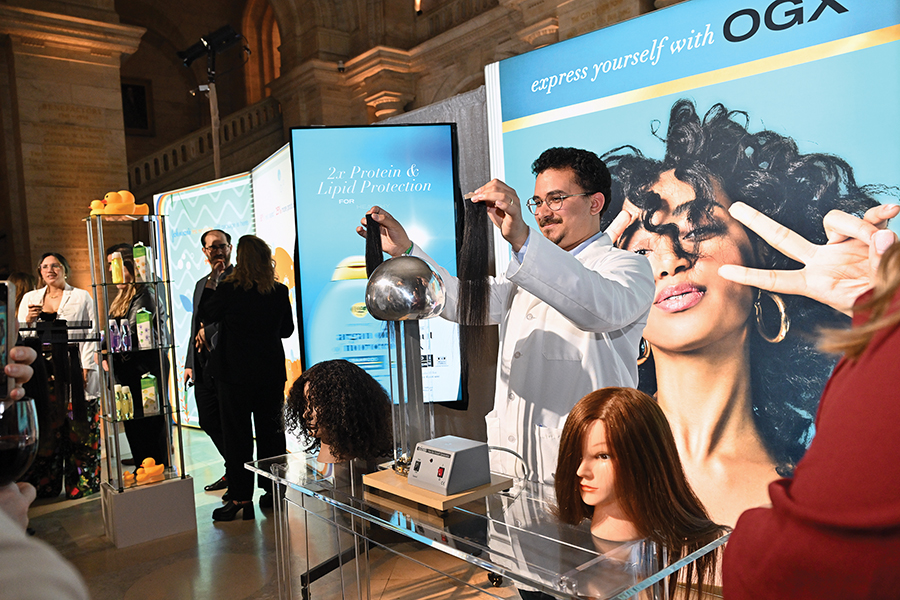
During an event at the New York Public Library in 2025, Kenvue brand OGX engaged event attendees with a live demonstration of its anti-static hair technology.
Theme Weaver
Kenvue's favorite way to accomplish cohesion among its many brands at a trade show or event is through a shared theme. For example, during Ulta's Field Leadership Conference a few years back, Kenvue employed a theme of “Get Your Skin in the Game,” which consisted of an interactive boxing experience shared across Neutrogena and Exuviance skincare. Both brands held on to their visual identities by being situated on their respective sides of Kenvue's section, but they also shared a central 360-degree photo booth and brand-specific props, including boxing bags and gloves, jump ropes, and even a Neutrogena Hydro Boost-branded bench press.
But one of the true masterpieces of this strategy was a media event held at the New York Public Library in 2024. With the famed literary institution as backdrop, inspiration, and even metaphor, Kenvue, working with ADM Creative Group, divided its products into stories and chapters whose themes were as clear as “Dick and Jane.” Guests — some 65 journalists and influencers from Allure, Cosmopolitan, Parents, and other publications — entered through a giant open book, its pages replaced with a glowing archway. Inside, cocktails bore cheeky literary aliases such as “The Love Story,” and “The Hard Cover.” The dinner's conversation cards, printed with questions (“When has everyday pain stopped you from doing something you loved?”), divided the attendees into thematic clusters (skin health over here, parenting over there) ensuring that no brand spilled into another's storyline. A poet performed with verses tracing the life cycle of self-care from cradle to adulthood, Johnson's baby products to Tylenol.
Kenvue divided its products into stories and chapters at a 2025 media event where freestanding installations
designed to appear as oversized books separated brands like volumes on a shelf.
In the event's final act, 11 freestanding installations were styled as oversized books. Behind each one stood a different world. Neutrogena's sunscreen shimmered under a projected sun; Zarbee's was scented with lavender plants; OGX offered a hands-on experiment with static-resistant hair; Band-Aid staged karaoke, its jingle looping like an earworm you can't escape. Together, they built an anthology of stories bound in a single volume.
Media coverage swelled beyond its goal — more than 35 stories, 20 million impressions, and a 10 percent lift in earned media — but the subtler victory was perceptual. In a culture perpetually overwhelmed by brands, Kenvue managed to introduce itself as not only something more than a faceless corporation, but also as an author of products as familiar as “Once upon a time” and “It was a dark and stormy night.” That's Kenvue's story and they're sticking to it.
The Takeaway:
Analyze the attendees coming to a show and only exhibit the brands they're most likely to be interested in, saving you from unnecessary expenditures on space and staff. Alternatively, if you must bring an extensive variety of brands to a show, group them all under a shared theme.
Analyze the attendees coming to a show and only exhibit the brands they're most likely to be interested in, saving you from unnecessary expenditures on space and staff. Alternatively, if you must bring an extensive variety of brands to a show, group them all under a shared theme.
Family-Style Exhibiting
When Dine Brands Global Inc. set up shop at the Restaurant Finance & Development Conference (RFDC), its goal was to tell a family-style story, which was appropriate for the business behind such family-friendly names as Applebee's, IHOP, and Fuzzy's Taco Shop.
Dine's exhibit team, Hill & Partners, faced down the company's most familiar challenge: The vast majority of attendees at RFDC would recognize the sub-brands instantly, but the Dine Brands name was as unfamiliar to most people as acai bowls and matcha were to the public 20 years ago.
At the Restaurant Finance & Development Conference (RFDC), Dine Brands Global Inc. arranged its brands next to each other so visitors could shift comfortably from known options to lesser-known ones, while ensuring all were equally represented.
Food for Thought
That problem was solved in a 10-by-30-foot booth. In the layout, designers placed the brands in a linear, plain-vanilla arrangement that even mimicked the way the company has started co-locating Applebee's and IHOP restaurants. The simplicity was intentional, removing hierarchy and allowing each brand to stand alone while still contributing to a larger, unified narrative. Each brand had plenty of visual breathing room, yet all were anchored by a cohesive design of modern materials, clean lines, and a warm, even communal feel. In the middle stood a large, glowing lightbox featuring exterior imagery of the sub-brands' restaurants — iconic facades that drew attendees in with the mental click! of instant familiarity. The approach invited passersby to ask how these iconic chains were related. Once they engaged attendees, Dine's representatives were able to widen the conversation from a single franchise to the entire family of brands.
Meeting tables, instead of demo stations, stimulated conversation and turned the usual menu of transactional business discussions into the kind of connections that happen over a good meal. In a space barely longer than a walk to a salad bar, Dine demonstrated that an authentic brand story, along with a well-set table, can bring everyone together.
The Takeaway:
Placing brands side by side allows attendees to quickly move from ones they know to ones they are less familiar with and puts them all on equal footing.
Placing brands side by side allows attendees to quickly move from ones they know to ones they are less familiar with and puts them all on equal footing.
It's What Inside that Counts
If you had as much skin(care) in the game as L'Oréal S.A., you'd start to understand why its 40-plus empire of brands, from LaRoche-Posay and CeraVe to Thayers and Maybelline, rules the day when it comes to exhibiting. No matter its goal for a show, the groundwork for each starts by laying out a foundation with its exhibit designer, IGOO Activation Ltd. of Hong Kong. The two map out each brand's “territory,” which includes price point, audience, positioning, and visual identity. So-called key “hero” brands (i.e., leaders in their field with sky-high name recognition) are put in center stage, while its niche names receive curated moments in the spotlight within the master design.
That marketing cartography was in evidence for flagship shows such as the TFWA (Tax Free Worlds Association) World Exhibition & Conference that took place in Cannes, France, in October 2025. L'Oréal slathered on its full multi-brand strategy, creating a 55,000-square-foot environment divided into a triad of sections containing nearly 20 brands. Rather than relying exclusively on physical partitions to prevent garbling the brands' messaging, L'Oréal's primary technique was to craft sophisticated yet subtle spatial, visual, and narrative separation for each brand, while making the overall environment feel like one coherent experience.
L'Oréal S.A. designs multibrand exhibits using spatial storytelling and understated but clear segmentation to showcase its many brands' distinct identities.
Take the exhibit's Fragrance and Beauty Bar, a discrete zone that contained 11 luxe brands placed on a bar where attendees could spritz scents on themselves and ask the mixologists to whip up a beverage inspired by the mood and story of each of the five featured brands. While those took center stage psychologically, the other brands were placed on the wall, though they were anything but wallflowers.
Compare that to the Slow Care Zone. While the Fragrance and Beauty Bar was as dark as a little black dress, the Slow Care Zone was the shade of flamingos and pink sand beaches.
The space offered a Lancôme experience zone in its core, with two counters showcasing a gallery of the fragrance brands (Armani Prive, Valentino, Miu Miu, among others) and the skincare brands (such as Armani and YSL). Guests could linger with a beverage to wait for consultation service from Lancôme behind the curtain.
While the two spaces appeared as different as mascara and moisturizer, the underlying template for both was the same restrained logic: distinct brand worlds built shoulder to shoulder. In each, the designers carved out a trilogy of space, sightline, and story. Color contrasts drew invisible but palpable borders, while well-planned activities slowed the visitors' pulses just enough to make them stay longer than they probably meant to, and all without causing a single wrinkle of confusion.
The Takeaway:
Distinguish brands by organizing them into distinct vignettes, each with unique spatial layouts, visual styles, and storytelling approaches. This enhances their memorability and differentiation for your audience.
Distinguish brands by organizing them into distinct vignettes, each with unique spatial layouts, visual styles, and storytelling approaches. This enhances their memorability and differentiation for your audience.
Split Take
Problem: Dublin-based Seabridge Freight Services needed a booth for Multimodal 2023 at England's NEC Birmingham. Remedy: a workaround King Solomon would have approved of. More to the point, the global provider of logistics and shipping services required a stand that would allow it to promote both Seabridge and its sister brand, Cosco Shipping, at Multimodal, a key exhibition for the logistics and supply-chain management industry.
At Multimodal 2023, Seabridge Freight Services made a bold choice. Dividing the booth into binary zones simplified side-by-side comparisons while leveling any differences in how much attendees recognized the brands. Splitting the space into two distinct zones made evaluating the brands a straightforward task for attendees.
Mirror Image
The solution its exhibit house, Quadrant2Design, provided harked back to the Biblical monarch, who built a temple, found time for 700 wives, and turned a custody battle into a parable. But as a substitute for dividing an infant right down the middle, it split the 12-by-8-meter (about 39-by-26 feet) island stand right down the middle instead. Known as mirrored branding, the strategy included one brand with unique messaging, color scheme, and features on one side, while the opposite side of the stand incorporated the sibling brand with its own version of the same attributes. Essentially it created two distinct booths in a single structure. The stand walls themselves became the partition between the dual brands, keeping them separate without muddying their respective messages.
Seabridge's two-in-one booth also featured two suspended cylindrical banners, individually branded, that hung above both sides of the structure to attract visitors to either company. Even the photo-floor was divided straight down the middle, half with Seabridge graphics and the other half with Cosco imagery. A walkthrough feature set into the stand depicted matching shipping container effects for both companies in their corresponding brand colors. This reinforced the link between the two brands, yet also allowed for cross-selling or cross-promotion. Mirrors, in fairy tales like “Snow White,” can be agents of truth or deception. But in Seabridge Freight Services' exhibit, a mirror strategy proved to be the fairest of them all.
The Takeaway:
Segment the booth into binary zones (e.g., left/right or anterior/posterior allocation per brand) to prevent any perceptual overlap. This configuration makes comparative assessment of the brands easy but also neutralizes disparities in brand recognition.
Segment the booth into binary zones (e.g., left/right or anterior/posterior allocation per brand) to prevent any perceptual overlap. This configuration makes comparative assessment of the brands easy but also neutralizes disparities in brand recognition.
Auto Tune
For businesses that have built themselves product by product through acquisition, managing brand identities under one roof can be as difficult as parallel parking blindfolded. For Cox Automotive, a powerhouse that now encompasses a dozen well-known names such as Autotrader and Kelley Blue Book, that dynamic plays out on the trade show floor with all the complexity of a Formula 1 race.
For years the Atlanta-headquartered company cruised along with separate booths for individual brands at trade shows like the National Automobile Dealers Association (NADA) and the Show Digital Dealer Conference.
But independent branding through co-located booths at expos eventually ran out of gas. Cox steered to a refined strategy that concentrated on pulling everyone into one large footprint and one shared strategy. Meaning: Its multiple booths would now be in a single booth, achieving brand cohesion without sacrificing individual brand strength.
Cox Automotive shifted gears, uniting multiple brands into one booth and driving cohesive identity while keeping each brand in its own lane.
In the Driver's Seat
Going from separate booths to a combined exhibit was a big jump that even a monster truck would have trouble making. To handle this, Cox would use a refined strategy that focused on creating a cohesive space that still allowed for individual brand identity. The top-level signage was focused on Cox Automotive and the eye-level signage was focused on the individual brands. The brand identity came through in each of their individual areas within the booth. These included demo stations, logos, digital screens, etc., tied together with key elements like overhead structure, lighting, and carpet.
The company's marketing team evolved its staff training to speed beyond mere product knowledge. The training now spans everything from handling booth flow and demo handoffs to how to introduce clients to other brand experts within the shared space. Live demos remain an anchor to engagement, with sales associates trained to guide discussions across the company's full suite of offerings. That designed-in ebb and flow capture how its clients actually move through the marketplace, weaving between brands in search of what they need.
The strategy is not rigid. A hot topic of ongoing discussion at Cox is whether to showcase all brands versus only participating brands. At the Digital Deal Conference & Expo last fall, it placed all brands on the exterior backwall and showcased participating brands in the interior backwall and on screensavers.
The Cox strategy was firing on all cylinders at the 2026 NADA Show in Las Vegas. The tier one of its 22,000-square-foot exhibit was established by the Cox Automotive name brandished on an exterior ceiling element that formed a can't-miss-it brand umbrella. Tier two was on the inside, where it promoted 10 of its 12 brands in distinct zones within the booth that allowed each to be unmistakable while connecting with the Cox name through shared materials, lighting, and content. Cox extended the message through off-floor touchpoints like receptions, out-of-home placements, and experiential events that linked each brand to the company's larger story. By changing direction with its brand exhibiting, Cox Automotive swerved through an obstacle course of potential pitfalls with a strategy for which, as Porsche used to brag about its sleek roadsters, “There is no substitute.” E
The Takeaway:
Evaluate the likely attendees for each show and bring only the brands relevant to that audience. Place the master brand on the exhibit's exterior and arrange immersive zones inside where each sub-brand can express its individuality but share materials, lighting, and content. Additionally, train staff to introduce guests to other brand experts within the shared space.
Evaluate the likely attendees for each show and bring only the brands relevant to that audience. Place the master brand on the exhibit's exterior and arrange immersive zones inside where each sub-brand can express its individuality but share materials, lighting, and content. Additionally, train staff to introduce guests to other brand experts within the shared space.
Editorial
Muscle Memory
We didn't invent trade shows. We inherited them. They represent humanity's oldest behavior.
Exhibitor Q & A
Staff Training
I want to make sure my staff goes to our next show prepared to speak to anyone who walks into our booth.
Ask Dan
Problem Solving
I want to encourage my staff's creative problem-solving at shows. How can I do that?
Exhibiting 101
David Versus Goliath
In a sea of show-floor behemoths, a small booth can employ the proverbial slingshot to hit above its weight.
Fuel
Ideas That Work
Queue the Experience, Build-a-Brand, Pillow Talk, and more
Products
New Tools
Three Can't-Miss Product Launches
Fixing Snafus
Location, Location, Relocation
When your perfectly installed booth needs to relocate twice in one day...
Archive
Message in a Bottle
1895: The Bordeaux Exposition features a giant bottle of absinthe
Quiz
Cross Examination
Decipher the clues to fill out the crossword puzzle with some of our industry's peculiar jargon and slang.
Design Awards
EuroShop: Design's Global Arena
Every three years, EuroShop sets the tone for what retail and exhibit design will become.
International
Designing with Purpose
When it comes to sustainability and experiential design, the world's best stands are raising the bar.
Portfolio
Serving Up Style
Six innovative designs that turned traditional hospitality into memorable highlights of the exhibition experience
Social Media
Posting with Purpose
If your social media strategy is just announcing your booth number, you're missing the point.
Experiential
Ready! Steady! Activation!
Providence, Rhode Island offers plenty of inspiration for event planners trying to engage the public.
Brand Strategy
Crowd Control
Five companies, big and small, show how they de-clutter their multiple brands.