|
|
product launch |
 |

 |
EVENT AT A GLANCE
Objective: Increase awareness about the acquisition of Panache by Classic Party Rentals and the new products and services the company offers clients and prospects.
Strategy: Turn the company’s yearly client-appreciation reception into a fashion-themed extravaganza to generate industry buzz and garner media attention.
Tactics: Host a multifaceted event that consists of a tabletop-design competition, warehouse tour, and linen fashion show; create an event RSVP Web site to track clickthroughs from invitation e-blasts and drive traffic to the company’s Web site.
Results: Panache Fashion Week generated 2,745 Web-site hits, $75,000 in at-event sales, and coverage in local and national industry publications.
|
|
t first glance, table linens have little in common with haute couture. After all, it’s hard to mistake a tailored tea-length dress for a table runner. However, a closer look reveals the two aren’t all that different. Both comprise fabric. Both are used to dress up an otherwise plain surface. And both tend to get glitzier around the holidays. Those parallels are in part what inspired Kelly Murphy, president and general manager of table-linen-rental company Panache, A Classic Party Rentals Co., to merge the two seemingly disparate ideas into one fashion-forward concept: a table-linen fashion show. As in, models sashaying down a runway like nobody’s business wearing garments made from table linens — a situation that in any other context might elicit Tim Gunn’s iconic directive, “Make it work.” But Murphy was no fashion freshman, and this wasn’t Parsons The New School for Design.
Murphy’s concept first hit the catwalk in 1997, and she has since repeated the runway show several times. One year, for example, students from the Art Institute of Fort Lauderdale created garments for a class project, and used Panache’s table linens as fabric. “We have done the fashion show with linens many times over the years,” she says. “Our influence was ‘Fashion Week,’ which is held in major cities nationwide, including in our backyard, Miami.” So, it made sense that Pompano Beach, FL-based Panache would turn once again to that staple when it debuted its new fall line of linens in September 2008 — with one French twist.
The previous year, Classic Party Rentals, a national, full-service event-rental company, had acquired Panache, which in turn changed its name to Panache, A Classic Party Rentals Co. The acquisition meant that Panache could now, thanks to the national network of partner companies owned by Classic Party Rentals, offer its clients and prospects a wider range of products and services from tents to HVAC systems. And Panache was eager to spread the word to industry A-listers.
In addition to the buzz-worthy acquisition and the fact that the debut lined up with official Fashion Week events in Miami and New York, Panache’s fall line had also elicited a range of comments from its own employees that hinted the linens were pretty enough to wear. And then it hit Murphy harder than a Balenciaga bag to the head during a frenzy at a sample sale: Instead of just another one-off runway show, she would host her own one-day version of fashion week, complete with fashion, food, cocktails, and a little friendly competition. With clothes made of the company’s new linens and partner companies acting as sponsors, Murphy’s vision of “Panache Fashion Week” began to take shape.
| Though Panache had the couture concept pinned down, it couldn’t lose sight of the objectives for the event — to introduce Classic Party Rentals’ senior management to clients and prospects, draw media attention, showcase new products for the upcoming event season, and ultimately generate sales. And as impressive as a table runner-turned-sari is to watch swooshing down the runway, it doesn’t exactly scream “place me on the tables at your next party!” To accomplish that, Murphy and her team needed to execute an event strategy that would not only attract attendees like hipsters to the grand opening of an American Apparel store, but also educate guests about the acquisition and entice them to sign on the dotted line.
Thus, she decided to showcase tangible applications for Panache’s linens and accessories alongside the outrageous outfits. So Murphy began devising a customer-appreciation-slash-launch event that was a soft sales pitch couched in a fun fashion show, all with a Gap-sized budget of $15,000.
SETTING THE TABLE
In the past, Panache had relied on a relatively low-key — albeit quirky — approach to debuting its new lines (the new lines are typically unveiled right before the height of the holiday season). And linen fashion shows were just the tip of the Vivienne Westwood heel. “We have always tried to do something out of the ordinary,” Murphy says. “For example, one year we did ‘speed dining’ with 350 guests. It was a sit-down dinner that required guests to change seats inbetween courses to encourage networking.” Although interesting from the attendee perspective, the networking angle didn’t necessarily boost Panache’s bottom line.
Caterers and decorators were invited to set up shop at a particular event venue (typically the company’s warehouse), and used the platform to wine and dine industry peers, who were, by nature of the business, potential clients themselves. The benefit to Panache was that the event’s design, food, and beverage was essentially donated by its clients (caterers, event planners, and decorators) and packaged as an event sponsorship. The drawback, however, was that little was done to actively highlight Panache’s line of rental linens, other than using them to dress the tables. Not exactly the makings of a buzz-building blowout.
So to elevate the blasé event to blowout status and reach as many industry people as possible, Murphy and her team planned a multifaceted evening that would put the spotlight back on Panache — while still offering the sponsorship
opportunities to clients. The team settled on an agenda that consisted of a tabletop design competition, a tour of Panache’s warehouse, and a table-linen-turned-garment fashion show.
To pique the interest of its clients and to broadcast the message that this was no under-the-table soft launch, Panache distributed 5,000 save-the-date announcements via invoices and other mailed correspondence in the two months leading up to the Sept. 25 event. The company also handed out similar save-the-dates during the monthly meetings of industry associations, such as the National Association of Catering Executives (NACE), the International Special Events Society (ISES), and Meeting Planners International (MPI) — members of which make up 15 percent of Panache’s client base.
Murphy and her team reached out again a month later, this time including event information in the company’s monthly e-mail newsletter, which was sent to its database of 7,000 clients, including trade and industry partners. The e-mail directed recipients to RSVP online by visiting the event’s Web site (www.PanacheFashionWeek.com). In addition to tracking RSVPs, the site featured information about the evening’s events, as well as the list of Panache client companies that were participating in the festivities as event sponsors.
To keep the event top-of-mind among invitees and registrants, Panache sent weekly e-mail invitations to its client database in the three weeks leading up the event. And to up the invitation ante even further, the company sent its staffers to hand deliver postcard invitations to those not yet registered, placed an event logo in all e-mail signatures that pointed recipients to the Web site, and made follow-up phone calls to clients encouraging them to attend Panache Fashion Week.
The multiple touch points ensured that even if invitees couldn’t attend, they would at least be aware of the event and the acquisition by Classic Party Rentals, news of which was included in each correspondence. With its clients and prospects now fully aware of the upcoming event, Murphy and her team secured catering companies to provide food and beverage service, models from area agencies to model the linen creations, and event designers to dress the models and the tables. Getting buy-in from that many people may seem like a supermodel-tall order, but the team didn’t have to pound the pavement long before its sponsorship slots were full, proving that sometimes all you have to do is ask.
“Many of our clients and vendors have participated in past Panache events, and the results for them have been very positive,” Murphy says. “So we simply ask, and participation is granted on a first-come, first-served basis.” In addition to securing sponsors, the team also cleaned the company’s warehouse, which would serve as the venue but it would still have to be operational in the days leading up to the event.
LINENS AND THINGS
When attendees arrived at Panache’s warehouse the evening of the event, they were directed to the showroom, where they checked in and were greeted by event staff. Once inside the showroom, which typically showcases different ways clients can use Panache linens and accessories, guests encountered the first attraction of the night: the tabletop competition. Murphy had invited four event-design companies (Panache clients) to dress one of four tables to the nines, with themes ranging from tropical to autumnal. Each tabletop creation was put together using Panache linens and accessories — and attendees were invited to vote on their favorite design, with the winner to be announced at the end of the evening.
Murphy hoped that the designs would spark creativity among attendees, and keep the company top-of-mind among event planners during the upcoming holiday season. “The fashion concept is relative to the trends of the event industry in terms of style and color, so showing those trends to our clients helps drive the eye of creativity,”
Murphy says. While attendees perused the tabletops, they mingled with Classic Party Rentals’ senior management, drank wine, and dined on passed hors d’oeuvres.
After a pivot-and-turn in the showroom, guests were guided through the “swatch room,” a 12-by-15-foot space housing all of the company’s fabric swatches and linen samples for customers to peruse. The tour moved through that area to the 35-by-60-foot sewing room — where the company turns yards of fabric into table linens — which had been transformed into “Club Panache.” The space was divided into eight separate vignettes, each filled with table settings covered in Panache linens. “We created color stories that combined not only linens, but all the tabletop items as well as furniture,” Murphy says. Like a lookbook come to life, each color story was designed to inspire attendees by providing examples of practical applications for Panache linens in a show, don’t tell, sales pitch. The idea was to get event planners thinking about how they could use the company’s linens and take advantage of the network of Classic Party Rentals companies and their respective products for their own events.
Alongside the vignettes was a cocktail lounge area that offered guests a quiet place to relax and network before heading to the loading dock for the main event — the fashion show.
PROJECT RUNWAY
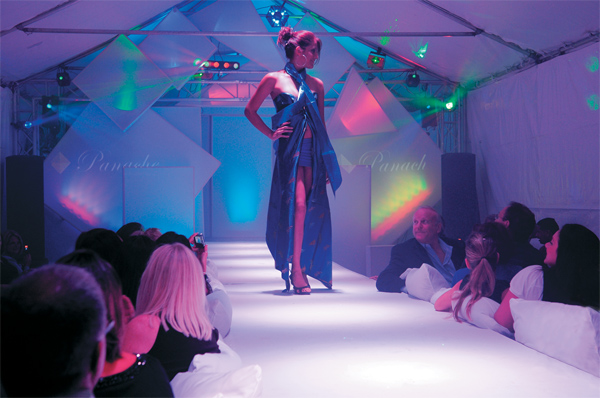
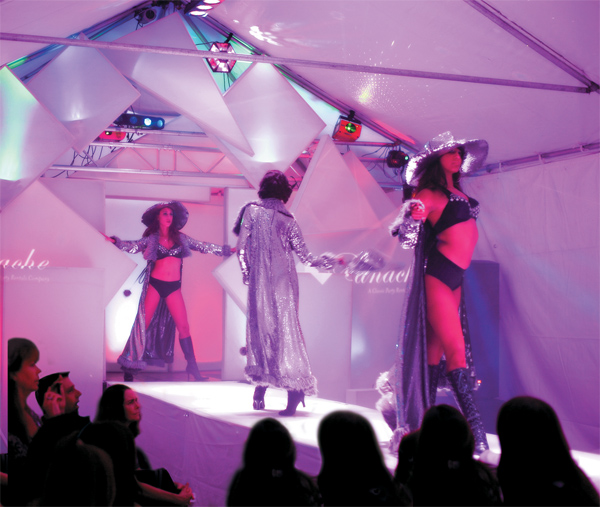
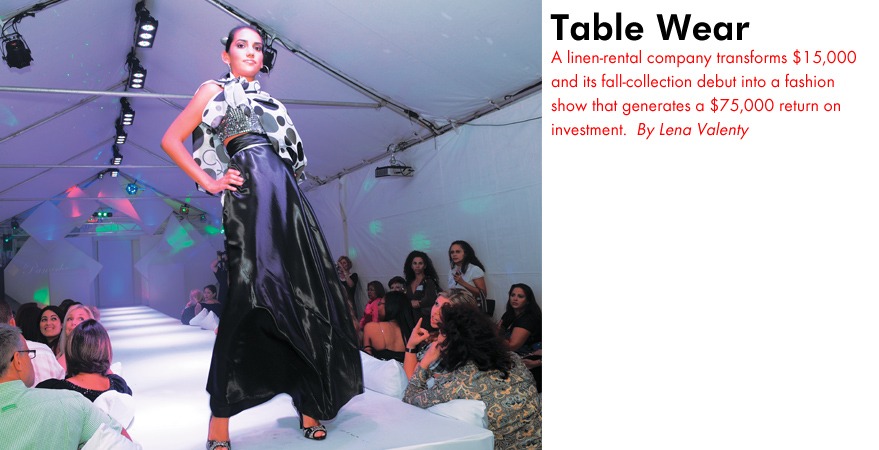
After taking a quick fiver in Club Panache, guests made their way to the loading dock, which was decorated in all white. The entire area was outfitted with a clear-truss tent system (courtesy of Prime Event Group, another Classic Party Rentals company), and featured white banquette seating lining a white runway as well as cocktail tables dressed in white linens and white, rhinestone-studded couches and armchairs. Before copping a squat for the show, guests could stop at 10 different food stations and several bars — all provided and staffed by event sponsors and Panache clients — lining the sides of the tent. Once their plates were loaded with everything from sushi to satays, they grabbed a seat and waited for the runway to come alive.
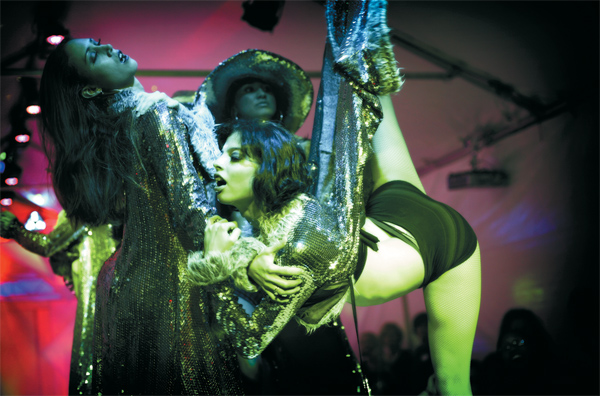
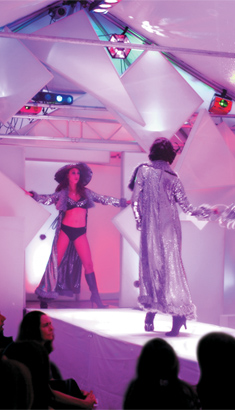
As the fashion show began, models entered the white catwalk through an archway comprising 10 square, white, fabric screens onto which event photos, live video, and other images such as Panache’s post-acquisition logo were projected. Despite the fact that the runway was in a linen-rental company’s warehouse, this was no amateur attempt at a fashion show. Spinfantastic, a local entertainment company, donated its services and choreographed the show and music for the event, creating a professional-looking fashion show that was more Barney’s than Burlington Coat Factory.
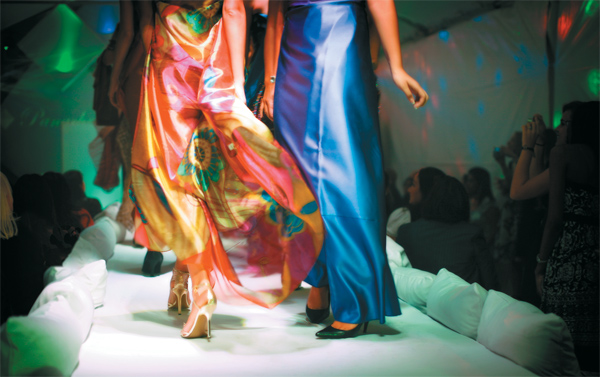
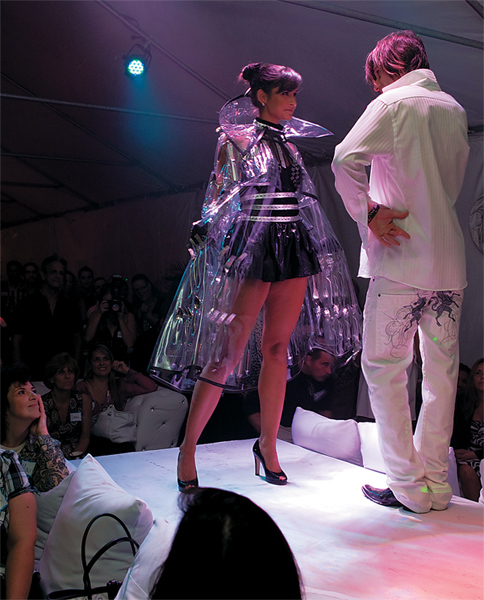
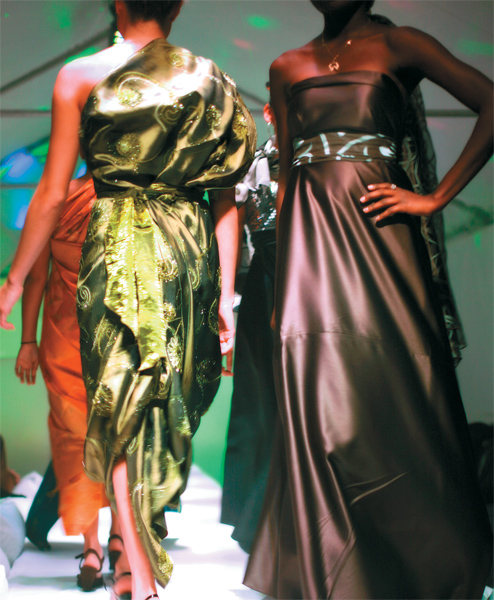
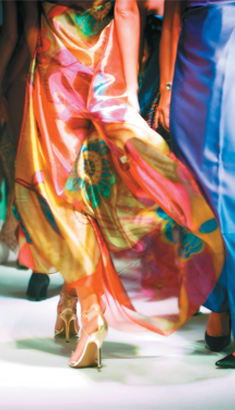
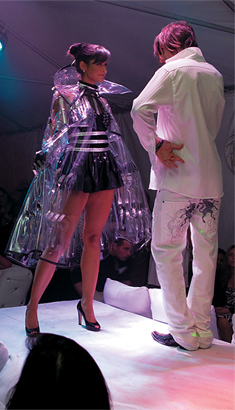
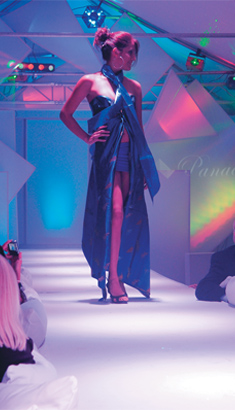
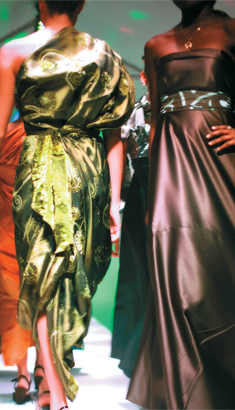
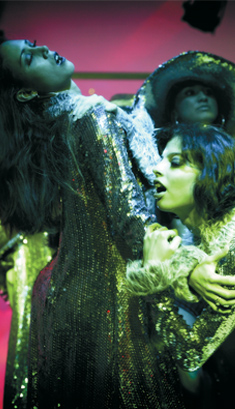
However, instead of couture from Jacobs, von Furstenberg, or McQueen, each of the models worked the runway clad in garments made of tablecloths, runners, and napkins that were pinned, wrapped, and tied to create unconventional outfits. In all, 14 looks were created, each of them with Panache linens and accessories — including up-dos made possible with flatware. The one-of-a-kind looks included a range of styles, from South Beach-inspired micro-minis and halter-tops to red-carpet-worthy strapless gowns, each created by local event designers that also happened to be Panache clients who donated their time and talent for a chance to be a part of Panache Fashion Week. At the end of the fashion show, all 10 models (who also donated their time) took their final strut down the runway, where they were greeted by cheers from the amazed crowd, which was eager for a closer look at the linens.
Following the fashion show, attendees, models, event designers, and Panache and Classic Party Rentals management danced the night away and continued networking until the winner of the tabletop competition was announced.
TAILOR-MADE RESULTS
By the time the final hors d’oeuvre was passed and the last cocktail sipped, Panache Fashion Week helped spread the word of the company’s acquisition not only to every single one of its 7,000 clients and prospects through the invoice stuffers, e-blasts, phone calls, and hand-delivered invites — which all directed traffic to the event Web site, resulting in 2,745 hits — but also to industry media outlets who picked up the story. The event received coverage in online and print editions of Event Solutions, BizBash, Catersource, Special Events Magazine, Vive, and Gold Coast Magazine, among others, stretching the reach of Panache Fashion Week like a well-worn pair of elastic-waist maternity jeans.
What’s more, the company was able to facilitate face time among Classic Party Rentals’ senior management and the event’s 470 attendees (10 percent more than the company hoped would show up), introduce those attendees to the Classic Party Rentals’ network of companies, and give its clients a place to showcase their own talents through the sponsorship opportunities — which also saved Panache an estimated $105,000 in event costs. And the sponsors left the event with a feather in their Philip Treacy bolero, as well, as Panache Fashion Week offered exposure to the market place, networking opportunities that resulted in new relationships, and a chance to support the industry. “It is a win-win for all,” Murphy says. “The experience and the goal of what we do is to encourage new relationships and endorse long-standing ones.” The result was a cohesive look — with a point of view — that would make even Michael Kors proud.
In the end, Panache spent a total of $15,000 out of pocket on signage, staffing, setup/teardown labor to prepare the warehouse, and other miscellaneous costs, with everything else coming from its own inventory or gratis from clients and partner companies. And since Panache Fashion Week resulted in a $75,000 order placed on the spot before the event even concluded, the single at-event sale immediately generated a 400-percent ROI. While high-fashion haute couture usually comes with a hefty price tag, Panache was able to saunter down the runway on a shoestring budget and in a tablecloth dress, proving that, at least in this instance, fashion and frugality go together almost as well as stilettos and skinny jeans. E
|
 |
|
|
|
 |