 |
|
|
|
awareness |
|
 |
EVENT AT A GLANCE
Objective: Drive retail purchases of Kodak EasyShare products.
Strategy: Demonstrate the simplicity and quality of Kodak EasyShare products to mothers with young children via multi-city in-mall demo events.
Tactics: Leverage a Disney partnership to create traffic-building opportunities, recognize economies of scale by using converted passenger vehicles rather than large box trucks, and drive retail traffic with store-demo schedules and coupons for a free memory card with any EasyShare purchase.
Results: In both years, holiday-season sales of EasyShare products in demo markets exceeded all prior records, selling out in most markets. Year-two exposures increased more than 100 percent with a 0-percent budget increase over the inaugural event.
|
|
 ot long ago, managing the precious family photo collection required a fair amount of effort. Buy film. Load it into a camera. Shoot (and hope no one blinked). Drop off and pick up the film at a processor. And, finally, mount the finished prints — those that turned out, anyway — into frames or a photo album. ot long ago, managing the precious family photo collection required a fair amount of effort. Buy film. Load it into a camera. Shoot (and hope no one blinked). Drop off and pick up the film at a processor. And, finally, mount the finished prints — those that turned out, anyway — into frames or a photo album.
Luckily, taking good pictures no longer requires the right f-stop and a prayer. Available to the consumer mainstream since the late 1990s, digital photography has made shooting, storing, organizing, and sharing high-quality images easier than ever. Photography heavyweight Eastman Kodak Co., which made a name for itself in the nearly extinct world of film, has come back from the brink and is today in the thick of the digital revolution. Its all-in-one Kodak EasyShare system offers cameras, software, docks, printers, services, and accessories to users who want the benefits of professional digital photography at home.
Still, for all of its benefits, Kodak wanted to increase share of mind though retail sales of its EasyShare products to a very influential market segment — moms, especially those who relish their role as the family’s chief documentarian. More specifically, it wanted deeper connection to that prized cohort of middle to upper-middle-class mothers of small children, otherwise known as “soccer moms.”
Whether due to an aversion to shopping for small electronics or a lingering fear of the digital technology, these buyers weren’t biting. What they needed, thought Kodak’s marketing team, was a hands-on experience with the cameras. “At Kodak, they have
proved that once you touch the product, you’ll get it,” says John Santeler, president of Kodak’s experiential-marketing partner EXP Productions Inc. “They want people to experience firsthand just how easy their EasyShare products are to use, and to
reinforce the brand-quality message. Once someone comes in contact with Kodak products, they tend to sell themselves.”
LETS GO TO THE MALL
Kodak wanted to move away from traditional sales-centric retail settings in order to gain access to their target audience in an environment where they could put the products directly in the hands of mothers. Initially, the company explored the idea of promoting EasyShare at soccer tournaments. They are, after all, rich in soccer moms, kids, and photo ops. But while soccer games draw Kodak’s target audience in droves, the parents are there to watch their children play, not learn about a digital-camera system. The perfect location for experiencing EasyShare would need to draw high numbers of mothers — who were in more of a purchasing mood.
That meant malls, of course. But to stand out, any mall execution would need to be something far more interesting than a run-of-the-mill kiosk, in-store promotion, or even a temporary pop-up store location. Those wouldn’t, Kodak thought, have the stopping power to draw women shoppers in and make them say, “I’m interested. Tell me more.”
|
Instead, the company adopted a strategic mobile-event approach that would bring its EasyShare system to shoppers in key U.S. markets.
After carefully analyzing a handful of potential locations, Santeler identified optimal malls within each predetermined market. “We looked at the various major mall chains, and cut deals with malls that most closely matched Kodak’s target demographics of middle to middle-upper-class families,” Santeler says.
The inaugural EasyShare tour was slated for the year’s annual holiday rush, starting in October and continuing until the week before Christmas. And to push feet into its retailers’ stores, particularly in those markets where a mall store was not available at the tour stop, the EasyShare team devised an incentive strategy to drive traffic. Each visitor to the EasyShare tour stops would receive a coupon for a free memory card with the purchase of an EasyShare product from a local retailer, along with a list of upcoming in-store demo days in the area.
CAMERA WORTHY
In spite of their on-paper appeal, the mall locations were not without challenges — noise, competing distractions, poor lighting, and so on. And really, when it comes to inspiring people to take pictures, malls don’t exactly brim with photo opportunities. The EasyShare event, Santeler knew, would need to create its own photo op if it hoped for picture-perfect results.
In a stroke of lucky timing, Kodak was able to take advantage of its corporate relationship with The Walt Disney Co. to create a significant traffic builder for the events. Disney happened to be releasing its landmark “The Lion King” film into IMAX theaters at the same time Kodak planned to launch its EasyShare tour. So Disney provided the tour with a 3-D statue of the Simba character from the film, along with a scenic backdrop, which the tour team could set up as part of its EasyShare installation footprint. “The idea was, you take your kids’ picture with Simba, and while the image is processing and
printing, we tell you about Kodak EasyShare cameras, software and printing,” Santeler says.
With Simba secured, the tour hit the road. Each stop followed the same schedule: Arrive at the mall location, unload the truck, and set up in the mall concourse after hours on a Wednesday. Work the weekend crowds from Thursday through Sunday, pack up, and hit the road on Monday for the next destination. Flanked by the giant 3-D statue of Simba and an oversized, sculpted camera modeled after a Kodak EasyShare that housed an LCD presentation screen, the demo setup’s staging caught mallwalkers’ eyes from afar. Additionally, a screen and photo-editing setup with computers and Kodak printers allowed staff to produce prints in the space while sharing the bigger picture of EasyShare’s complete line of products with participants on the large LCD display.
During each event, EXP staff circulated around the demo area in the mall concourse, encouraging passersby to have a picture taken with Simba and receive a free glossy print. After stopping shoppers and snapping their photos, event staff edited and printed the images using EasyShare products — all the while talking with participants about their digital-photography questions and concerns. Larger crowds could view the staff’s process of shooting, editing, and printing on the oversized screen embedded into the giant camera.
As finished photos were handed off, staff punctuated guests’ experiences with the coupon and local in-store event-schedule handouts. The direct retail-link strategy worked. During and following the inaugural EasyShare tour, area Kodak retailers reported record holiday-season sales of the company’s digital-photography products.
DOUBLE PRINTS
The retail sales recorded in event markets proved the effectiveness of the EasyShare road-show strategy — so much so that Kodak opted to re-up the program for a second season. This time, however, there was an added challenge. The company wanted to double the number of campaign stops and exposures, but do so on the same budget as the previous incarnation.
Santeler began to examine the program, looking for ways to stretch marketing dollars to cover the 40-plus markets Kodak now wanted to reach. In its first year, the EasyShare event components had traveled in two large box-truck rigs that were used for transport only, remaining parked outside in mall parking lots while the indoor events took place. Each truck required a Class-C licensed driver who acted as a site producer, managing offload and load-in efforts. In addition to the event producer, the demo staff consisted of one traveling lead presenter supplemented by one or two local Kodak reps who would host the on-site demos.
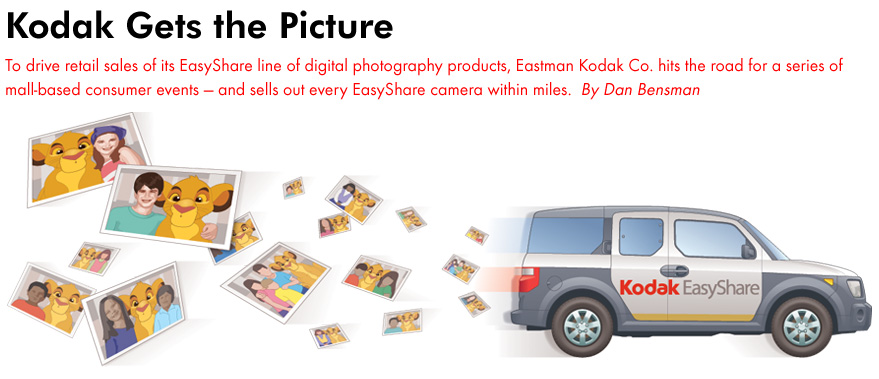
For the year-two reprise, Santeler suggested that Kodak go small to go big. It traded the bigger rigs for five small SUVs — Honda Elements — lightly customized by EXP and skinned with Kodak EasyShare and brand graphics by a local auto-graphics vendor. The EasyShare demo equipment, including a flat-screen monitor and other electronics, were fit into a demo station that lifted easily from the Element’s side door and required just one person to set up.
The greatly simplified vehicle requirements translated into significant savings in transportation and staffing expenditures. As an official “passenger” vehicle, each SUV could be driven by the EXP talent staffing the demos, eliminating the need for a Class-C driver. Furthermore, the slide-in/slide-out unloading capabilities afforded by the modified Honda Elements meant Kodak no longer needed to hire site labor, who were previously needed to unload the trucks and set up the equipment inside the malls. Finally, the demo vehicles which contained their own small power generator, could be driven directly onto each mall concourse, eliminating any equipment drayage and power requirements previously needed to transport, set up, and operate all the components of the demo.
Post-campaign, the lightly customized, consumer-grade vehicle choice offered another advantage. The graphics and internal customizations were easily removed, and each of the five Honda Elements was eventually refurbished and sold, allowing Kodak to recoup a portion of its investment.
Most important, the five vehicles could cover more ground, and do so more quickly than their two box-truck predecessors. With each of the five vehicles assigned to its own region, the second incarnation of the EasyShare tour was able to reach 41 cities during the critical nine-week pre-Christmas shopping rush — more than double the previous year’s exposure.
On site, the Elements’ “cool factor” and a new Disney photo op, a 3-D sculptural Santa Mickey standing by a fireplace, added further traffic-drawing power. The mobile event reprised the proven component from the first tour (a photo op, a schedule of in-store events in the area, and a memory-card coupon) to again push traffic out into Kodak’s retail partners.
To more effectively attract, retain, and manage traffic, the EXP team tightened the demo process in year two for better crowd throughput. While the first-year demo ran about eight minutes, the second-year demo was nipped to five minutes.
SNAPPY RESULTS
Kodak’s second EasyShare tour proved you don’t need a fleet of big box trucks to host a multi-city event. In fact, the series of mall stops proved that a tightly budgeted, pocket-sized road-show setup can generate as many — or more — brand impressions as its big-trucked counterparts. By downsizing the vehicles and associated staffing requirements, Kodak more than doubled its market presence and visitor exposures, without increasing its event spend. These exposures translated into measurable results, as Kodak’s strategy lead to virtual sellouts of EasyShare cameras in the tour markets; results that were easily trackable thanks to the coupon tactic.
“The visual attractions, the interactive demos, the cool branded SUVs, the mall locations, the coupons, and the event talent created an opportunity that truly connected with target audience we were hoping to attract,” Santeler says. And with the retail results to prove its effectiveness, it seems Kodak’s mall-based marketing approach helped soccer moms see the big digital picture. E

|
|
 |
| Thanks to internal research, Eastman Kodak Co. identified “soccer moms” as the target market for its EasyShare product line. |
|
| Families posed in front of a Lion King backdrop and had their portraits taken by EXP Productions Inc. staff. |
|
LICENSE TO DRIVE: TWO BOX TRUCKS
VERSUS FIVE HONDA ELEMENTS
|
Two large box trucks, which required a
Class-C licensed driver, were used in year one. |
By year two, Kodak switched to five Honda Elements, which could be driven by event staff. |
|
|
| The Honda Elements were driven directly onto a mall concourse, eliminating drayage costs. |
|
| To drive traffic to retail locations at each tour stop, Kodak distributed a coupon redeemable for a free memory card with any EasyShare purchase. |
|
| Passersby could view the photo-editing process, which was displayed on an LCD screen housed in a giant replica of an Easy-Share camera. |
|
| In its first year, the tour stopped in 20
cities. By year two, the itinerary more
than doubled to include 41 cities in the
14 highlighted states. |
|
| The mobile event introduced “soccer moms” to Kodak’s EasyShare line of products, and resulted in increased retail sales at each tour stop. |
|
| The EasyShare demo stations slid easily into the Honda Elements, making for easy loading and unloading. |
|
| Kodak leveraged its relationship with The Walt Disney Co. to get its hands on oversized, 3-D statues of Simba and Santa Mickey for photo ops. |
|
|
|
 |
 |



