interview
It's All About the People
Derse Inc. leaders discuss industry trends, the importance of relationships, how to deliver cost-effective activations, and figuring out what to do with all that data to ensure a meaningful trade show program. By Emily Olson
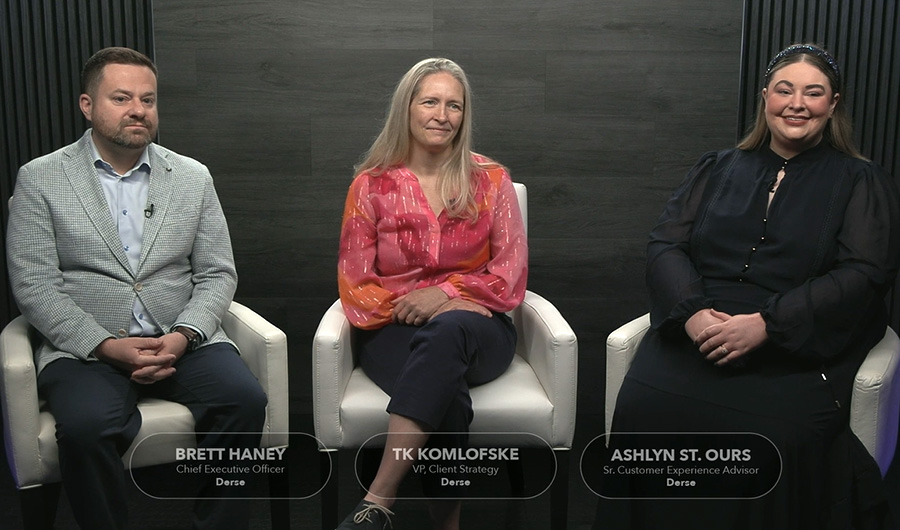
During EXHIBITORLIVE 2026, EXHIBITOR magazine sat down with the leaders of Derse Inc. to discuss private equity in the events industry, the way the ROI of an event fits into a company's larger marketing strategy, and how to measure the magic inherent in events. The following is a transcript of EXHIBITOR magazine's interview with three Derse team members: Brett Haney, CEO; TK Komlofske, VP of client strategy; and Ashlyn St. Ours, senior customer experience advisor. The interview has been lightly edited for clarity.
Emily Olson (EXHIBITOR magazine): I want to talk about the wave of consolidation that we've seen recently in the events industry. What do you all think is driving that?
Brett Haney (Derse Inc): We're seeing private equity investment happening for multiple reasons. One, private equity is everywhere. It's not unique to our industry. Two, in the digital world we live in, in-person events where we can develop relationships with clients in person may be more valuable than ever, and investment groups are seeing that. And three, the future of live events has never been more robust and exciting to be in. So for all those reasons, we're seeing a wave of consolidation and investment right now.
EO: How will consolidation change the way programs are delivered?
BH: I think that remains to be seen because this wave of investment from private equity groups is still in its early stages. A big benefit could be that it's going to push more investment and innovation in the industry, which I think will be a very good thing for exhibitors and programs. But that remains to be seen, and this will play out over a number of years.
EO: What would you advise to an exhibitor who is navigating a more consolidated vendor landscape?
BH: My biggest suggestion is to make sure that you have confidence that the key people you work with at your exhibit house are going to be there in the future. You want dependability and stability, and you don't want a revolving door of people coming in and out.
At Derse, our biggest, most valuable thing that we have is our people. For exhibitors navigating this landscape, making sure that the people you work with are consistent and trusted is key.
EO: Relationships are so important, and that leads me to something else I'm curious about. As some of these smaller firms get absorbed into larger organizations, what happens to those relationships? Is there a potential that there's less flexibility for some of the smaller exhibitors? Could they get lost in a transition?
BH: Yeah, I think there is a risk of that. It depends on the investment group and what their strategy is for who they're buying. Derse has bought several smaller exhibit companies in recent years, and our first approach is to focus on the employees of the company that we're acquiring, and make sure that the cultures of the companies fit. Spending our initial time in that way has been a really big success for us. It's all about the people.
EO: Speaking of people, you talked about the importance of live face-to-face events growing. Do you agree that AI is driving some of that?
BH: Yeah, I do. I agree completely. I think it will be interesting to see how AI disrupts our industry. I don't think it will be as disruptive as other things our industry has experienced, however. But people don't want to just stare at a screen. People don't want to just go to Google or ChatGPT. They want to have interactions with one another. And that's why I'm so bullish on what we do in the future of the events industry.
EO: Interactions are so important, and that leads to a question about ROI, because I know that's one of the things that people are measuring when they're on a show floor. Are your clients being asked to measure things that they haven't been asked to measure in the past.
TK Komlofske (Derse Inc.): Yes, we're hearing more from our customers about the need to understand their impact overall. If we think about events as a whole and the allocation of budget that is provided to those events, and the nature of ROI, it implies that there's a return. And our ability to reflect that return on a growth strategy for the organization is critical. So yes, we're seeing an uptick in that and much more interest in understanding how to do that.
EO: I'm curious about what internal conversations exhibitors have with their teams. Are they trying to figure out what they should measure, what matters, what metrics they should put their focus on? How do you help them through those decisions?
TKK: I think historically, events have been considered a cost center. But companies are beginning to understand that they're a growth driver. And because of that, the key is to understand what the objectives are for the event and how they ladder up to the larger objectives of the organization. When we shift our focus toward how do we contribute to the sales cycle, how do we contribute to the pipeline, that starts to change the conversation about how the event is viewed inside of the organization and its role as part of the larger sales and marketing engine.
EO: And do you find that your clients are having to defend their programs internally to justify the spend?
TKK: I actually think it's moved away from defense and is a lot more about defining and claiming their attribution to growth. And when they say, â?oI'm actually part of the growth engine and this is how our program is optimized to support that engine,â?� they start having better conversations with their leadership.
EO: One of the things that concerns me as we're talking more about numbers is losing the magic of events. If we focus so much on the spreadsheets, maybe we won't think as much about the serendipity, the experience, the relationships. Is that a concern for you at all?
Ashlyn St. Ours (Derse Inc.): I think that there's measurement behind magic and everything can be measured. A common misconception is that there's not measurement designed for qualitative, but we're finding that there is. There's sentiment analysis, there's quality of conversation measurement, there's dwell time, there's facial recognition that can help us to measure whether someone is finding an experience magical. And so those tools exist, they are designed to empower teams to justify the spend on experience and on making sure that we are delivering magic.
EO: How do you quantify the quality of a conversation?
ASO: There are behavior and observational techniques to measure such things. But there's also the desired effect measure. If an experience is designed to do a particular thing, and there's an action at the end of that engagement, and we want someone to have their perception changed in a particular way, the quality of the conversation is defined by whether that perception shift happened. So when someone is asking questions, when someone is sharing their story, when someone is committing to a follow-up, those are the desired metrics of conversation.
EO: I imagine there has to be a lot of booth staff training involved to make sure that perception shift happens.
ASO: Yes, the choreography and the booth staff training and the scripting to make it all feel choreographed. It's almost the Disney effect, where everything is meticulously designed behind the scenes to make it feel frictionless and flawless and seamless, personalized for the attendees who are experiencing it.
EO: I want to talk more about experiences, but first I want to talk about data. A lot of data is collected at events, and I know exhibitors are busy, often going from one show to the next with very little down time. Once they've collected all that data, what do you advise them to do with it?
TKK: It's important to understand the data that's coming in and know why you're gathering it. Data can become overwhelming if it's not directed at an objective and it's not consistently collected and it's not consistently reported on. Many teams setting up a measurement program first think about what tools they can use to measure. I think the more important question is, â?oWhat do I need to understand from this interaction?â?� Then find a tool or tools that can capture that so you can evaluate that effectiveness.
So first figure out your objectives. Then determine how the event program objectives ladder up to larger objectives of the organization's sales and marketing efforts. Then ask how that data informs a moment where you might need to make a shift today. Longer term, determine how a program is performing over time and the impact it has over the course of a year. Because what we want to see is on that ladder or teeter-totter, we want to see the effectiveness chart going up and to the right. Over time, we can begin to see that.
When you only measure in a silo, when you only measure one event or maybe your top four events, you're catching a lot of noise and you miss the trend.
EO: Yesterday I heard someone talking about communicating data internally and how you might change your approach to communicating with different people in the C-suite. You might share data one way with the CFO and differently with the CMO. Do you find your clients doing that or do you advise them to do that?
TKK: I think doing that is incredibly smart. ROI is a very wide term. And underneath that sits stakeholders who all affect and have a lens with which they view ROI. And when you bring forward evidence of your participation in an effective campaign, they evaluate it through the lens with which they understand ROI.
Imagine the difference between a CEO and how they think about growth and revenue and pipeline versus someone who maybe works on the finance side who's concerned about the cost of capital and how that might affect where their investment goes. They think about those things differently. And so when you deliver the data in a way that it's reflective of their worldview, it's much more meaningful.
EO: Speaking of making things meaningful, I do want to get back more into the magic of trade shows. How do you know an experiential element of an environment is actually working?
ASO: Yeah, if we think about that question from a measurement perspective, there are, of course, quantitative data points that we can look at. We can look at number of badge scans, dwell time, number of asset downloads. And there are also qualitative indicators that something is working. And that would be things like the sentiment analysis, the conversational effectiveness. But really the question boils down to, is it doing what it was designed to do? And that is the most important measure of effectiveness when it comes to experiential. There is a desired behavior shift and perception shift. And so whatever it was that the client and the team decided was the most effective behavior shift, that's what we're looking for. Did more people come into the space? Did they stay for longer? Did they ask those questions? Did they commit to that follow-up? And when we consider that and whether it kind of checks the boxes of perception and behavior changing tangibly, that is how we know that it has worked and kind of achieved the goal of the magic.
EO: I think dwell time is such an interesting metric. What do you do with a jet-lagged attendee who dozes off in your chair?
ASO: I think that a space can be full and not necessarily be effective. Designing for certain behaviors or journey mapping to mitigate the risk of such things, like people dwelling who aren't really engaging. Or people can come into a space and engage with the thing, but not really take away the desired effects of it. And designing for behavior is considered carefully in the creative development process of an experience.
EO: Everybody wants experiential, but I'm also hearing about belt tightening. How do you deliver an incredible experience with a smaller budget? Can it be done?
ASO: There are so many ways to do something special that doesn't require a huge budget. I'm going to limit myself to two examples. So one is that analog is back. That's my hot take for the day. Analog is kind of having a comeback moment when digital has become table stakes, especially in the last five years. And everyone on a trade show floor has become digitally fluent, knows how to navigate a touchscreen, knows how to meet with others in thumbnail format. That's no longer moving hearts and minds in the way that something tangible is. So analog can often be more cost-effective because it doesn't have the AV and the content development spend. And it creates that kind of muscle memory where it's familiar, it's intuitive. There's inherent understanding about how to engage with something that has that kind of analog appeal. And so it's becoming more memorable. It's regaining novelty. And so that is definitely one way of creating a low cost, high impact output.
The other is hospitality. Hospitality is something that a lot of exhibitors are already doing that is baked into their budget allocation. But it's a missed opportunity to make it feel personal, to make it feel customized, and to make it feel like a driver of story. So when there's a way to tie hospitality in as a touch point in this larger journey, this current of storytelling, that is something that's super effective.
For example, if it's an ice cream refreshment, the color of the sprinkles can be meaningful, can be a designation of an answer, can be a delineation of roles. And that is such a cost-effective add-on to an existing part of the program to make it feel more story-driven and experiential.
EO: Now we're all here at EXHIBITORLIVE. You have a pretty incredible environment on the show floor. Can you tell me a little bit about what your approach is?
ASO: We are encouraging attendees to peek into their future. To Brett's earlier points about consolidation and what it means for our industry, it puts exhibitors on shaky ground. They don't know how to look into the future with their existing exhibit partners and know what that partnership looks like a year from now, five years from now, and whether it will change drastically because of these mergers and acquisitions that are happening. So I think that the steadfastness of good partnership is comforting in times of tumult and upheaval. And when we invite our attendees to look into the future, that's not necessarily predictive. We're not making claims, but we are saying that we will be there and we will be the same partner as we've always been a year or five years from now. We can confidently look into the future and know what it holds because we can see a trajectory based on our wealth of experience and what we can do for clients. So we've created this really dynamic and almost ephemeral kind of exhibit here on the EXHIBITORLIVE show floor that takes a look into the future through that lens of good partnership and confidence in the clarity that the future holds.
Emily Olson (EXHIBITOR magazine): I want to talk about the wave of consolidation that we've seen recently in the events industry. What do you all think is driving that?
Brett Haney (Derse Inc): We're seeing private equity investment happening for multiple reasons. One, private equity is everywhere. It's not unique to our industry. Two, in the digital world we live in, in-person events where we can develop relationships with clients in person may be more valuable than ever, and investment groups are seeing that. And three, the future of live events has never been more robust and exciting to be in. So for all those reasons, we're seeing a wave of consolidation and investment right now.
EO: How will consolidation change the way programs are delivered?
BH: I think that remains to be seen because this wave of investment from private equity groups is still in its early stages. A big benefit could be that it's going to push more investment and innovation in the industry, which I think will be a very good thing for exhibitors and programs. But that remains to be seen, and this will play out over a number of years.
EO: What would you advise to an exhibitor who is navigating a more consolidated vendor landscape?
BH: My biggest suggestion is to make sure that you have confidence that the key people you work with at your exhibit house are going to be there in the future. You want dependability and stability, and you don't want a revolving door of people coming in and out.
At Derse, our biggest, most valuable thing that we have is our people. For exhibitors navigating this landscape, making sure that the people you work with are consistent and trusted is key.
EO: Relationships are so important, and that leads me to something else I'm curious about. As some of these smaller firms get absorbed into larger organizations, what happens to those relationships? Is there a potential that there's less flexibility for some of the smaller exhibitors? Could they get lost in a transition?
BH: Yeah, I think there is a risk of that. It depends on the investment group and what their strategy is for who they're buying. Derse has bought several smaller exhibit companies in recent years, and our first approach is to focus on the employees of the company that we're acquiring, and make sure that the cultures of the companies fit. Spending our initial time in that way has been a really big success for us. It's all about the people.
EO: Speaking of people, you talked about the importance of live face-to-face events growing. Do you agree that AI is driving some of that?
BH: Yeah, I do. I agree completely. I think it will be interesting to see how AI disrupts our industry. I don't think it will be as disruptive as other things our industry has experienced, however. But people don't want to just stare at a screen. People don't want to just go to Google or ChatGPT. They want to have interactions with one another. And that's why I'm so bullish on what we do in the future of the events industry.
EO: Interactions are so important, and that leads to a question about ROI, because I know that's one of the things that people are measuring when they're on a show floor. Are your clients being asked to measure things that they haven't been asked to measure in the past.
TK Komlofske (Derse Inc.): Yes, we're hearing more from our customers about the need to understand their impact overall. If we think about events as a whole and the allocation of budget that is provided to those events, and the nature of ROI, it implies that there's a return. And our ability to reflect that return on a growth strategy for the organization is critical. So yes, we're seeing an uptick in that and much more interest in understanding how to do that.
EO: I'm curious about what internal conversations exhibitors have with their teams. Are they trying to figure out what they should measure, what matters, what metrics they should put their focus on? How do you help them through those decisions?
TKK: I think historically, events have been considered a cost center. But companies are beginning to understand that they're a growth driver. And because of that, the key is to understand what the objectives are for the event and how they ladder up to the larger objectives of the organization. When we shift our focus toward how do we contribute to the sales cycle, how do we contribute to the pipeline, that starts to change the conversation about how the event is viewed inside of the organization and its role as part of the larger sales and marketing engine.
EO: And do you find that your clients are having to defend their programs internally to justify the spend?
TKK: I actually think it's moved away from defense and is a lot more about defining and claiming their attribution to growth. And when they say, â?oI'm actually part of the growth engine and this is how our program is optimized to support that engine,â?� they start having better conversations with their leadership.
EO: One of the things that concerns me as we're talking more about numbers is losing the magic of events. If we focus so much on the spreadsheets, maybe we won't think as much about the serendipity, the experience, the relationships. Is that a concern for you at all?
Ashlyn St. Ours (Derse Inc.): I think that there's measurement behind magic and everything can be measured. A common misconception is that there's not measurement designed for qualitative, but we're finding that there is. There's sentiment analysis, there's quality of conversation measurement, there's dwell time, there's facial recognition that can help us to measure whether someone is finding an experience magical. And so those tools exist, they are designed to empower teams to justify the spend on experience and on making sure that we are delivering magic.
EO: How do you quantify the quality of a conversation?
ASO: There are behavior and observational techniques to measure such things. But there's also the desired effect measure. If an experience is designed to do a particular thing, and there's an action at the end of that engagement, and we want someone to have their perception changed in a particular way, the quality of the conversation is defined by whether that perception shift happened. So when someone is asking questions, when someone is sharing their story, when someone is committing to a follow-up, those are the desired metrics of conversation.
EO: I imagine there has to be a lot of booth staff training involved to make sure that perception shift happens.
ASO: Yes, the choreography and the booth staff training and the scripting to make it all feel choreographed. It's almost the Disney effect, where everything is meticulously designed behind the scenes to make it feel frictionless and flawless and seamless, personalized for the attendees who are experiencing it.
EO: I want to talk more about experiences, but first I want to talk about data. A lot of data is collected at events, and I know exhibitors are busy, often going from one show to the next with very little down time. Once they've collected all that data, what do you advise them to do with it?
TKK: It's important to understand the data that's coming in and know why you're gathering it. Data can become overwhelming if it's not directed at an objective and it's not consistently collected and it's not consistently reported on. Many teams setting up a measurement program first think about what tools they can use to measure. I think the more important question is, â?oWhat do I need to understand from this interaction?â?� Then find a tool or tools that can capture that so you can evaluate that effectiveness.
So first figure out your objectives. Then determine how the event program objectives ladder up to larger objectives of the organization's sales and marketing efforts. Then ask how that data informs a moment where you might need to make a shift today. Longer term, determine how a program is performing over time and the impact it has over the course of a year. Because what we want to see is on that ladder or teeter-totter, we want to see the effectiveness chart going up and to the right. Over time, we can begin to see that.
When you only measure in a silo, when you only measure one event or maybe your top four events, you're catching a lot of noise and you miss the trend.
EO: Yesterday I heard someone talking about communicating data internally and how you might change your approach to communicating with different people in the C-suite. You might share data one way with the CFO and differently with the CMO. Do you find your clients doing that or do you advise them to do that?
TKK: I think doing that is incredibly smart. ROI is a very wide term. And underneath that sits stakeholders who all affect and have a lens with which they view ROI. And when you bring forward evidence of your participation in an effective campaign, they evaluate it through the lens with which they understand ROI.
Imagine the difference between a CEO and how they think about growth and revenue and pipeline versus someone who maybe works on the finance side who's concerned about the cost of capital and how that might affect where their investment goes. They think about those things differently. And so when you deliver the data in a way that it's reflective of their worldview, it's much more meaningful.
EO: Speaking of making things meaningful, I do want to get back more into the magic of trade shows. How do you know an experiential element of an environment is actually working?
ASO: Yeah, if we think about that question from a measurement perspective, there are, of course, quantitative data points that we can look at. We can look at number of badge scans, dwell time, number of asset downloads. And there are also qualitative indicators that something is working. And that would be things like the sentiment analysis, the conversational effectiveness. But really the question boils down to, is it doing what it was designed to do? And that is the most important measure of effectiveness when it comes to experiential. There is a desired behavior shift and perception shift. And so whatever it was that the client and the team decided was the most effective behavior shift, that's what we're looking for. Did more people come into the space? Did they stay for longer? Did they ask those questions? Did they commit to that follow-up? And when we consider that and whether it kind of checks the boxes of perception and behavior changing tangibly, that is how we know that it has worked and kind of achieved the goal of the magic.
EO: I think dwell time is such an interesting metric. What do you do with a jet-lagged attendee who dozes off in your chair?
ASO: I think that a space can be full and not necessarily be effective. Designing for certain behaviors or journey mapping to mitigate the risk of such things, like people dwelling who aren't really engaging. Or people can come into a space and engage with the thing, but not really take away the desired effects of it. And designing for behavior is considered carefully in the creative development process of an experience.
EO: Everybody wants experiential, but I'm also hearing about belt tightening. How do you deliver an incredible experience with a smaller budget? Can it be done?
ASO: There are so many ways to do something special that doesn't require a huge budget. I'm going to limit myself to two examples. So one is that analog is back. That's my hot take for the day. Analog is kind of having a comeback moment when digital has become table stakes, especially in the last five years. And everyone on a trade show floor has become digitally fluent, knows how to navigate a touchscreen, knows how to meet with others in thumbnail format. That's no longer moving hearts and minds in the way that something tangible is. So analog can often be more cost-effective because it doesn't have the AV and the content development spend. And it creates that kind of muscle memory where it's familiar, it's intuitive. There's inherent understanding about how to engage with something that has that kind of analog appeal. And so it's becoming more memorable. It's regaining novelty. And so that is definitely one way of creating a low cost, high impact output.
The other is hospitality. Hospitality is something that a lot of exhibitors are already doing that is baked into their budget allocation. But it's a missed opportunity to make it feel personal, to make it feel customized, and to make it feel like a driver of story. So when there's a way to tie hospitality in as a touch point in this larger journey, this current of storytelling, that is something that's super effective.
For example, if it's an ice cream refreshment, the color of the sprinkles can be meaningful, can be a designation of an answer, can be a delineation of roles. And that is such a cost-effective add-on to an existing part of the program to make it feel more story-driven and experiential.
EO: Now we're all here at EXHIBITORLIVE. You have a pretty incredible environment on the show floor. Can you tell me a little bit about what your approach is?
ASO: We are encouraging attendees to peek into their future. To Brett's earlier points about consolidation and what it means for our industry, it puts exhibitors on shaky ground. They don't know how to look into the future with their existing exhibit partners and know what that partnership looks like a year from now, five years from now, and whether it will change drastically because of these mergers and acquisitions that are happening. So I think that the steadfastness of good partnership is comforting in times of tumult and upheaval. And when we invite our attendees to look into the future, that's not necessarily predictive. We're not making claims, but we are saying that we will be there and we will be the same partner as we've always been a year or five years from now. We can confidently look into the future and know what it holds because we can see a trajectory based on our wealth of experience and what we can do for clients. So we've created this really dynamic and almost ephemeral kind of exhibit here on the EXHIBITORLIVE show floor that takes a look into the future through that lens of good partnership and confidence in the clarity that the future holds.

Editorial
Some Things Never Change
Forty years ago we were putting business cards in fishbowls and traveling on blissfully Wi-Fi-free airplanes.
Exhibitor Q & A
Graphics
What are some cost-effective ways to refresh my booth graphics without undergoing a full redesign?
Ask Dan
Effective Brainstorming
How can I ensure my pre-show group brainstorming sessions aren't a waste of time?
Exhibiting 101
Extend Your Reach
From emails to apps, pre-show outreach can maximize your visibility and improve your odds of success onsite.
Fuel
Ideas That Work
Quiet Power, Write on Cue, Stage Presence, and more
Products
New Tools
Three Can't-Miss Product Launches
Advertorial
Aluvision
Designed for Impact & Efficiency
Conventional Wisdom
Broward County Convention Center
Broward County Convention Center's vibe screams meeting space meets cruise-port chic.
Fixing Snafus
Sharpies Save the Show
This Plan B comes from the office-supply aisle and the imagination of a good designer.
Quiz
Show or Sham?
Try to guess which shows are real and which are shams in this month's quiz
Archive
Seeing the Future
1911: The Dresden International Hygiene Exhibition
City Profile
Get Out: Fort Lauderdale, Florida
Fort Lauderdale blends beach-town ease with nightlife, culture, and coastline intrigue
Insight
Breaking Barriers
Few issues have changed the business landscape like that of accessibility.
International
Exhibiting Internationally
Here are four things you need to know before taking your exhibit abroad.
Planning
Gen Z Thinks Your Conference Is Cringe
Here are four ways to adjust your event to meet the unique needs of Gen Z.
Portfolio
Counter Intelligence
In the competitive landscape of trade show exhibits, the reception desk stands as your first point of contact.
Awards
EXHIBITOR Magazine's 13th Annual Portable/Modular Awards
Read about the portable, modular, and system exhibits that took home top honors.
Interview
It's All About the People
Derse Inc. leaders discuss industry trends, cost-effective activations, and ensuring a meaningful trade show program.
Salary Survey
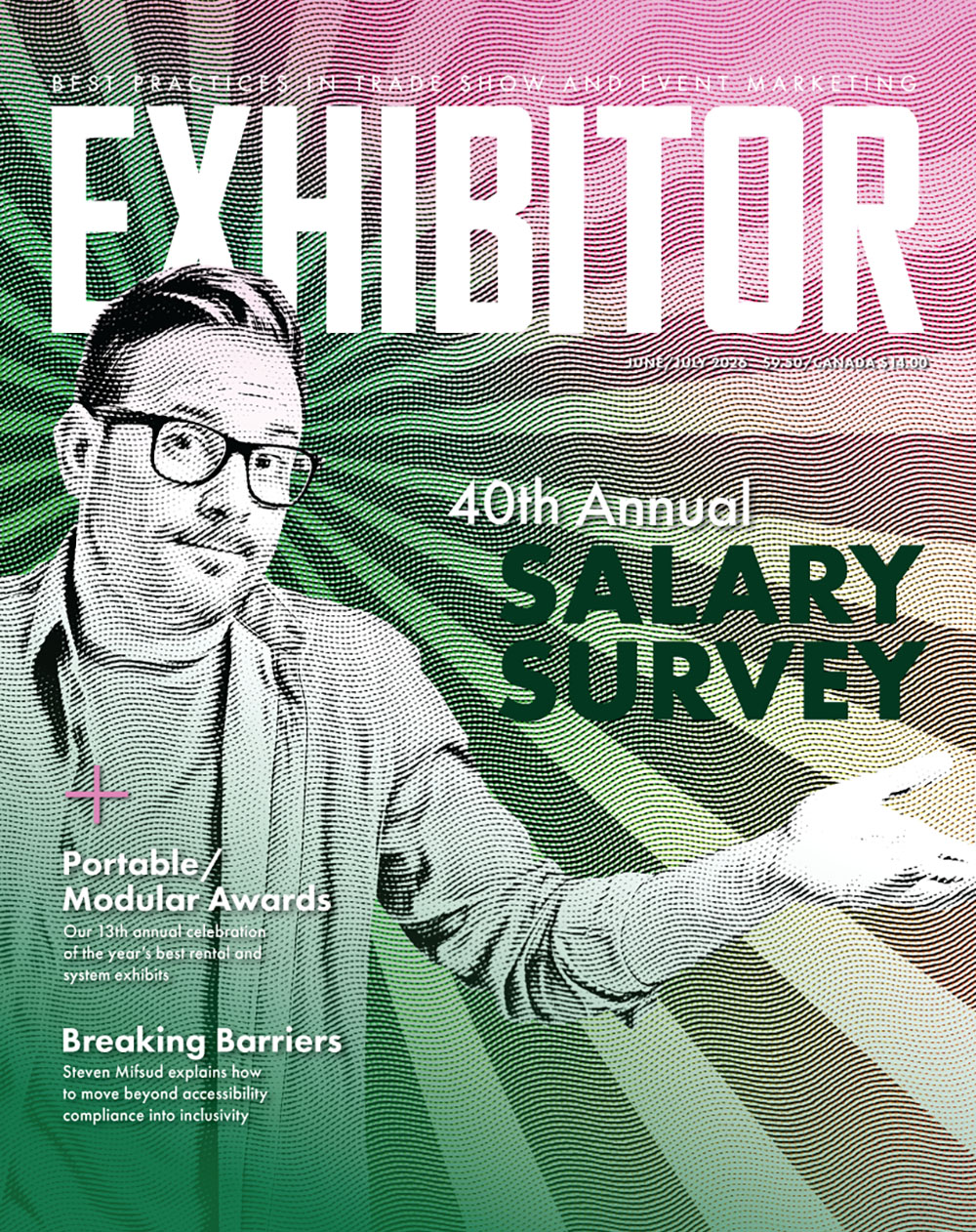
40th Annual Salary Survey
Forty years in and the numbers look good: annual raises, strong support for events, and six-figure salaries.
Salary Survey
40th Annual Salary Survey by Title
The full 2026 Salary Survey, including an in-depth analysis of the six most common jobs